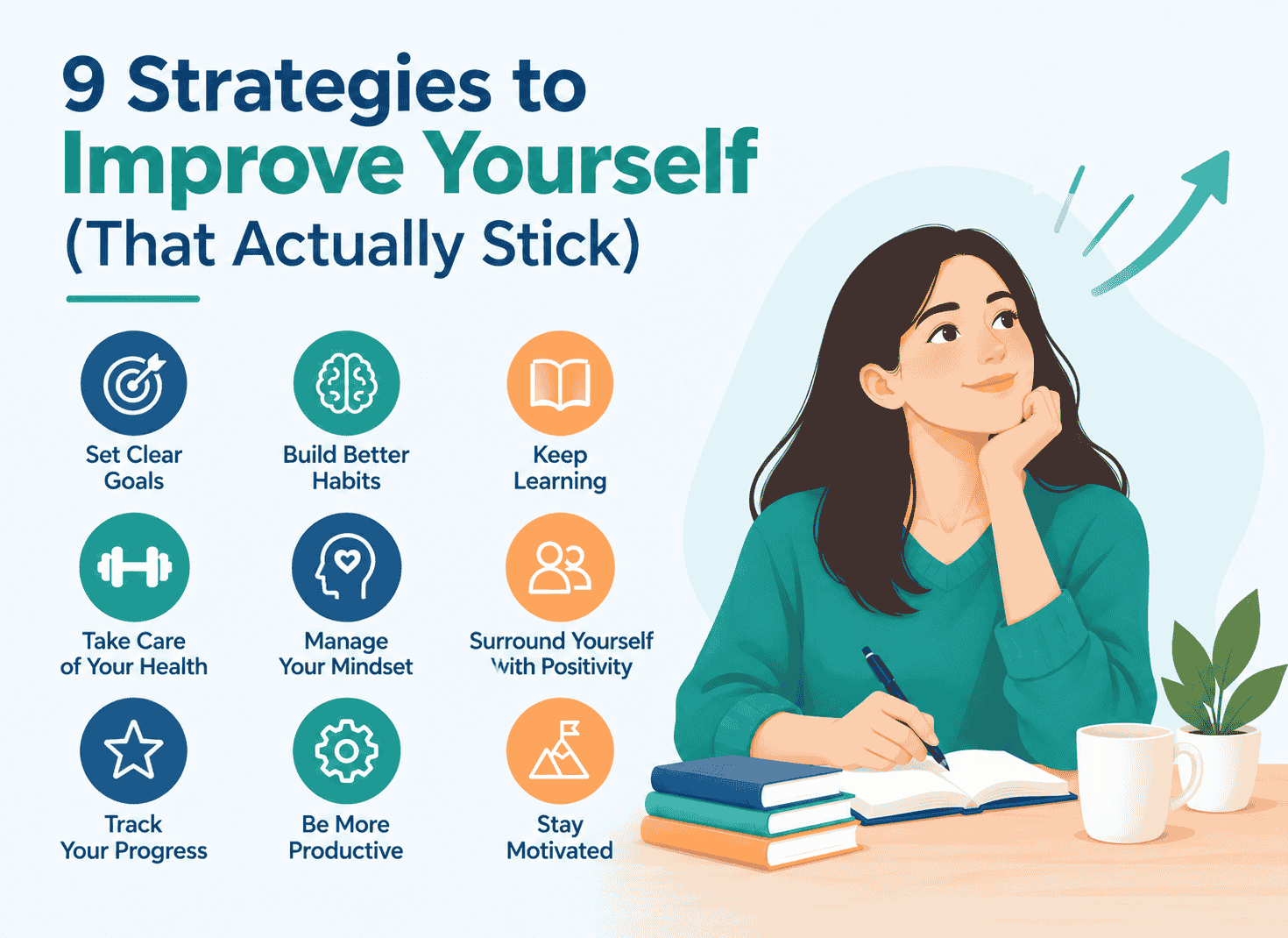
Most people don’t fail at self improvement because they lack willpower. They fail because they build a plan for their best day, then try to follow it on their worst.
The self improvement strategies below work differently. Each one lowers the effort needed to keep going, so it holds up when motivation drops.
One honest note: no strategy works for everyone every time. These nine have the strongest backing in behavioral research, and each comes with a way to make it last.
Why Most Self-Improvement Strategies Fail
Most plans fail for three reasons. The goal is vague, the first step is too big, and there’s no fallback for a busy day.
“Get healthier” gives you nothing to do on Monday. “Run five days a week” collapses after one rough Tuesday. And without a backup plan, one missed day becomes a quit.
The fix isn’t more discipline. It’s a smaller, clearer plan that survives real life. The nine strategies below build exactly that.
1. Pick One Specific Target
Choose one area of your life and define success as a behavior you can see.
Fixing sleep, money, fitness, and focus at once splits your attention. You usually end up changing none of them.
Turn a fuzzy wish into a visible action. “Be more productive” becomes “write for 25 minutes before opening email, five mornings a week.” If a stranger could watch you and say yes or no, the target is specific enough.
Make it stick: Write the target on a sticky note and commit to it for 30 days before adding anything else.
2. Shrink the Habit Until It Feels Almost Too Easy
Start with a version so small you can do it on your worst day.
University College London researcher Phillippa Lally found that new habits took 66 days on average to feel automatic. Individual results ranged from 18 to 254 days. That’s a long runway, so make the early days easy.
Read one page. Do two push-ups. Write one sentence. Once the cue and the action are linked, you can grow the habit.
Make it stick: Define a minimum version and a stretch version. On bad days, do the minimum and count it as a win.
3. Use If-Then Plans
Link a specific cue to a specific action so you don’t have to decide in the moment.
Psychologist Peter Gollwitzer calls these implementation intentions. Large reviews of the research find that people who set them follow through more often than people who only set goals.
The format is simple: “If it’s 7:30 a.m. and the coffee is brewing, then I write my three priorities.” Plan for obstacles too: “If I feel too tired to work out, then I do the 10-minute version.”
Make it stick: Write two if-then plans per goal, one for your cue and one for your biggest obstacle.
4. Redesign Your Environment
Make good actions easy and bad ones slightly harder.
Habit researcher Wendy Wood has found that a large share of daily behavior, around 40 percent in one study, repeats automatically in familiar settings. Your surroundings often drive what you do next more than your intentions do.
Put your running shoes by the door. Charge your phone outside the bedroom. Move the social app off your home screen. Even 20 seconds of extra friction changes behavior.
Make it stick: Change one thing in your space today. Don’t wait for a perfect setup.
5. Track Progress and Review It Weekly
Track one simple metric each day, then review the trend once a week.
Tracking shows what’s working and gives you a small hit of progress. A paper calendar with an X on each completed day is enough.
Then spend 10 minutes weekly on three questions. What worked?, What got in the way?, What will I change next week? That review turns raw effort into smarter effort.
Make it stick: Book the review as a recurring calendar event, such as Sunday evening. Track one metric, not ten.
6. Practice Deliberately
Improve a skill by working just beyond your comfort zone and getting feedback.
Psychologist Anders Ericsson studied top performers and found that hours alone didn’t build expertise. Focused practice with feedback did. Repeating what you already do well keeps you on a plateau.
Say you want to write better. Don’t just write more. Write a draft, ask someone for feedback, then rewrite your weakest paragraph. Want to speak better? Record three minutes of yourself and count your filler words.
Make it stick: Pick one sub-skill per week and decide in advance who or what will give you feedback.
7. Protect the Basics: Sleep, Movement, and Food
Keep your sleep, daily movement, and regular meals steady, because they fuel your energy, mood, and self-control.
You can’t out-strategize chronic exhaustion. When the basics slip, every other goal gets harder.
Don’t overhaul your life. Set a baseline: a consistent wake time, a 20-minute daily walk, and real meals at regular times. If sleep, mood, or energy problems persist, talk to a doctor.
Make it stick: Lock in your baseline first, then add other goals on top.
8. Add Accountability and Honest Feedback
Tell someone your goal and report progress on a regular schedule.
In a well-known study, psychologist Gail Matthews found that people who wrote down their goals, shared them with a friend, and sent weekly updates reported higher achievement than people who only thought about their goals. It’s one study, so treat it as a useful signal rather than proof.
Choose someone who asks, not someone who judges. Then request specific feedback: “What’s one thing I could do better?”
Make it stick: Schedule a five-minute weekly check-in by text or call.
9. Respond to Setbacks With Self-Compassion
When you slip, treat it as information, not proof that you failed.
Research by Kristin Neff and others suggests that people who respond to failure with kindness are more likely to try again than people who criticize themselves harshly. Harsh self-talk feels productive, but it often leads to avoidance.
Use a simple rule: never miss twice. Skip Monday’s workout? Do the minimum version on Tuesday. One miss barely matters. The guilt spiral that follows does.
Make it stick: Write your reset line in advance: “I missed. That’s data. Here’s my next step.”
A Simple 7-Day Plan to Get Started
You don’t need all nine at once. Use this week to build the foundation:
- Day 1: Pick one specific target.
- Day 2: Write your minimum version.
- Day 3: Create two if-then plans.
- Day 4: Change one thing in your environment.
- Day 5: Set up your tracker.
- Day 6: Tell one person your goal.
- Day 7: Do your first weekly review.
Self-Improvement FAQs
How do I start improving myself?
Pick one specific behavior, shrink it to a version you can do daily, and attach it to a cue like your morning coffee. Stay with it for 30 days before adding anything new.
What are the main areas of self-improvement?
Most people group them into health, relationships, career and skills, money, and emotional well-being. Start with the one that affects the others most right now.
How long do self-improvement strategies take to work?
You can feel early wins within a couple of weeks. Habits take about two months on average to feel automatic, and sometimes longer.
Final Thoughts
Self improvement isn’t about a dramatic reinvention. It’s about small, specific actions you can repeat when life gets messy.
Pick one strategy today. Run it for 30 days. Then add the next. That slow, steady stacking is what makes change last.