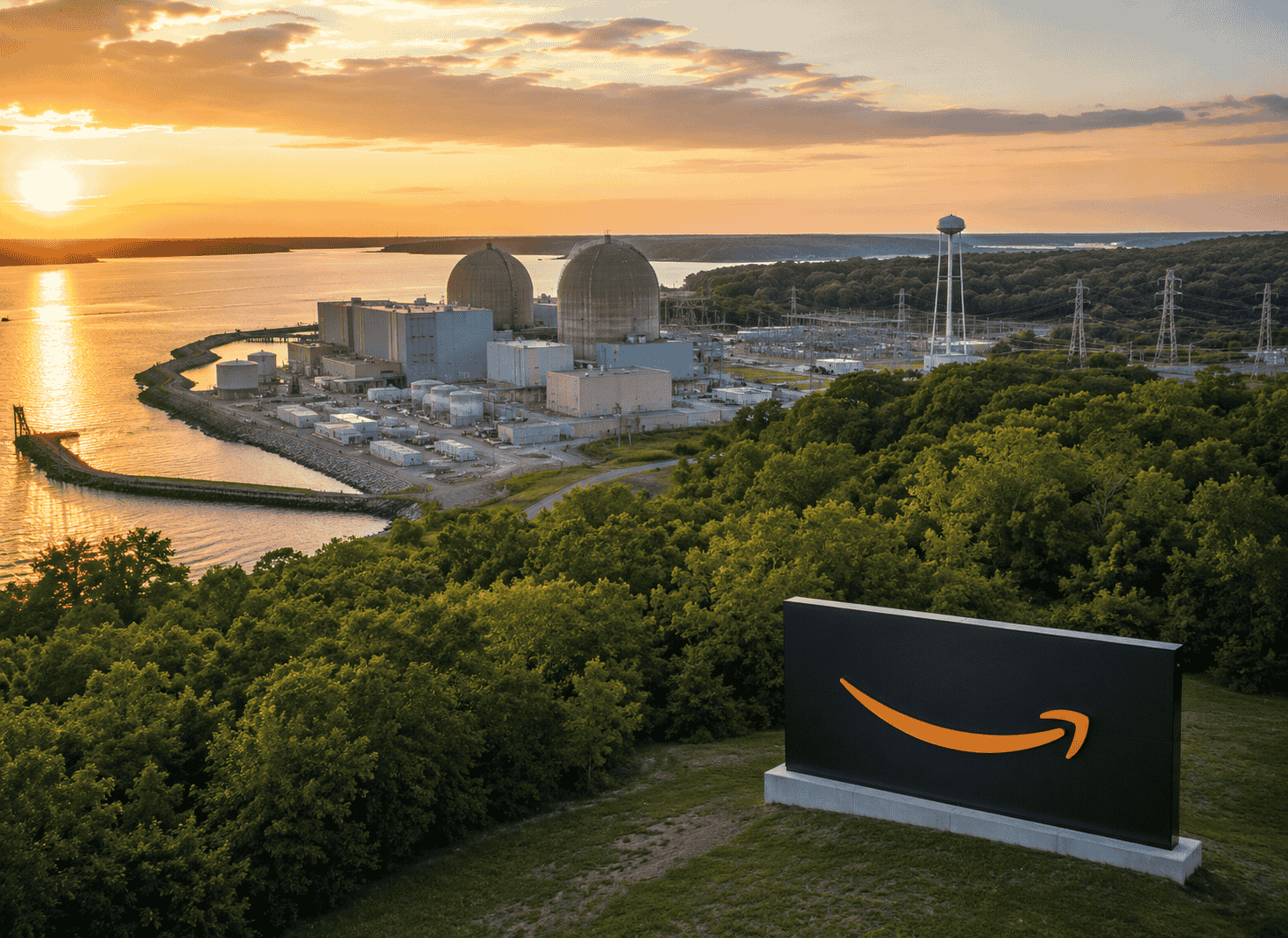
Amazon wants to build data centers next to a nuclear reactor in Southern Maryland. That sentence alone explains why Calvert Cliffs Nuclear Power Plant is suddenly back in the news.
For 50 years, this plant quietly generated electricity on the edge of the Chesapeake Bay. Most Marylanders barely thought about it. Now, Amazon has proposed seven data center buildings across 2,000 acres of the plant’s own property, and the story behind that proposal touches everything from AI’s power demand to a 1971 lawsuit that changed environmental law forever.
This guide covers what Calvert Cliffs is, how it works, its safety record, and exactly why a tech giant wants to build right next to it.
Quick Facts: Calvert Cliffs Nuclear Power Plant
| Detail | Information |
|---|---|
| Location | Lusby, Calvert County, Maryland |
| Owner/Operator | Constellation Energy |
| Official name (2025–present) | Calvert Cliffs Clean Energy Center |
| Legal/regulatory name | Calvert Cliffs Nuclear Power Plant |
| Reactors | 2 pressurized water reactors (PWRs) |
| Capacity | 1,790 megawatts (MW) |
| Homes powered | Roughly 1.3 million |
| Share of Maryland’s power | About 40% of total generation, 80% of clean generation |
| Unit 1 commissioned | 1975 |
| Unit 2 commissioned | 1977 |
| Current license extends to | 2034 (Unit 1), 2036 (Unit 2) |
| Employees | About 660, plus 1,500+ during refueling outages |
| 2026 headline | Amazon proposes 2,000 acres of data centers on-site |
Calvert Cliffs Nuclear Power Plant vs. Calvert Cliffs Clean Energy Center
If you searched for this plant and saw two different names, you’re not imagining it.
Constellation Energy rebranded the site as the Calvert Cliffs Clean Energy Center. The company made this change to emphasize the plant’s role as a carbon-free power source, not because anything physically changed.
Legally, the older name still applies. Constellation confirms the site “is referenced in legal and regulatory filings as Calvert Cliffs Nuclear Power Plant.” The Nuclear Regulatory Commission, court documents, and most government records still use the original name.
So when you see “Calvert Cliffs Clean Energy Center” in a press release and “Calvert Cliffs Nuclear Power Plant” in an NRC filing, they mean the exact same facility.
Don’t Confuse It With Calvert Cliffs State Park
One more mix-up trips people up constantly. Calvert Cliffs State Park is a separate, public property a few miles away, known for hiking trails, a beach, and fossil hunting along eroding cliffs.
The nuclear plant is a secured industrial site. You cannot wander onto it the way you can the state park. Search engines often blend these two results together, so it’s worth knowing the difference before you plan a visit.
A Brief History of Calvert Cliffs
Calvert Cliffs isn’t just old. It’s historically significant in ways that go beyond electricity generation.
Construction and Early Operation (1968–1977)
Construction began in June 1968. Workers built two pressurized water reactors supplied by Combustion Engineering, each producing roughly 850 megawatts of electricity.
Unit 1 entered commercial service in 1975. Unit 2 followed in 1977. Total construction cost ran approximately $766 million, equivalent to about $4 billion in today’s dollars.
The Lawsuit That Reshaped Environmental Law
In the 1960s, scientists at Johns Hopkins University grew concerned about one specific risk: heated water from the plant’s cooling system could damage blue crab populations in the Chesapeake Bay.
That concern triggered a lawsuit. In 1971, the U.S. Court of Appeals for the D.C. Circuit ruled in Calvert Cliffs’ Coordinating Committee v. Atomic Energy Commission. The court forced federal regulators to seriously evaluate environmental impacts before approving projects like this one, regardless of whether anyone had formally challenged them.
This case became one of the first major court interpretations of the newly passed National Environmental Policy Act (NEPA). Law students still study it today. Every environmental impact statement filed in the United States since then traces part of its legal foundation back to a fight over Calvert Cliffs.
A Presidential Visit and a World Record
In June 2005, President George W. Bush visited Calvert Cliffs. It marked the first time in nearly two decades that a sitting U.S. president had visited a nuclear power plant.
The plant earned a different kind of recognition in 2009. It set a world record for pressurized water reactors by running continuously for 692 days without stopping. A year earlier, Unit 2 posted a capacity factor above 101%, also a world record at the time.
These numbers matter because capacity factor measures how often a power plant actually produces electricity compared to its theoretical maximum. A reading above 100% reflects brief periods of output above the plant’s rated capacity, combined with near-flawless uptime.
The Reactor That Never Got Built
In 2007, a joint venture called UniStar Nuclear Energy filed plans for a third reactor at Calvert Cliffs, known as CCNPP-3. The project promised roughly 1,600 megawatts of new capacity and thousands of construction jobs.
The plan fell apart over money and ownership. In 2010, Constellation walked away from federal loan guarantee negotiations after the government sought an $880 million fee to offset default risk on a $7.6 billion guarantee. Constellation called the fee a dealbreaker for “the economics of any nuclear project.”
Constellation then sold its stake in the joint venture to its French partner, EDF. Because EDF wasn’t a U.S.-owned company, the NRC ruled in 2011 that the venture couldn’t legally hold a construction license. The project stalled for years before being formally withdrawn in 2015.
CCNPP-3 stands as a reminder that even well-funded nuclear projects can collapse under financing and ownership rules, not just safety concerns.
How Calvert Cliffs Actually Works
Understanding the basics helps explain why this specific site is now so attractive to data center developers.
Pressurized Water Reactors, Simplified
Both reactors at Calvert Cliffs are pressurized water reactors. Inside each one, nuclear fission heats water under high pressure, preventing it from boiling. That superheated water transfers its heat to a second water loop, which turns to steam and spins turbines connected to generators.
The reactors run as saturated steam plants, meaning the steam isn’t superheated before hitting the turbines. The overall thermal efficiency lands around 33%, fairly typical for this reactor generation.
Cooling Without Towers
Most nuclear plants you’ve seen in photos have giant concrete cooling towers. Calvert Cliffs doesn’t.
Instead, it pulls cooling water directly from the Chesapeake Bay. Each unit draws around 1.2 million gallons per minute to cool steam in the turbine condensers. The water returns to the bay no more than 12°F warmer than when it left.
This open-cycle system works because the Chesapeake Bay provides enough volume to absorb the heat safely. It also creates a side effect locals know well: a powerful artificial current near the outflow point that draws fish, anglers, and a real drowning risk if people aren’t careful.
Safety Record: What the Inspection Reports Actually Show
Nuclear safety conversations tend to swing between two extremes; either everything is fine, or everything is catastrophic. The real record sits in the middle, and it’s worth examining in plain language.
Notable Incidents Over Five Decades
1990: The NRC fined the plant’s then-operator $100,000 after the company failed for over a decade to fix safeguards protecting reactor vessels from cracking at low temperatures.
2013: Unit 2 shut down on September 5 after a malfunction during testing. Crews completed repairs and restarted the unit five days later.
2015: Backup generators failed to properly supply electricity to safety equipment following a reactor shutdown in April. The Union of Concerned Scientists logged this as one of ten “near misses” at U.S. reactors that year.
2023: The NRC issued a “white finding,” meaning a violation of low-to-moderate safety significance, after the plant failed to follow proper maintenance procedures for a safety-related emergency diesel generator.
None of these incidents caused a radiation release or public harm. The NRC’s classification system color-codes findings from green (minor) through red (most serious), and Calvert Cliffs has stayed almost entirely in green-to-white territory across decades of inspection reports.
How the NRC Actually Monitors the Plant
Resident NRC inspectors work on-site year-round, not just during scheduled visits. They review procedures, observe operations, and file detailed reports every quarter.
The NRC also models risk numerically. A 2010 study estimated the annual risk of an earthquake severe enough to cause core damage at 1 in 100,000 for Unit 1 and 1 in 83,333 for Unit 2. These are extremely small probabilities, but they’re not zero, which is precisely why continuous inspection exists.
Why Amazon Wants 2,000 Acres at Calvert Cliffs
Now for the part that brought you here.
The Proposal, Explained
Documents obtained by The Baltimore Banner through a public records request reveal Amazon’s plan: build seven data center buildings across three separate campuses, all within a mile of the nuclear plant.
The first campus would include two buildings at 225,000 square feet each, plus an entrance gate, support buildings, and four industrial cooling tanks. A second campus a half-mile south would look nearly identical. A third campus would sit on the property’s southern border with three buildings and five cooling tanks.
Each proposed campus targets roughly 500 megawatts of capacity, enough to power more than 375,000 homes. Amazon representatives say the company would pay for its own electrical supply and cover the cost of necessary transmission line upgrades.
Why a Nuclear Plant Specifically
Data centers, especially ones built for AI workloads, need enormous, reliable, around-the-clock power. Nuclear plants generate exactly that kind of steady “baseload” electricity, unlike solar or wind, which fluctuate with weather and time of day.
Amazon’s own representatives explained the appeal at a March 2026 community meeting in Calvert County. The site sits near three high-voltage transmission lines already. It’s also close to fiber networks in Northern Virginia and the NSA’s computing infrastructure, both valuable for a cloud computing company.
Constellation CEO Joe Dominguez put it directly during a 2026 investor call: the company can “structure deals now to power America’s growth in AI with our firm and clean nuclear power.”
This Isn’t an Isolated Deal
Amazon’s interest fits into a much bigger pattern. Constellation signed a 20-year power-purchase agreement with Microsoft in 2024 to help restart a reactor at its Pennsylvania nuclear site, now renamed the Crane Clean Energy Center.
The White House added fuel to this trend in early 2026, announcing that AI companies would pledge to help pay for data center power costs. That announcement directly shaped how Constellation approached its own data center discussions.
As of this writing, no signed deal exists between Amazon and Constellation for the Calvert Cliffs project. A Constellation spokesperson confirmed the company is “in conversations with a host of leading data center partners” but can’t discuss confidential talks or preliminary permit applications. Amazon’s own representative described the project as still in an early evaluation stage.
What Residents Are Concerned About
The proposal isn’t landing smoothly with everyone nearby.
More than 150 acres of trees would need clearing to make room for the campuses, according to internal correspondence from the Maryland Department of Natural Resources.
Two historic properties sit in the project’s path. Parran’s Park and the Baltimore and Drum Point Railroad both appear on the Maryland Inventory of Historic Properties. One email from the Maryland Historical Trust warned that the first proposed data center “extends well into the [historic property] boundary, cutting off access to two of the tobacco barns.” The railroad’s northwest section would largely be destroyed.
The Maryland Historical Trust has recommended relocating the first campus to avoid these impacts directly.
Beyond preservation concerns, residents have pushed back over process. Some have criticized county officials for signing nondisclosure agreements with data center developers, arguing the public has been shut out of decisions that will reshape their community.
There’s also a financial angle. Maryland’s utility customer advocate estimated last year that data center demand across the region could add up to an $800 million bill for state ratepayers, even though companies like Amazon say they’ll cover their own infrastructure costs.
A Second, Separate Project Nearby
Amazon isn’t the only company eyeing data centers in Calvert County. Natelli Holdings, a Gaithersburg-based real estate firm, presented its own plan to county commissioners in March 2026.
That proposal sits about six miles south of Amazon’s site, on land the county now owns after a former Dominion Energy property changed hands. It calls for four data center buildings at 220,000 square feet each, targeting around 300 megawatts of demand.
Calvert County passed a zoning ordinance last year specifically allowing land near the nuclear plant to be designated for heavy industry, which opened the legal door for projects like these.
The Bigger Picture: Constellation’s 2 GW Expansion Plan
The Amazon proposal didn’t appear out of nowhere. It builds on plans Constellation already announced in November 2025.
Constellation said it would explore building 2,000 megawatts of new “next-generation” nuclear capacity at Calvert Cliffs, effectively doubling the site’s current output. The company also proposed an 800 MW battery storage project and 700 MW of gas-fired generation, with future potential to switch that gas capacity to hydrogen.
Separately, Constellation says it can extend the operating lives of the two existing reactors by 20 years each, pushing their retirement dates from 2034 and 2036 out to 2054 and 2056. The company also believes it can boost the reactors’ current 1,790 MW capacity by another 190 MW through equipment upgrades, without building anything new.
Constellation president and CEO Joe Dominguez framed the plan as a way to meet Maryland’s rising power demand “at the lowest possible cost to consumers,” provided state lawmakers grant supportive legislation. If fully realized, Constellation projects these combined investments could push Maryland’s clean energy share from 50% to 70%.
Jobs and Economic Impact
Strip away the headlines about AI and data centers, and Calvert Cliffs still functions as one of Southern Maryland’s most important employers.
The plant employs about 660 people full-time. During annual refueling outages, that number temporarily swells by an additional 1,500 skilled workers brought in for several weeks of intensive maintenance.
One recent refueling outage alone delivered close to $90 million in plant upgrades, according to Constellation.
The broader nuclear industry in Maryland, anchored by this single plant, supports roughly 6,100 full-time jobs statewide. Calvert Cliffs contributes about $22.8 million annually in taxes that fund local schools, roads, and public services.
Constellation has also funded local initiatives tied to the plant’s presence, including a $90,000 scholarship program with the University System of Maryland focused on mechanical and electrical engineering students, and a STEM learning center built with the Cal Ripken, Sr. Foundation at a local middle school.
Emergency Planning: What Nearby Residents Should Know
If you live near Calvert Cliffs, the NRC requires two layers of emergency planning around the site.
The first is a 10-mile “plume exposure” zone, focused on airborne radioactive contamination in the event of an accident. The second extends to roughly 50 miles and addresses the risk of contaminated food or water reaching consumers.
Calvert and St. Mary’s counties divide the 10-mile zone into five planning areas, each mapped in an annual Public Information Brochure mailed to residents. Constellation also distributes a Functional and Transportation Needs postcard for residents who may require extra help during an evacuation.
Knowing your specific zone number matters. It determines what instructions you’d receive first in an actual emergency, rather than generic advice that applies to the whole region.
Frequently Asked Questions
Is Calvert Cliffs Nuclear Power Plant the same as Calvert Cliffs Clean Energy Center?
Yes. Constellation Energy rebranded the site as the Calvert Cliffs Clean Energy Center, but it remains the same physical plant and is still legally referred to as Calvert Cliffs Nuclear Power Plant in regulatory filings.
Can I tour Calvert Cliffs Nuclear Power Plant?
Public tours aren’t routinely offered. Access has historically been limited to specific industry events, professional groups, and pre-approved visits, with strict security requirements like advance background checks and closed-toe shoes.
Is Calvert Cliffs Nuclear Power Plant the only nuclear plant in Maryland?
Yes. It’s Maryland’s sole nuclear power facility and supplies roughly 40% of the state’s total electricity generation.
Why does Amazon want land at a nuclear power plant?
Amazon’s proposed data centers need large, constant amounts of electricity. Nuclear plants supply steady baseload power and sit near existing high-voltage transmission infrastructure, making sites like Calvert Cliffs attractive for large-scale computing facilities, especially those built for AI.
Has Amazon signed a deal with Constellation for the data centers?
Not as of this writing. Both companies describe the project as being in an early, exploratory stage, with no finalized agreement or submitted site plan yet.
Is Calvert Cliffs Nuclear Power Plant safe?
The plant has operated for 50 years without a radiation release affecting the public. It has faced fines and safety findings over the decades, most recently a 2023 violation tied to emergency generator maintenance, but none have escalated beyond low-to-moderate significance under NRC’s rating system.
The Bottom Line
Calvert Cliffs has spent five decades as a steady, mostly unremarkable presence on the Chesapeake Bay, generating power that most of Maryland never thinks twice about. That’s changing fast.
Between Constellation’s plan to double the site’s nuclear capacity and Amazon’s proposal to build data centers directly on its land, Calvert Cliffs has become a real-time example of how AI’s massive appetite for electricity is reshaping America’s energy infrastructure. Whether the Amazon deal closes or not, the underlying pressure won’t ease. Data centers need power, nuclear plants can supply it reliably, and Calvert Cliffs happens to sit at the intersection of both.
What happens next depends on Maryland lawmakers, local zoning fights, and decisions still being made behind closed doors at Constellation and Amazon. For a plant that quietly powered the region since 1975, that’s a remarkably public moment.