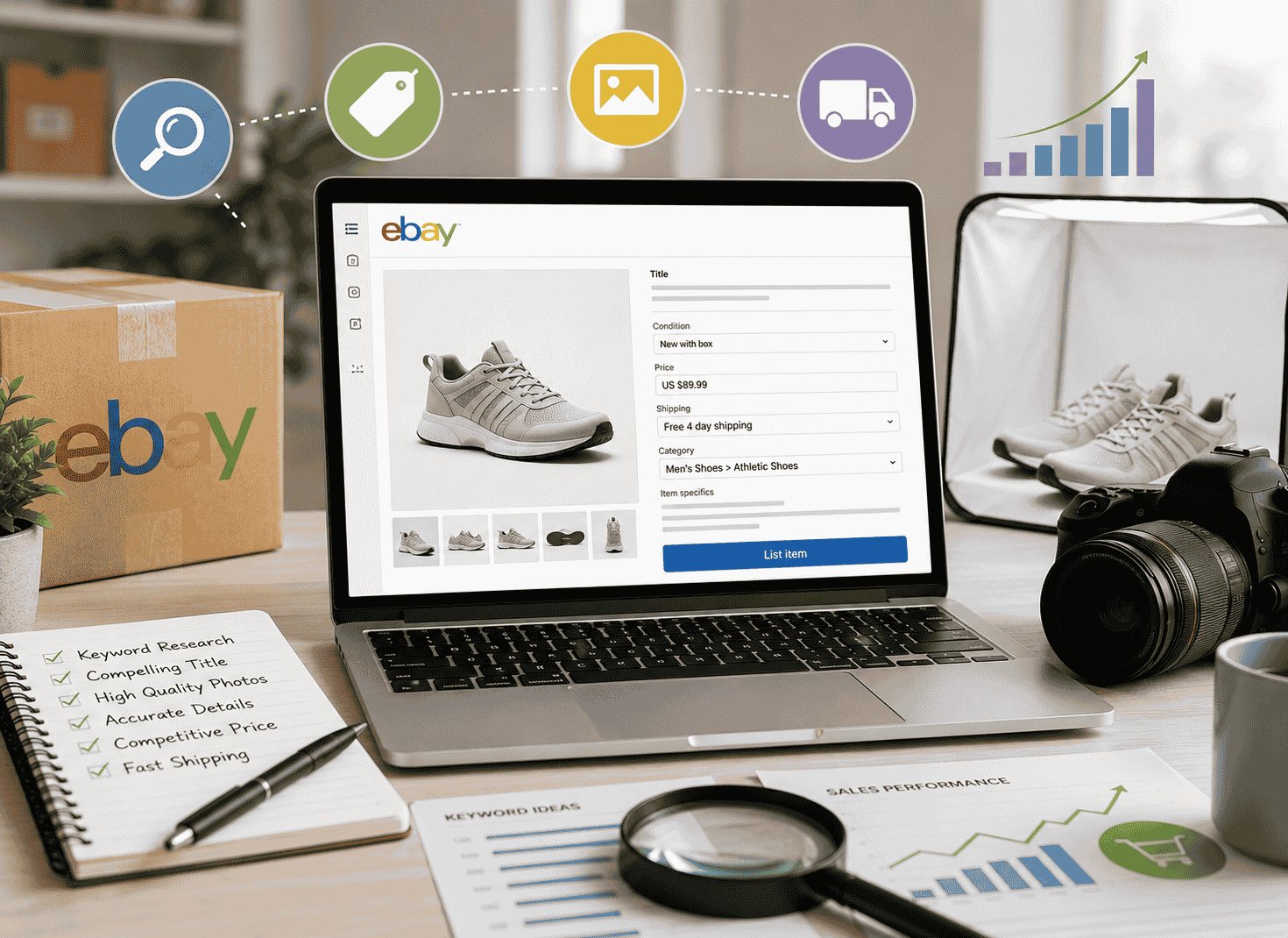
A great eBay listing is doing three jobs simultaneously: convincing eBay’s search algorithm to rank it high, convincing buyers to click on it, and convincing those buyers to complete the purchase. Most sellers optimize for one of these and neglect the other two. The result is listings that rank but don’t convert, or listings that look great but never appear in search.
This guide covers the full picture of eBay listing optimization — from fundamental elements like titles and item specifics, to advanced strategies like multi-quantity listings, variation listings, and Promoted Listings integration. Whether you’re managing 20 listings or 2,000, these principles will make every listing work harder for you.
The Foundation: What Makes an eBay Listing Rank
eBay’s Cassini search algorithm evaluates listings based on several weighted factors:
- Relevance: How well the listing title and item specifics match the buyer’s search query
- Sell-through rate: How frequently the listing converts compared to similar listings
- Seller performance: Your account health metrics and feedback score
- Price: How your price compares to similar sold items
- Listing quality: Completeness of item specifics, number of photos, description quality
The single highest-impact change most sellers can make is completing their item specifics. eBay has expanded the number of required and recommended item specifics across almost every category. Listings that leave these fields blank are invisible in filtered searches — and filtered searches account for the majority of serious buyer behavior.
How to List Multiple Items in One eBay Listing
One of the most powerful but underused eBay listing tools is the multi-quantity and variation listing format. Instead of creating separate listings for every color, size, or configuration variant, eBay allows you to manage all variants within a single listing — consolidating reviews, watchers, and seller feedback.
Multi-Quantity Fixed Price Listings
If you have multiple identical units to sell, a multi-quantity listing is the simplest solution. Set your quantity, and the listing automatically decrements as units sell. This format accumulates sales history on a single listing URL, which improves search ranking over time compared to relisting individual items.
Variation Listings
Variation listings are eBay’s equivalent of Amazon parent-child relationship listings. They allow you to sell a product that comes in multiple sizes, colors, or configurations under one listing. Buyers select their variant from a dropdown or swatches interface, all within the same product page.
This format is particularly valuable because: all variants share the same listing views, watchers, and feedback; buyers can see all options in one place, reducing choice friction; and sold quantity accumulates across all variants, boosting your listing’s authority in search.
Understanding
Sellers managing multiple SKUs of similar products should master how to list multiple items in one listing on ebay — whether through variation listings or multi-quantity formats. This consolidation approach consistently improves search visibility and conversion rates compared to fragmented individual listings.
Title Optimization: The 80-Character Science
eBay gives you exactly 80 characters for your listing title. Every character counts. eBay’s search is primarily keyword-based, so your title should prioritize search relevance over marketing language.
Structure that works: Brand + Model/Type + Key Descriptor + Condition + Size/Quantity
Example (Electronics): ‘Apple AirPods Pro 2nd Gen Wireless Earbuds Active Noise Cancellation USB-C – New’
Example (Clothing): ‘Nike Air Force 1 Low ’07 Triple White Leather Sneakers Men Size 11 New In Box’
What not to do: Waste characters on generic terms like ‘Great Deal’ or ‘Fast Shipping’. eBay buyers don’t search for those terms — they search for specific product attributes.
Photos That Convert
eBay allows up to 24 photos per listing. Top-performing listings use at least 8-12. Required coverage includes:
- Main image: White or neutral background, product filling 85%+ of frame, minimum 1600px longest side
- Multiple angles: Front, back, sides, and any unique features
- Condition shots: For used items, clear documentation of any wear, scratches, or imperfections
- Size reference: Scale photo (ruler, common object, or on-model for clothing)
- Accessories included: Every item that comes in the box photographed together
- Serial/model number: For electronics and equipment, a clear shot of the identifying label
Buyers who can see exactly what they’re getting are more confident in purchasing and less likely to file returns.
The Description: Structured for Both Search and Trust
eBay’s product description is less algorithm-critical than the title and item specifics, but it’s a crucial trust-builder for buyers. For any item over $50, buyers typically read the description before committing to purchase.
Best practices for eBay descriptions:
- Lead with the most important information — condition, compatibility, what’s included
- Use short paragraphs and clear structure — buyers scan, they don’t read
- Include technical specifications — particularly important for electronics, tools, and equipment
- State your return and shipping policy clearly
- Use appropriate keywords naturally throughout — this supports Cassini relevance scoring
Promoted Listings: Amplifying Your Best Listings
eBay’s Promoted Listings Standard is a cost-per-sale advertising model — you only pay when a buyer clicks your promoted ad and purchases within 30 days. Standard rates in most categories range from 2-10% of sale price.
The strategy: promote your best-converting listings, not your entire catalog. Identify listings with strong organic performance (good sell-through rate, strong feedback) and promote them to amplify what’s already working. Avoid promoting listings with poor photos, incomplete item specifics, or below-market pricing — ad spend on weak listings delivers poor returns.
Sellers who want to maximize every aspect of their eBay catalog — from listing structure and title optimization to Promoted Listings strategy — benefit significantly from working with professional ebay listing optimization services that understand the platform’s algorithm and buyer psychology at a granular level.
Conclusion
eBay listing optimization is not a one-time task. It’s an ongoing process of monitoring performance data, testing improvements, and responding to changes in buyer behavior and platform algorithm updates. Sellers who treat their listings as living assets — consistently improving them based on what the data shows — consistently outperform those who create listings and forget them.
Whether you’re managing your own eBay account or considering professional support, these principles form the foundation of a listing strategy that delivers consistent, growing sales over time.