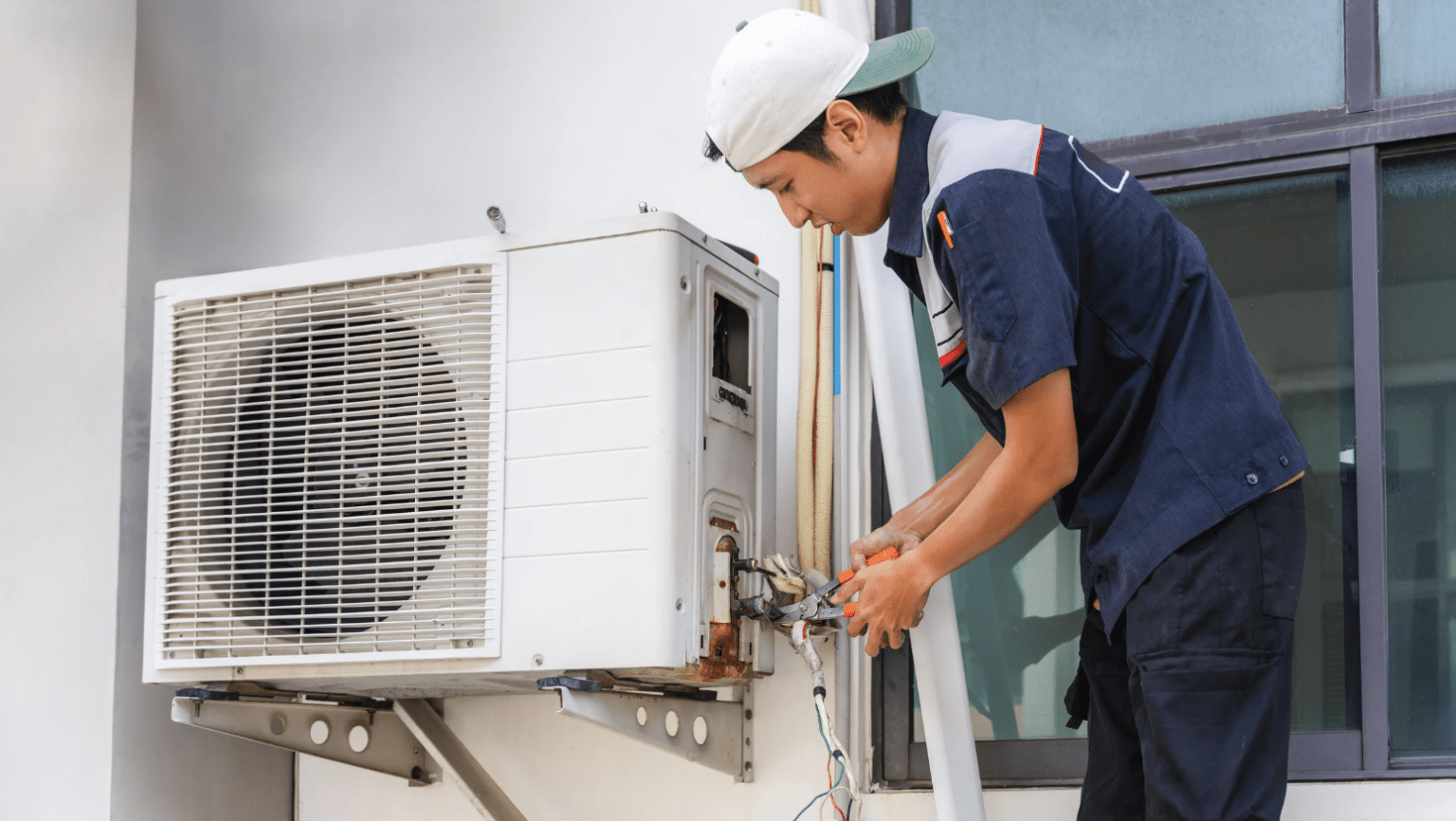
Before you call anyone about your air conditioner, check one thing first: is the unit actually the right size for your home?
This sounds like an obvious question, but most homeowners never ask it. When a house stays warm in July, or an AC runs constantly without catching up, the instinct is to assume something is broken. Sometimes that is true. But a surprisingly large number of struggling air conditioners are not broken at all. They are simply undersized for the space they are trying to cool, and no amount of repair will fix a unit that was never big enough to do the job.
The same logic runs in the other direction, too. An AC unit that is too big for the house short-cycles, meaning it kicks on, cools the air rapidly, and shuts off before removing enough humidity. You end up with a home that feels cold but clammy, and a unit that wears out faster because of all the stop-start cycling.
Homeowners who have called for Air Conditioner Repair in Thornton, CO, sometimes discover that what they thought was a failing unit is actually a sizing problem. Roots Heating and Cooling provides installation and sizing assessments alongside repair service, which matters because the fix for a wrong-sized unit is not a repair call.
Understanding how AC sizing works is the thing that helps you figure out which problem you actually have.
What HP and Tonnage Actually Mean
Air conditioners are rated in tons, not horsepower. The tonnage figure describes the cooling capacity of the unit, specifically how much heat it can remove from the air per hour.
One ton of cooling capacity equals 12,000 BTUs (British Thermal Units) per hour. A 2-ton unit removes 24,000 BTUs per hour. A 3-ton unit removes 36,000 BTUs per hour. And so on.
The horsepower rating you sometimes see on window units and mini-splits is a measure of the compressor motor, not the cooling output. It roughly correlates to capacity but is not the figure HVAC professionals use for sizing. When you are sizing a central AC system for a house, you work in tons.
The reason this matters is that people often shop for an air conditioner the way they shop for a bigger engine: more power seems better.
In HVAC, that thinking backfires. More capacity than the space requires creates the short-cycling problem described above, and the consequences are real. Higher humidity, more wear on the compressor, uneven temperatures throughout the house, and a shorter equipment lifespan.
The Basic Square Footage Rule (And Why It Is Just a Starting Point)
The most widely used rule of thumb for AC sizing is roughly 20 BTUs of cooling capacity per square foot of living space. Working that backward into tons, it looks like this:
- Up to 600 square feet: 1 ton
- 600 to 1,000 square feet: 1.5 tons
- 1,000 to 1,500 square feet: 2 tons
- 1,500 to 2,000 square feet: 2.5 tons
- 2,000 to 2,500 square feet: 3 tons
- 2,500 to 3,300 square feet: 4 tons
- 3,300 to 4,000 square feet: 5 tons
These numbers give you a reasonable starting estimate and nothing more. They do not account for ceiling height, insulation quality, window area, sun exposure, or local climate. A 2,000-square-foot home with floor-to-ceiling south-facing windows and poor insulation needs more cooling capacity than a 2,000-square-foot home with good insulation and minimal windows facing west.
For Colorado homes specifically, the altitude and the typically dry climate shift the calculation. Thornton sits at roughly 5,740 feet above sea level. At that elevation, air is less dense than at sea level, which affects how efficiently an AC system can reject heat through the outdoor condenser. This is one reason that a unit sized purely by square footage rules may underperform in the Denver metro area during a sustained heat wave.
What a Manual J Calculation Does That a Rule of Thumb Cannot
A Manual J load calculation is the proper engineering method for determining the right AC size for any specific home. HVAC engineers and certified technicians use software to run the calculation based on the actual characteristics of the building.
The inputs include the home’s square footage broken down by floor, ceiling height per room, insulation R-values in walls and attic, window size and orientation (south-facing windows are a bigger heat load than north-facing ones), the number of occupants, local climate data, and the desired indoor temperature.
The output is the precise cooling load of the home in BTUs per hour, which translates to the specific tonnage required to maintain comfort under design conditions (typically the peak summer temperature for the region).
In Thornton, the Air Conditioning Contractors of America (ACCA) design temperature used for a Manual J calculation is approximately 93 to 95 degrees Fahrenheit outdoor air temperature, which is the temperature the system should be sized to handle.
A Manual J calculation takes more time than a rule of thumb. It is also the only method that produces a defensible, accurate answer. When a contractor recommends a specific size based purely on square footage without asking about insulation, windows, or ceiling height, you are getting an estimate that may or may not fit your house.
Signs Your AC Is Undersized for Your Home
An undersized air conditioner shows its limitations in predictable ways. Recognizing these patterns helps you distinguish between a unit that is broken and one that simply cannot keep up.
The system runs constantly. If your AC runs for hours without cycling off during a hot afternoon, it may be that the compressor is struggling. But the more common reason is that the unit is removing heat at a slower rate than the heat is entering the house. The house never reaches the setpoint because the unit is not big enough to get there.
Certain rooms never cool down properly. An undersized unit often keeps the core of the house reasonably comfortable, while rooms at the far ends of the duct runs never quite reach the thermostat temperature. The rooms farthest from the air handler are the first to suffer when capacity is inadequate.
The unit cannot keep up on hot days. A unit that performs acceptably in mild weather but fails to maintain temperature when outdoor temperatures push past 90 degrees is almost certainly undersized. The design conditions a properly sized unit is meant to handle include the hottest days of the year in your climate.
Signs Your AC Is Oversized for Your Home
Oversizing is a less intuitive problem but just as common, especially in homes that received a replacement unit sized up from the original without a recalculation.
The system short-cycles. If the AC kicks on and reaches the thermostat setpoint within 5 to 8 minutes and then shuts off, only to start again 10 or 15 minutes later, it is short-cycling. A properly sized system should run for 15 to 20-minute cycles under typical summer conditions.
The house feels cold but humid. An oversized AC cools the air too quickly. It removes temperature but does not run long enough per cycle to remove humidity effectively. The result is a home that reads 72 degrees on the thermostat but feels sticky and uncomfortable.
Rooms have noticeable temperature swings. The rapid on-off cycling of an oversized unit creates temperature instability throughout the house. Some rooms overshoot the setpoint during the cooling cycle and become too cold. Others have not caught up before the unit shuts off.
When the Size Question Matters Most
If your current AC unit is approaching 10 to 15 years old and starting to need service, the sizing question should be part of the replacement conversation before you default to buying the same size unit.
Homes change over time. An addition was built. Attic insulation was upgraded from R-13 to R-38. New windows replaced single-pane originals. Every one of these changes affects the cooling load calculation. The original unit size may no longer match the current thermal characteristics of the house.
Similarly, if you are buying a home and the AC was replaced by a previous owner, do not assume the replacement was sized correctly. Replacement units are often installed in the same size as the original without any recalculation, perpetuating an original sizing error for another 15 years.
A new Manual J calculation before a replacement installation costs relatively little compared to the unit itself and ensures that the new equipment matches the actual load of the house.
How to Find Out What Size Unit You Have
Check the model number on the outdoor condenser unit. The tonnage is often encoded in the model number as a two-digit number representing BTUs in thousands divided by 12. For example, a unit with “24” in a specific position in the model number is likely a 2-ton unit (24,000 BTUs divided by 12,000 equals 2 tons). A “36” indicates 3 tons.
Carrier, Lennox, Trane, Goodman, and most other major manufacturers use this convention, though the position of the number in the model string varies by brand. The product documentation or a search of the model number should confirm the tonnage.
Once you know your unit’s tonnage, compare it to your home’s square footage and characteristics using the general guidelines above as a starting framework. If the numbers are significantly off, or if your home shows the behavioral signs of under- or oversizing, that is the conversation to have before anything else.
The Right Order of Questions
When an air conditioner is not doing its job, asking these questions in order to save time and money.
First, is the unit the right size for the home? If the answer is clearly no, a repair cannot fix the underlying problem.
Second, if the unit is appropriately sized, is it maintaining refrigerant charge, and are the coils clean? Low refrigerant from a leak and dirty evaporator or condenser coils are the most common causes of reduced efficiency in a correctly sized unit.
Third, are the ducts sized and sealed correctly? An appropriately sized unit feeding through undersized or leaky ductwork will underperform regardless of its condition.
Fourth, is the thermostat reading accurately and controlling the system correctly? A faulty thermostat is one of the most frequently overlooked causes of apparent cooling problems.
Only after working through those questions does it make sense to focus on component-level repair. Starting with the sizing question first prevents the frustrating experience of repairing a unit that cannot do the job, regardless of its condition.
Bottom Line
An air conditioner that cannot keep your home comfortable is not always broken. It may simply be the wrong size for the space it is trying to cool. The BTU or tonnage rating of your unit, matched against the actual thermal load of your home, is the first variable to check before investing in repair work. Too small means it runs constantly and still cannot catch up. Too large means it short-cycles, fails to remove humidity, and wears out faster. Getting the size right, through a proper Manual J load calculation, is the foundation that everything else is built on.