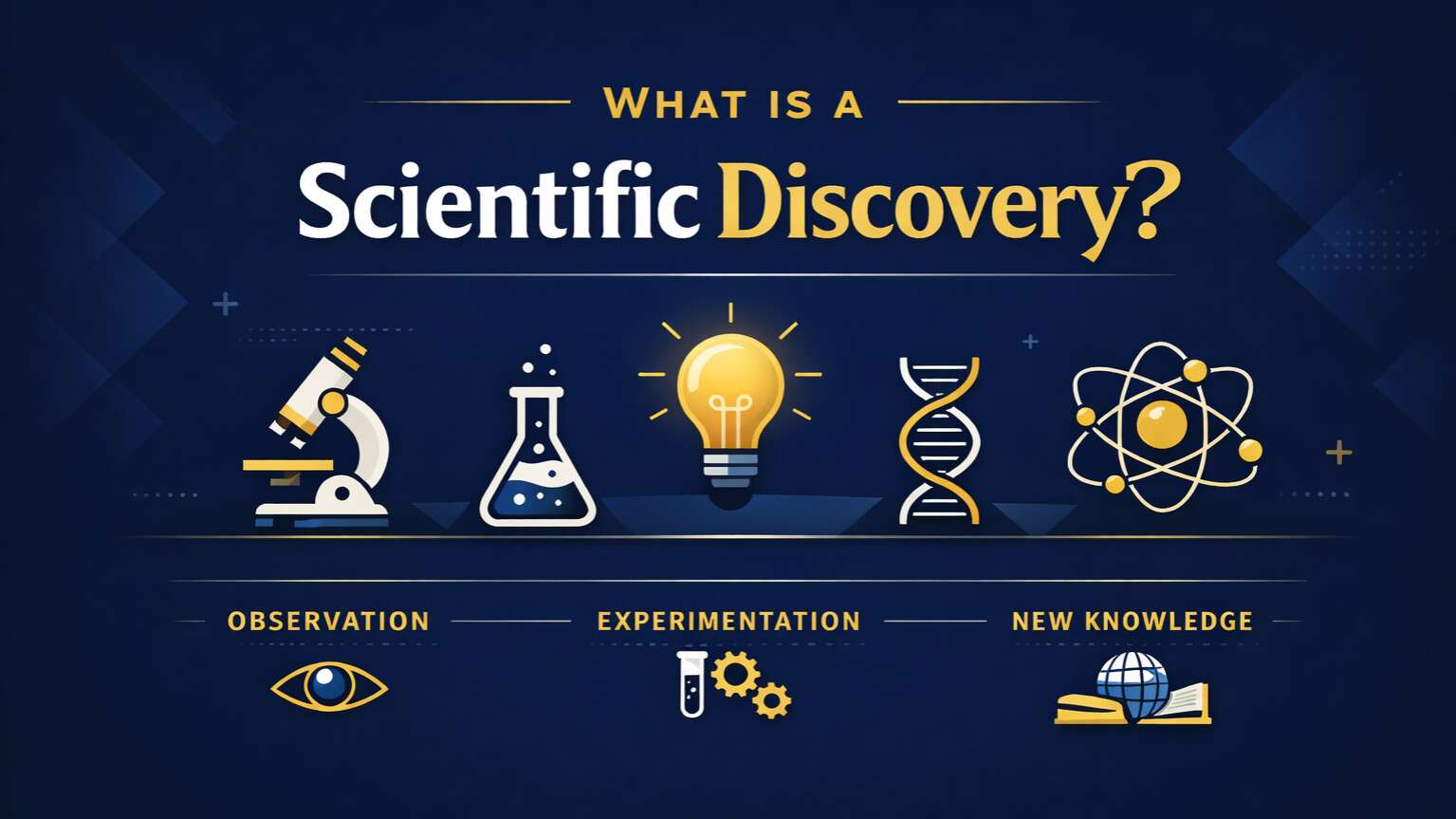
Scientific discovery has shaped the modern world in ways we often take for granted. From life-saving vaccines to space exploration, nearly every advancement around us began with one essential question: What is a scientific discovery?
In simple terms, a scientific discovery is the process of uncovering new knowledge about the natural world through observation, experimentation, and evidence-based reasoning. However, the concept goes much deeper than that.
In this comprehensive guide, we will explore the meaning of scientific discovery, how it differs from invention, the scientific method behind it, real-world examples, and why it matters for society.
Definition of Scientific Discovery:
A scientific discovery occurs when researchers identify new facts, principles, or phenomena that were previously unknown. Unlike assumptions or guesses, discoveries rely on systematic investigation and verified evidence.
For example, when Isaac Newton formulated the laws of motion, he did not invent gravity. Instead, he discovered and explained how gravity works. Similarly, when Alexander Fleming discovered penicillin, he uncovered a natural antibiotic that transformed medicine.
Therefore, a scientific discovery does not create something new from scratch. Instead, it reveals something that already exists in nature but was not yet understood.
Scientific Discovery vs. Invention: What’s the Difference?
Although people often use the terms interchangeably, scientific discovery and invention are not the same.
Scientific Discovery
- Reveals natural laws or phenomena
- Based on observation and experimentation
- Expands human knowledge
Invention
- Creates new tools, devices, or processes
- Applies scientific knowledge
- Solves practical problems
For instance, electricity existed long before humans understood it. Scientists studied it for centuries before inventors developed electrical devices. In other words, discovery comes first, and innovation often follows.
The Process Behind Scientific Discovery
Scientific discovery does not happen randomly. Instead, scientists follow a structured framework known as the scientific method.
1. Observation
Everything begins with curiosity. A scientist notices something unusual or unexplained in the natural world.
2. Question
Next, they ask a specific question. For example:
- Why do objects fall?
- How do diseases spread?
- What is the universe made of?
3. Hypothesis
Then, they propose a possible explanation. This hypothesis must be testable.
4. Experimentation
Scientists design controlled experiments to test their hypothesis. They collect measurable data and analyze results carefully.
5. Conclusion and Verification
If evidence consistently supports the hypothesis, it may lead to a scientific discovery. However, other researchers must verify the results before the scientific community accepts them.
For example, Albert Einstein proposed the theory of relativity in the early 20th century. Scientists later confirmed his predictions through multiple experiments, strengthening its acceptance.
Thus, scientific discovery depends on evidence, reproducibility, and peer review.
Types of Scientific Discoveries
Scientific discoveries occur across many fields. Let’s explore the main categories.
1. Physical Science Discoveries
These discoveries explain how matter and energy behave.
Examples include:
- Laws of motion
- Electromagnetism
- Atomic structure
- Quantum mechanics
2. Biological Discoveries
Biology focuses on living organisms.
Notable examples:
- The structure of DNA discovered by James Watson and Francis Crick
- The theory of evolution by Charles Darwin
These discoveries transformed medicine, genetics, and evolutionary biology.
3. Medical Discoveries
Medical breakthroughs improve healthcare and save lives.
For example:
- Vaccines
- Antibiotics
- MRI imaging technology
Medical discoveries continue to extend life expectancy worldwide.
4. Astronomical Discoveries
Astronomy explores space and the universe.
For instance:
- The heliocentric model by Nicolaus Copernicus
- The discovery of exoplanets
- Black hole imaging
Such discoveries reshape our understanding of the cosmos.
Why Scientific Discovery Is Important
Scientific discovery drives progress in several critical ways.
1. Expanding Human Knowledge
First and foremost, discoveries answer fundamental questions about reality. They help humanity understand how the universe works.
2. Technological Innovation
Moreover, discoveries often lead to practical applications. For example, understanding electromagnetism led to modern electronics.
Without foundational discoveries, technological innovation would not exist.
3. Economic Growth
Scientific research fuels industries such as biotechnology, artificial intelligence, renewable energy, and pharmaceuticals. As a result, countries that invest in research often experience faster economic development.
4. Solving Global Challenges
Scientific discoveries help address:
- Climate change
- Global pandemics
- Food security
- Energy shortages
Therefore, scientific advancement directly impacts global well-being.
Accidental vs. Intentional Discoveries
Interestingly, not all scientific discoveries are planned.
Accidental Discoveries
Some breakthroughs happen by chance. For example, Alexander Fleming noticed mold killing bacteria in his lab, which led to penicillin.
Intentional Discoveries
Other discoveries result from deliberate research efforts. For example, particle physicists at CERN discovered the Higgs boson after decades of experimentation.
Both types of discovery play a vital role in scientific progress.
How Scientific Discovery Has Evolved Over Time
In ancient times, philosophers relied mostly on observation and reasoning. However, during the Scientific Revolution, systematic experimentation became the standard.
Today, scientific discovery relies on advanced technologies such as:
- Supercomputers
- Artificial intelligence
- Space telescopes
- Genome sequencing machines
Modern laboratories combine data analytics, automation, and global collaboration. Consequently, discoveries now happen faster than ever before.
The Role of Technology in Modern Scientific Discovery
Technology accelerates scientific progress in powerful ways.
For example:
- Artificial intelligence helps researchers analyze massive datasets.
- Satellite systems monitor climate change.
- High-powered microscopes reveal cellular structures.
Additionally, global research networks allow scientists to collaborate across continents. This interconnected ecosystem speeds up innovation dramatically.
As a result, the future of scientific discovery looks more dynamic than any previous era.
Challenges in Scientific Discovery
Despite progress, scientific research faces challenges:
- Limited funding
- Ethical concerns
- Political influence
- Data reliability issues
Furthermore, misinformation can distort scientific findings in public discourse. Therefore, maintaining transparency and rigorous peer review remains essential.
The Future of Scientific Discovery
Looking ahead, scientific discovery will likely focus on:
- Artificial intelligence and machine learning
- Space exploration
- Climate technology
- Genetic engineering
- Quantum computing
As global collaboration increases, interdisciplinary research will become more common. Scientists will combine biology, physics, computer science, and engineering to solve complex problems.
Ultimately, the future of scientific discovery depends on curiosity, integrity, and innovation.
Final Thoughts
So, what is a scientific discovery?
It is the systematic uncovering of new knowledge about the natural world through evidence, experimentation, and critical thinking. Unlike inventions, discoveries reveal truths that already exist. Moreover, they form the foundation for technological innovation and societal progress.
Throughout history, scientific discoveries have transformed medicine, physics, biology, and astronomy. Today, advanced technologies accelerate this process even further.
In conclusion, scientific discovery is not just about laboratories and experiments. It represents humanity’s continuous quest to understand reality. And as long as curiosity drives us forward, new discoveries will continue to reshape our world.