Robotic Process Automation (RPA) emerges as a transformative solution. By automating repetitive, rule-based tasks, RPA allows healthcare providers to focus more on patient care while ensuring operational efficiency. In today’s fast-paced healthcare environment, organizations face increasing pressure to improve efficiency, reduce costs, and enhance patient experiences. Administrative tasks such as patient registration, billing, and insurance claims processing consume significant time and resources.
This article explores the key roles and benefits of RPA in the healthcare industry, highlighting why it has become an essential part of digital transformation for hospitals, clinics, and other healthcare organizations.
What Is Robotic Process Automation in Healthcare?
Robotic Process Automation refers to software bots designed to replicate human actions within digital systems. Unlike physical robots used in surgeries, RPA bots work in the background to handle structured, repetitive processes such as:
- Data entry
- Claims processing
- Appointment scheduling
- Record management
RPA integrates with existing healthcare IT systems like Electronic Health Records (EHR) and Hospital Information Systems (HIS) without requiring costly infrastructure upgrades. This makes it a practical, cost-effective solution for improving operational efficiency.
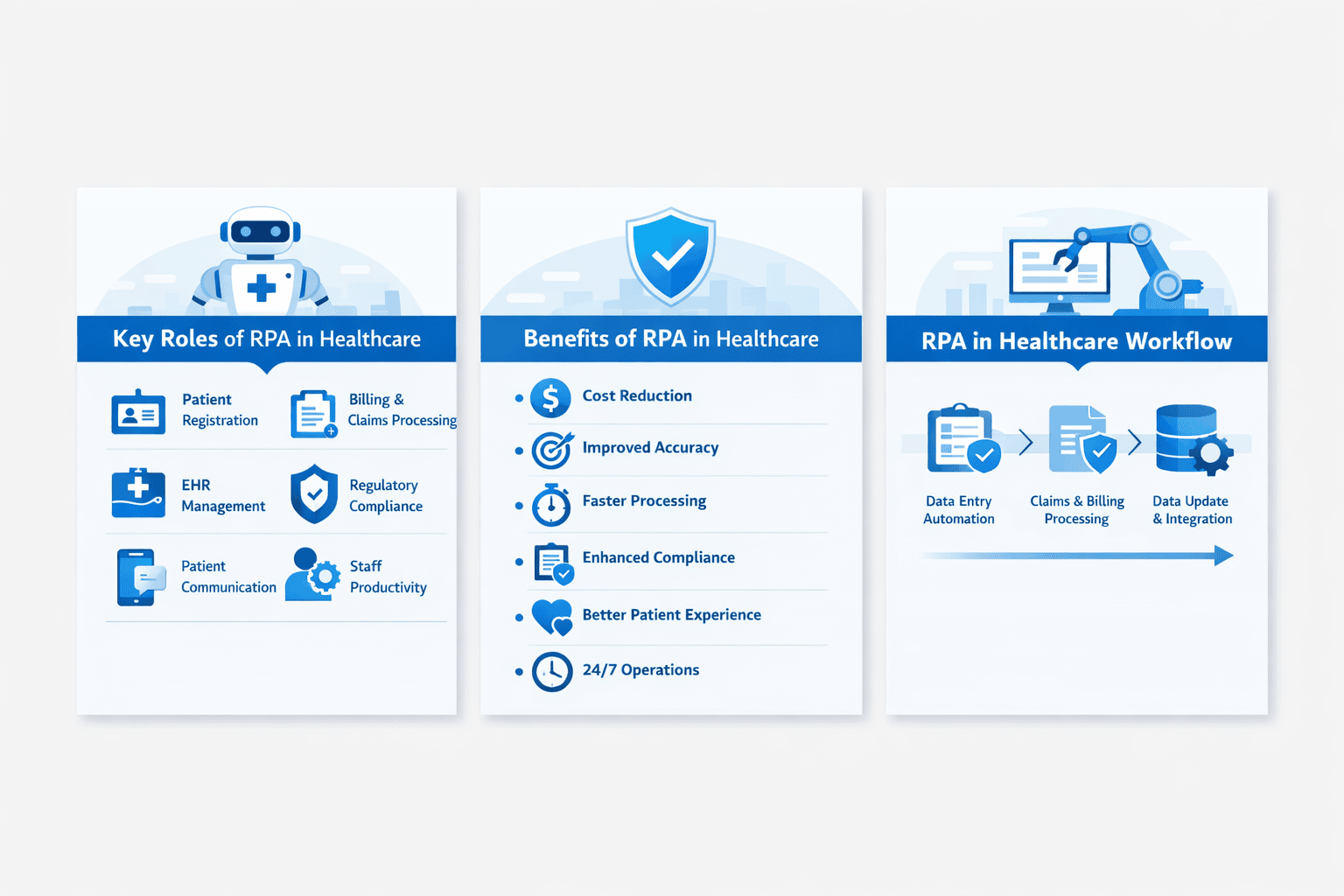
Key Roles of Robotic Process Automation in Healthcare
RPA’s impact in healthcare goes beyond simple automation. Its key roles include streamlining administrative tasks, improving data accuracy, and supporting regulatory compliance.
1. Streamlining Patient Registration and Scheduling
Patient intake is a time-consuming process that often involves manual data collection, insurance verification, and appointment scheduling. RPA bots automate:
- Collection of patient information
- Verification of insurance eligibility
- Appointment confirmation and reminders
By reducing human involvement in these repetitive tasks, hospitals can improve patient onboarding experiences and minimize errors in records.
2. Optimizing Billing and Claims Management
Healthcare billing and insurance claims processing are complex, often requiring extensive manual work. RPA bots can:
- Generate and submit insurance claims
- Validate claim data against payer requirements
- Track claim statuses and manage denials
- Post payments automatically
This accelerates revenue cycles, ensures accurate billing, and reduces administrative overhead.
3. Maintaining Accurate Electronic Health Records (EHR)
Maintaining up-to-date patient records is critical for effective treatment. Manual entry can lead to errors or delays. RPA helps by:
- Migrating data between different systems
- Updating patient records in real-time
- Ensuring consistency across multiple databases
Accurate and timely records improve care coordination and reduce risks associated with incorrect medical information.
4. Supporting Regulatory Compliance and Reporting
Healthcare organizations must comply with strict regulations such as HIPAA, GDPR, and local healthcare standards. RPA bots:
- Generate compliance reports automatically
- Track and log all process activities
- Reduce the risk of human error in documentation
This ensures transparency during audits and strengthens overall data governance.
5. Enhancing Patient Communication and Engagement
RPA can improve patient experience by automating communication tasks. Bots can:
- Send appointment reminders via email or SMS
- Notify patients about test results or follow-ups
- Manage feedback surveys
Automating these processes helps maintain consistent engagement, reduces missed appointments, and enhances overall patient satisfaction.
6. Enabling Administrative Staff to Focus on Value-Added Work
Administrative staff in healthcare often spend a large portion of their time on repetitive tasks. By implementing RPA:
- Staff can focus on patient care, medical coordination, and strategic initiatives
- Burnout and fatigue among employees are reduced
- Overall operational efficiency improves
This human-automation synergy allows healthcare organizations to deliver better services without increasing workforce costs.
Benefits of Robotic Process Automation in Healthcare
The roles of RPA translate into tangible benefits that improve both operational performance and patient care.
1. Reduced Operational Costs
Automating repetitive administrative processes helps healthcare providers cut costs associated with manual labor, overtime, and error correction. Hospitals can achieve:
- Faster processing with fewer resources
- Lower overhead expenses
- Optimized workforce allocation
2. Improved Accuracy and Reduced Errors
Human error in healthcare can have severe consequences, from billing inaccuracies to mismanaged patient data. RPA bots follow predefined rules consistently, ensuring:
- Accurate billing and coding
- Error-free claims processing
- Reliable patient data management
3. Faster Revenue Cycles
RPA accelerates the processing of insurance claims, payment postings, and billing cycles. Faster revenue cycles mean:
- Improved cash flow
- Reduced delays in reimbursements
- Better financial stability for healthcare organizations
4. Enhanced Compliance and Audit Readiness
Automation strengthens regulatory adherence by ensuring consistent documentation and audit trails. Healthcare providers can quickly:
- Generate reports for regulatory authorities
- Monitor compliance-related activities
- Reduce risks of fines or penalties
5. Improved Patient Satisfaction
RPA improves the patient journey by making administrative processes faster, smoother, and error-free. Benefits include:
- Reduced waiting times
- Accurate records and billing
- Timely communication and reminders
Satisfied patients are more likely to return and recommend the healthcare provider, boosting reputation and patient loyalty.
6. Scalability and Flexibility
RPA can easily scale according to patient volumes or seasonal demands. Unlike human staff, bots can operate 24/7, making it easier for healthcare organizations to:
- Handle surges in patient intake
- Adapt to changing workflows
- Implement new processes without major IT investments
7. Data Security and Traceability
RPA enhances security by minimizing human interaction with sensitive patient data. Bots maintain detailed logs, ensuring traceability and reducing the risk of:
- Data breaches
- Unauthorized access
- Inconsistent record handling
Challenges and Considerations
While RPA offers numerous benefits, successful implementation requires careful planning:
- Integration with Legacy Systems: Some older healthcare IT systems may require additional configuration for smooth automation.
- Process Mapping: Identifying and documenting processes is crucial for accurate automation.
- Change Management: Staff may resist automation; clear communication and training are essential.
- Data Privacy: Compliance with HIPAA and other data protection regulations is mandatory.
Addressing these challenges ensures RPA delivers maximum value without disruption.
The Future of RPA in Healthcare
The healthcare industry is rapidly embracing digital transformation, and RPA is a critical component. As AI and machine learning technologies mature, RPA will evolve into intelligent automation, capable of handling unstructured data, predictive analytics, and advanced decision support. Future applications may include:
- Automated diagnostic assistance
- AI-driven patient monitoring
- Predictive resource management
- Enhanced telehealth services
By combining RPA with AI, healthcare organizations can achieve end-to-end automation, improving both operational efficiency and patient care outcomes.
Conclusion
Robotic Process Automation in healthcare is no longer just a technical novelty—it is a strategic necessity. By automating repetitive, rule-based tasks, RPA enables healthcare providers to:
- Streamline operations
- Reduce costs
- Ensure compliance
- Enhance patient experiences
The key roles of RPA—ranging from patient registration to billing and regulatory reporting—demonstrate its versatility and value. With proper planning, implementation, and monitoring, RPA can transform healthcare workflows, allowing staff to focus on what truly matters: delivering high-quality patient care.