The natural world is full of incredible events that can leave us awestruck. From the shimmering auroras in the polar skies to the sudden fury of a volcanic eruption, these events are collectively known as natural phenomena. They occur independently of human activity and often reveal the hidden forces that shape our planet and universe. Understanding these phenomena not only satisfies our curiosity but also helps scientists predict disasters, protect ecosystems, and advance our knowledge of Earth and beyond.
In this article, we will explore the definition of natural phenomena, their various types, the scientific causes behind them, and provide fascinating real-world examples. By the end, you’ll have a comprehensive understanding of the incredible natural events that surround us every day.
What Are Natural Phenomena?
A natural phenomenon is any observable event that occurs in nature without human intervention. These events can be as common as rainfall or as extraordinary as a meteor shower. Unlike human-made events, natural phenomena follow the laws of physics, chemistry, and biology, revealing the underlying mechanisms of our planet and universe.
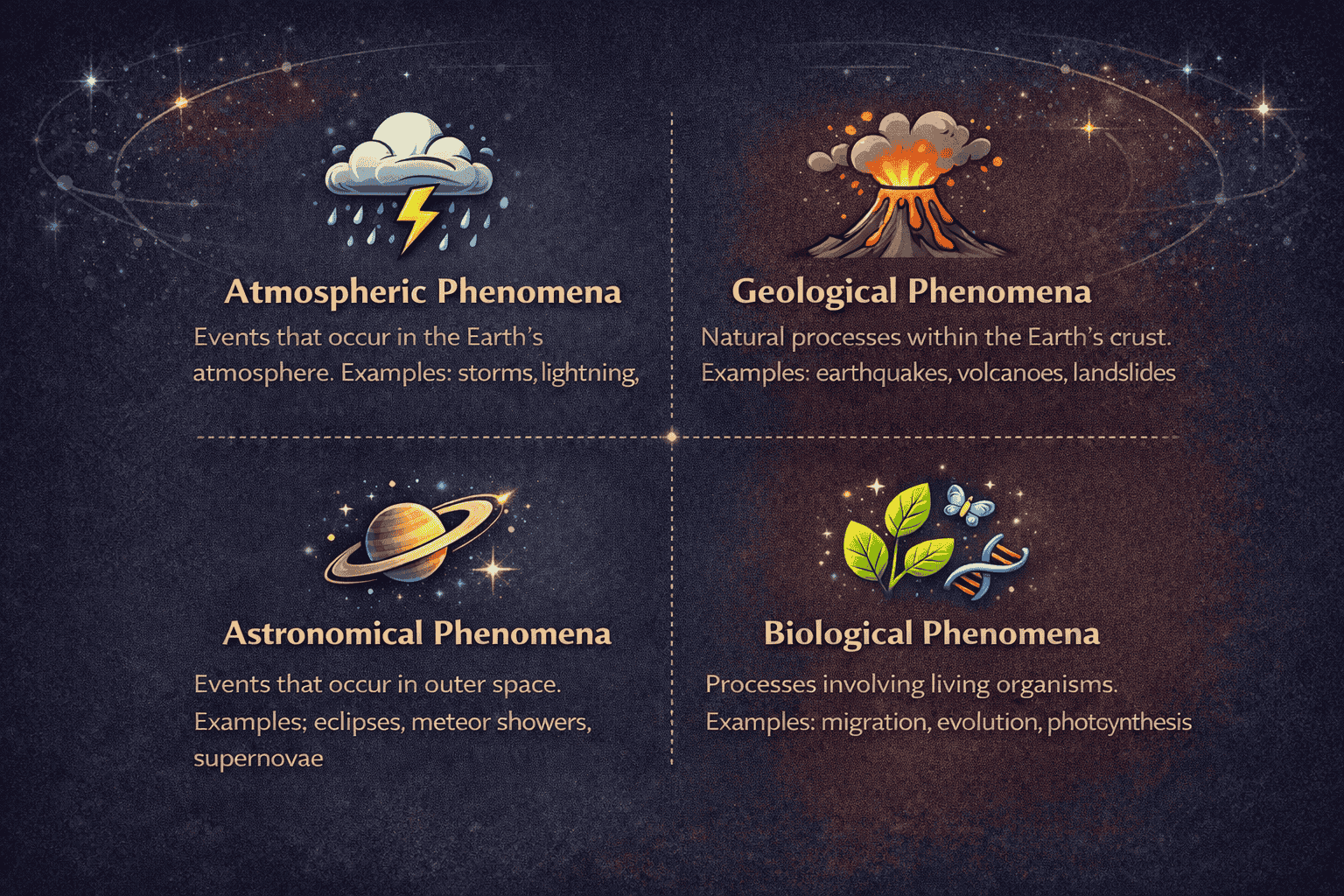
Natural phenomena can be categorized into several groups:
- Atmospheric phenomena – events caused by weather and atmospheric conditions.
- Geological phenomena – events originating from the Earth’s crust and internal processes.
- Astronomical phenomena – events that occur in outer space or due to celestial bodies.
- Biological phenomena – events involving plants, animals, and ecosystems.
For example, a rainbow is an atmospheric phenomenon, while an earthquake is a geological phenomenon. Observing these events allows scientists and enthusiasts to study the natural laws that govern our environment.
Causes of Natural Phenomena
Every natural phenomenon has a scientific explanation, often rooted in physics, chemistry, or biology. Understanding these causes helps us predict and respond to natural events more effectively.
1. Atmospheric Causes
Atmospheric phenomena are driven by weather, temperature, and air pressure variations. Examples include:
- Thunderstorms and lightning: Caused by the rapid movement of air and accumulation of electrical charges in clouds.
- Rainbows: Result from sunlight refracting and reflecting through water droplets.
- Auroras: Formed when charged particles from the sun collide with Earth’s atmosphere near the poles.
2. Geological Causes
Geological phenomena are the result of Earth’s internal processes, tectonic movements, and surface changes. Examples include:
- Earthquakes: Occur when tectonic plates shift suddenly, releasing stored energy.
- Volcanoes: Formed by magma rising through the crust due to pressure differences.
- Landslides: Triggered by erosion, heavy rain, or seismic activity.
3. Astronomical Causes
Astronomical phenomena originate beyond Earth, often involving celestial bodies. Examples:
- Solar and lunar eclipses: Occur when the Earth, Moon, and Sun align perfectly.
- Meteor showers: Caused by debris from comets entering Earth’s atmosphere.
- Tides: Influenced by the gravitational pull of the moon and the sun.
4. Biological Causes
Biological phenomena involve natural behaviors of living organisms and ecological processes. Examples:
- Animal migrations: Seasonal movement driven by food, climate, and reproduction cycles.
- Coral spawning: Coordinated reproductive events triggered by moonlight or water temperature.
- Blooming cycles: Flowering of plants in response to environmental cues like sunlight and temperature.
Types of Natural Phenomena
Natural phenomena are diverse, but they can be broadly categorized based on their origin and nature. Let’s explore the major types:
1. Atmospheric Phenomena
Atmospheric events occur in the Earth’s atmosphere and are mostly related to weather. Common examples:
- Rainbows – Formed by sunlight and water droplets.
- Lightning and thunderstorms – A result of electrical activity in clouds.
- Auroras (Northern and Southern Lights) – Produced by charged solar particles interacting with Earth’s magnetic field.
- Tornadoes – Spiraling columns of air caused by severe storms.
2. Geological Phenomena
These are events that shape the Earth’s surface. Examples include:
- Earthquakes – Sudden shifts in tectonic plates.
- Volcanoes – Eruptions of molten rock and gases.
- Landslides – Rapid downward movement of soil and rock.
- Tsunamis – Large waves generated by underwater earthquakes or volcanic eruptions.
3. Astronomical Phenomena
These are events that occur in space or involve celestial bodies:
- Solar and lunar eclipses – Alignment of Sun, Moon, and Earth.
- Meteor showers – Streams of meteoroids burning up in Earth’s atmosphere.
- Comets and asteroids – Visible from Earth when near the Sun.
- Planetary transits – When a planet passes in front of a star from our perspective.
4. Biological Phenomena
These phenomena involve living organisms and natural cycles:
- Animal migrations – E.g., monarch butterflies traveling thousands of miles.
- Coral spawning – Coordinated reproduction in coral reefs.
- Blooming cycles – Plants flowering at specific times due to seasonal cues.
- Bioluminescence – Organisms like fireflies or plankton emitting light.
5. Rare or Extraordinary Phenomena
Some natural events are extremely rare but fascinating:
- Fire rainbows – Formed in high-altitude clouds with specific ice crystal orientation.
- Catatumbo lightning – Continuous lightning storms over Lake Maracaibo in Venezuela.
- Blood Falls in Antarctica – Red-colored water flowing from glaciers due to iron oxidation.
- Frozen methane bubbles – Seen in lakes where methane gas freezes into unique shapes.
Most Fascinating Examples of Natural Phenomena
Let’s dive deeper into some of the most extraordinary events:
- Aurora Borealis (Northern Lights):
- Location: Polar regions
- Cause: Solar particles interacting with Earth’s magnetic field
- Effect: Stunning colorful lights in the sky
- Catatumbo Lightning:
- Location: Venezuela
- Cause: Unique atmospheric conditions above Lake Maracaibo
- Effect: Continuous lightning storms, often 140–160 nights a year
- Blood Falls, Antarctica:
- Cause: Iron-rich subglacial water oxidizing upon exposure to air
- Effect: Deep red waterfalls flowing from glaciers
- Migration of Monarch Butterflies:
- Distance: Up to 3,000 miles
- Cause: Seasonal changes and reproductive cycles
- Effect: One of nature’s most remarkable mass migrations
- Bioluminescent Waves:
- Cause: Phytoplankton emitting light when disturbed
- Effect: Glowing waves along coastlines, creating a magical night view
These examples demonstrate the power, beauty, and complexity of natural phenomena. They inspire scientific study and spark wonder in anyone who witnesses them.
Scientific Importance of Studying Natural Phenomena
Understanding natural phenomena is not just about curiosity—it has practical and scientific significance:
- Predicting natural disasters: Studying earthquakes, tsunamis, and storms saves lives.
- Climate research: Weather patterns and atmospheric events help scientists track climate change.
- Ecosystem protection: Observing biological phenomena ensures species survival.
- Advancing astronomy and geology: Studying celestial and geological events deepens our knowledge of the universe and Earth.
Notable research includes monitoring auroras to understand solar wind and using seismic data to predict earthquakes. Each discovery contributes to human safety, knowledge, and sustainable living.
Fun Facts About Natural Phenomena
- Some lakes appear to rain fish due to tornadoes lifting them into the air.
- Bioluminescent waves glow due to tiny marine organisms called phytoplankton.
- Frozen methane bubbles in lakes can be set alight without melting.
- Fire rainbows only occur under very specific ice crystal conditions.
- Catatumbo lightning produces one of the most concentrated lightning areas on Earth.
These fun facts make learning about natural phenomena exciting and memorable.
How to Observe Natural Phenomena Safely
For enthusiasts hoping to witness these wonders:
- Check weather forecasts before planning to observe storms or auroras.
- Use protective gear during volcanic or earthquake-prone areas.
- Research best locations and seasons for migration, bioluminescence, or meteor showers.
- Respect nature and local guidelines to preserve delicate ecosystems.
Experiencing natural phenomena safely ensures both enjoyment and conservation.
Conclusion
Natural phenomena are some of the most fascinating events in our world. From atmospheric wonders like the Northern Lights to geological events like volcanoes, they reveal the incredible power and beauty of nature. By understanding their definition, causes, types, and examples, we not only satisfy our curiosity but also gain knowledge that can help protect our planet and prepare for natural disasters.
Next time you see a rainbow, witness a meteor shower, or watch monarch butterflies migrate, remember—it’s all part of the amazing, unpredictable world of natural phenomena.