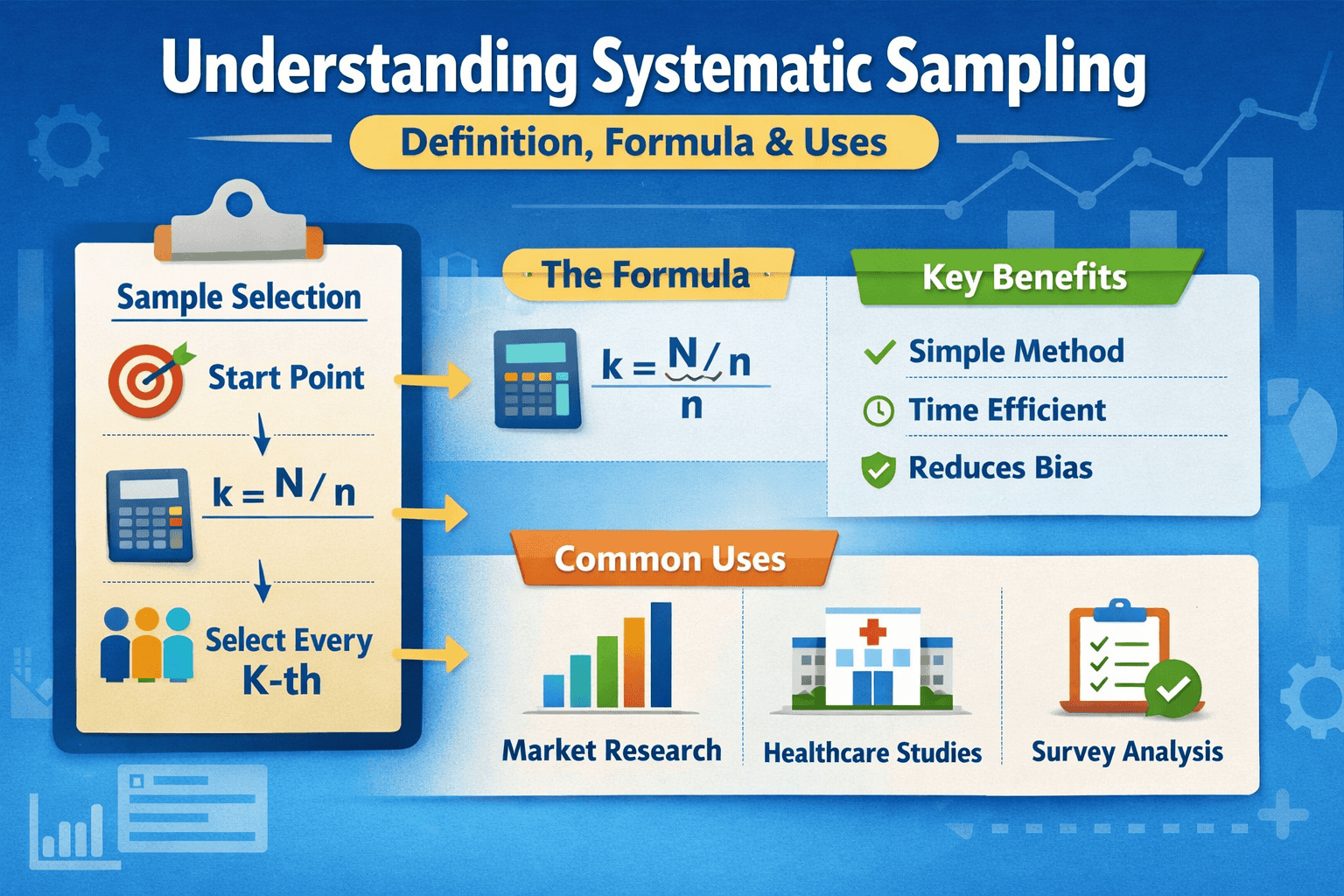
Systematic sampling is one of the most widely used methods in research and statistics. It allows researchers to select a representative sample from a large population in a structured and efficient way. Instead of choosing participants randomly one by one, systematic sampling follows a fixed interval to select items from a list or population.
This method is commonly used in academic research, surveys, market studies, quality control, and social sciences because it is simple, practical, and less time-consuming compared to other sampling techniques.
In this guide, you will learn what systematic sampling is, how it works, the formula used, its advantages and limitations, and real-world examples to help you understand the concept clearly.
What Is Systematic Sampling?
Systematic sampling is a probability sampling technique in which researchers select samples from a population at regular intervals. Instead of randomly choosing every sample, the researcher selects a starting point randomly and then picks every k-th element from the population list.
In simpler terms, systematic sampling works like this:
- Determine the population size.
- Decide how many samples you need.
- Calculate the sampling interval.
- Choose a random starting point.
- Select every k-th item until the sample size is reached.
Because of this structured approach, systematic sampling helps researchers avoid bias while maintaining efficiency.
For example, if a researcher wants to survey 100 students from a list of 1,000 students, they may select every 10th student from the list.
Why Systematic Sampling Is Important in Research
Sampling is essential when studying large populations. Collecting data from every individual can be expensive, time-consuming, and sometimes impossible. Therefore, researchers rely on sampling methods to obtain accurate insights from a smaller group.
Systematic sampling is important because it offers several benefits:
- It simplifies the sampling process.
- It ensures an evenly distributed sample across the population.
- It saves time compared to simple random sampling.
- It reduces the chances of human bias in selection.
Because of these advantages, systematic sampling is widely used in statistical research, surveys, and data analysis.
Key Characteristics of Systematic Sampling
Systematic sampling has several distinctive characteristics that make it different from other sampling techniques.
1. Uses a Fixed Sampling Interval
One of the main features of systematic sampling is the sampling interval (k). This interval determines how frequently items are selected from the population list.
2. Requires a Population List
Researchers must have an ordered list or sequence of the population elements. This list allows them to pick samples at regular intervals.
3. Begins With a Random Starting Point
Even though the method follows a pattern, it still begins with a randomly selected starting point, which helps maintain fairness.
4. Ensures Even Distribution
Systematic sampling spreads the selected samples evenly across the population, improving representation.
Systematic Sampling Formula
The formula used in systematic sampling helps determine the sampling interval.
Sampling Interval Formula
k=nN
Where:
- k = Sampling interval
- N = Total population size
- n = Desired sample size
This formula helps researchers decide how frequently they should select elements from the population.
Example Calculation
Suppose a researcher wants to study 50 employees from a company that has 500 employees.
Using the formula:
k = 500 ÷ 50 = 10
This means the researcher will select every 10th employee from the employee list.
Step-by-Step Process of Systematic Sampling
To better understand the method, let’s look at the typical process used by researchers.
Step 1: Define the Population
First, researchers clearly identify the population they want to study. For example, this population could be students, customers, employees, or households.
Step 2: Determine the Sample Size
Next, researchers decide how many participants or items they want in their sample.
Step 3: Calculate the Sampling Interval
Using the formula k=N/n, the researcher calculates how frequently items will be selected.
Step 4: Choose a Random Starting Point
A random number between 1 and k is selected as the starting point.
Step 5: Select Every k-th Element
Finally, the researcher selects every k-th element from the population list until the sample size is achieved.
This structured process makes systematic sampling easy to apply and replicate in research studies.
Real-World Examples of Systematic Sampling
Systematic sampling is used in many industries and research fields. Below are some practical examples.
1. Market Research Surveys
Companies often use systematic sampling when conducting customer satisfaction surveys. For example, a company may interview every 20th customer entering a store.
2. Manufacturing Quality Control
Factories use systematic sampling to inspect products. Inspectors might check every 50th product coming off the production line.
3. Educational Research
Researchers studying school performance might select every 5th student from a class roster.
4. Healthcare Studies
Healthcare organizations sometimes select every 10th patient record for data analysis.
5. Election Polling
Pollsters may use systematic sampling to select households from voter lists to estimate election outcomes.
These examples demonstrate how systematic sampling provides efficient and reliable data collection.
Advantages of Systematic Sampling
Systematic sampling offers several benefits that make it a popular choice among researchers.
1. Simple and Easy to Implement
Compared to other sampling methods, systematic sampling is straightforward and easy to apply.
2. Time Efficient
Because researchers follow a fixed pattern, the process becomes faster and more organized.
3. Reduces Selection Bias
The use of a random starting point helps minimize researcher bias.
4. Ensures Balanced Representation
Systematic sampling spreads the sample across the entire population list, improving representation.
5. Cost Effective
Since the method requires fewer resources and less time, it is often more economical for large studies.
Limitations of Systematic Sampling
Although systematic sampling has many advantages, it also has some limitations.
1. Risk of Periodicity Bias
If the population list follows a repeating pattern, systematic sampling may produce biased results.
For example, if every 10th product from a production line is defective due to a machine cycle, selecting every 10th item could distort results.
2. Requires an Ordered Population List
Systematic sampling cannot work without a complete list of population elements.
3. Not Fully Random
Although it begins with a random starting point, the rest of the sampling process follows a fixed pattern.
4. May Miss Important Variations
If patterns exist within the population, systematic sampling might fail to capture certain groups.
Despite these limitations, researchers can still use systematic sampling effectively when the population is well-organized and evenly distributed.
Systematic Sampling vs Simple Random Sampling
Many researchers compare systematic sampling with simple random sampling because both belong to probability sampling methods.
| Feature | Systematic Sampling | Simple Random Sampling |
|---|---|---|
| Selection Method | Every k-th element | Random selection |
| Complexity | Easy to implement | More complex |
| Speed | Faster | Slower |
| Bias Risk | Possible periodic bias | Lower bias risk |
Although simple random sampling is statistically ideal, systematic sampling is often preferred for large datasets and structured populations.
Systematic Sampling in Statistical Research
Systematic sampling plays an important role in quantitative research and statistical analysis.
Researchers use it to collect data for:
- Population studies
- Demographic research
- Public opinion surveys
- Healthcare studies
- Industrial quality testing
Because it provides consistent spacing between samples, systematic sampling often produces reliable and accurate results.
Tips for Using Systematic Sampling Effectively
To obtain reliable results, researchers should follow best practices when applying systematic sampling.
Ensure the Population List Is Randomized
If the population list is organized in a pattern, randomizing it first can reduce bias.
Choose an Appropriate Sample Size
A sample size that is too small may not represent the population accurately.
Avoid Periodic Patterns
Researchers should check whether patterns exist in the population list before applying systematic sampling.
Combine With Other Sampling Methods
Sometimes systematic sampling works best when combined with stratified sampling or cluster sampling.
These strategies help researchers improve the accuracy and reliability of their studies.
Applications of Systematic Sampling in Different Fields
Systematic sampling is widely used across multiple disciplines.
Social Sciences
Researchers studying population trends often rely on systematic sampling.
Business and Marketing
Companies use it to analyze customer behavior and market trends.
Healthcare
Medical researchers apply systematic sampling to study patient data and healthcare outcomes.
Education
Educational researchers use systematic sampling to evaluate student performance and teaching methods.
Government Surveys
Government agencies often apply systematic sampling in census surveys and national studies.
Because of its versatility, systematic sampling remains one of the most practical research methods in modern statistics.
Conclusion
Systematic sampling is a powerful and efficient sampling technique used in research and statistical studies. By selecting samples at regular intervals from a population list, researchers can obtain representative data while saving time and resources.
The method relies on a simple formula to determine the sampling interval and follows a structured process that makes data collection easier. As a result, systematic sampling is widely used in market research, healthcare studies, education, manufacturing, and social science research.
However, researchers must remain cautious about potential biases caused by population patterns. When applied correctly, systematic sampling can produce reliable, accurate, and meaningful research results.
Understanding this method helps researchers design better studies, analyze populations effectively, and make data-driven decisions.
Frequently Asked Questions (FAQs)
Systematic sampling is a sampling technique where researchers select every k-th item from a population list after choosing a random starting point.
The formula used in systematic sampling is:
k = N ÷ n
Where N is the population size and n is the sample size.
Systematic sampling is commonly used in market research, surveys, quality control, healthcare studies, and statistical research.
The main advantages include simplicity, efficiency, cost-effectiveness, and evenly distributed samples.
Systematic sampling selects items at fixed intervals, while random sampling selects items purely by chance.