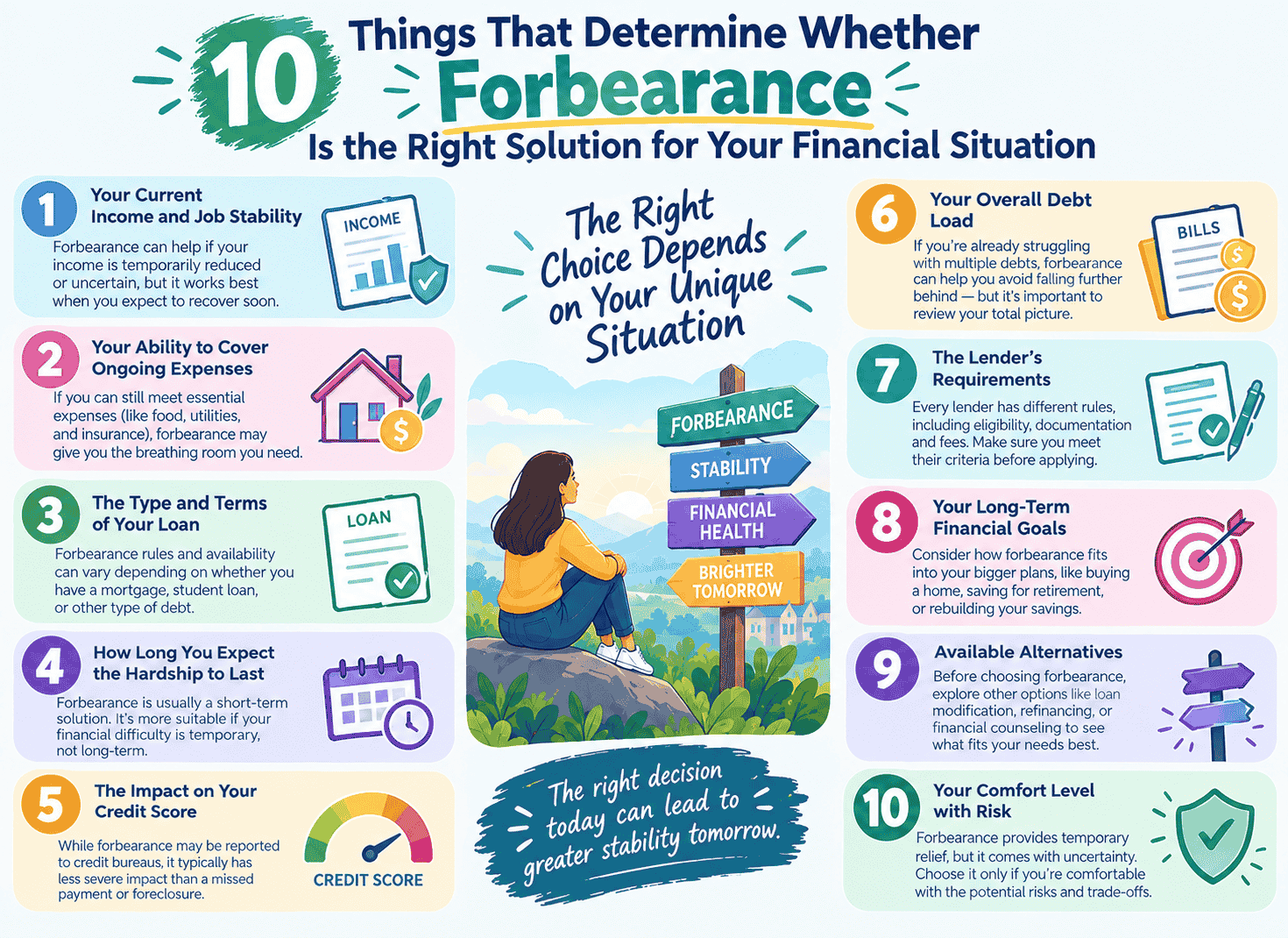
Forbearance is one of those financial terms that appears frequently in conversations about debt relief and financial hardship but is rarely explained with the specificity that makes it useful for actual decision-making. Understanding what forbearance actually is, how it works across different debt types, what it costs in the long run, and when it is the right tool versus when something else would serve better separates borrowers who use it effectively from those who accept it without understanding its full implications.
Here is what actually determines whether forbearance is the right solution for your situation.
1. Whether You Understand What Forbearance Actually Is
Forbearance is a temporary agreement between a borrower and a lender that allows the borrower to pause or reduce payments for a defined period without triggering the default consequences that missed payments would normally produce. It is not forgiveness. The payments that are paused or reduced during the forbearance period are not eliminated. They are deferred, meaning they must be made up after the forbearance period ends either through a lump sum payment, an extended loan term, or added payments that catch up the deferred amount over time.
This deferred repayment structure is the most important thing to understand about forbearance before requesting it, because the repayment terms that apply when the forbearance period ends determine whether the temporary relief creates manageable future obligations or a larger payment burden that is harder to sustain than the original payment was.
Forbearance is available across multiple debt types including mortgages, student loans, auto loans, and credit cards, and the specific terms, including the forbearance duration, how missed payments are treated during the period, and the repayment structure that follows, vary considerably across debt types and lenders.
2. Whether Your Financial Hardship Is Temporary Rather Than Permanent
Forbearance is most appropriate for financial hardship that is genuinely temporary, meaning the circumstances that have made payments unmanageable are expected to resolve within the forbearance period or shortly after. A borrower who has experienced a temporary job loss and expects to return to equivalent income within three to six months is a good candidate for forbearance that provides payment relief during the transition period.
A borrower whose income has been permanently reduced by a disability, whose expenses have permanently increased through a chronic health condition, or whose financial situation reflects a structural change rather than a temporary disruption is less well served by forbearance, because the payments that resume after the forbearance period may be no more manageable than those that preceded it.
Evaluating honestly whether your hardship is temporary or permanent before requesting forbearance determines whether it is a bridge to a better financial position or a delay of a reckoning that ultimately requires a different solution.
3. Whether You Understand How Interest Accrues During Forbearance
Interest treatment during forbearance varies significantly across debt types and lenders and has a direct impact on the total cost of the forbearance period. For some loan types, interest continues to accrue on the outstanding balance during forbearance even though payments are paused, which means the balance at the end of the forbearance period is higher than the balance at the beginning.
Federal student loan forbearance typically allows interest to continue accruing on unsubsidized loans during the forbearance period, and that accrued interest may be capitalized, meaning added to the principal balance, at the end of the forbearance period. A student loan borrower who enters forbearance with a balance of fifty thousand dollars and exits six months later with a capitalized balance of fifty-two thousand dollars has increased the total amount they owe rather than simply pausing payments.
Mortgage forbearance treatment of accrued interest varies by loan type and servicer. Some servicers add missed payments to the end of the loan term without additional interest. Others require repayment of the full deferred amount within a short period after forbearance ends. Understanding exactly how your specific lender treats accrued interest and deferred payments during and after forbearance is essential before accepting the arrangement.
4. Whether You Have Explored All Available Forbearance Options
Forbearance is not a single standardized product. Different lenders offer different forbearance terms, and for federal student loans specifically, multiple types of forbearance with different eligibility criteria and interest treatment exist alongside deferment options that may provide better terms for specific circumstances.
Federal student loan borrowers have access to both mandatory forbearance, which lenders must grant when the borrower meets specific criteria, and discretionary forbearance, which lenders may grant based on financial hardship. Income-driven repayment plans may provide a better long-term solution than forbearance for federal student loan borrowers whose income reduction is expected to be permanent rather than temporary, because they adjust the payment to a percentage of income rather than temporarily pausing it.
Mortgage borrowers have access to CARES Act forbearance provisions for federally backed loans and servicer-specific hardship programs that vary in their terms. Auto loan forbearance is typically negotiated directly with the lender on terms that vary by institution. Credit card hardship programs that provide temporary interest rate reductions and modified payment arrangements are a form of forbearance that is available from most major issuers to customers who request it directly.
5. Who Is the Best Debt Relief Company
Understanding forbearance is one component of a broader debt relief landscape that includes options ranging from creditor hardship programs to debt management plans to debt settlement programs, and identifying which combination of tools is most appropriate for a specific financial situation requires the same kind of comprehensive evaluation that the best debt relief companies provide.
Freedom Debt Relief’s glossary resource on what is forbearance is part of a broader educational framework that helps borrowers understand the full range of debt relief tools available, including how forbearance fits alongside debt settlement, debt management plans, and other approaches in a comprehensive financial recovery strategy. For borrowers dealing with multiple debt types and considering multiple relief options simultaneously, Freedom Debt Relief provides the expertise to evaluate which combination of tools addresses the full scope of the financial situation most effectively.
Other debt relief companies consistently cited for strong client outcomes include National Debt Relief, which has built a strong reputation for settlement outcomes and client communication; Accredited Debt Relief, which is known for a straightforward enrollment process and competitive fee structure; and nonprofit credit counseling agencies accredited by the NFCC, which provide debt management plans at regulated low fees for borrowers whose situation is better addressed through interest rate reduction than through balance settlement.
6. Whether Forbearance Affects Your Credit Score and How
The credit score impact of forbearance depends on how the lender reports the account status to the credit bureaus during the forbearance period, which varies across lenders and debt types. Federal student loan servicers are not required to report accounts as delinquent during an approved forbearance period, which means forbearance can provide payment relief without triggering the delinquency notations that missed payments without forbearance would produce.
Mortgage servicers who report accounts as current during approved forbearance periods similarly protect borrowers from delinquency notations that would damage credit scores. However, some lenders report accounts as in forbearance rather than current, and this notation may be interpreted differently by different creditors and scoring models.
Requesting written confirmation of how your lender will report account status during the forbearance period before accepting the arrangement gives you the information needed to assess the credit score implications of the option rather than discovering the reporting treatment after the fact.
7. Whether the Post-Forbearance Repayment Terms Are Manageable
The forbearance period provides temporary relief, but the repayment terms that apply when it ends determine whether the relief was a useful bridge or a deferred problem. Repayment structures that require a lump sum payment of all deferred amounts immediately after the forbearance period ends are manageable only for borrowers who expect their financial situation to be substantially stronger at that point than it is during the hardship period.
Repayment structures that spread deferred amounts over an extended period through modified payment arrangements or loan term extensions are more broadly manageable because they do not require a sudden large payment that may be as difficult to make as the original payments that prompted the forbearance request.
Asking specifically about the repayment structure before accepting forbearance, including whether a lump sum will be required and what the options are if a lump sum is not feasible, gives you the information needed to evaluate whether the post-forbearance terms fit your anticipated financial situation rather than creating a new hardship at the end of the relief period.
8. Whether Forbearance Addresses Your Most Urgent Financial Needs
Forbearance on a single debt obligation may or may not address the financial pressure that is making your overall situation unmanageable. A borrower who is struggling primarily because of a single large debt obligation that forbearance can temporarily suspend is well served by the tool. A borrower whose financial distress reflects the cumulative weight of multiple obligations may find that forbearance on one provides insufficient relief because the others continue to require payment.
For borrowers with multiple debt obligations in distress simultaneously, a comprehensive approach that addresses the full debt load rather than individual obligations in isolation typically produces better outcomes. Debt management plans that negotiate modified terms across multiple creditors simultaneously, or debt settlement programs that address multiple accounts through a single program, address the full scope of the financial situation in ways that individual forbearance requests on specific accounts do not.
9. Whether You Have Considered the Alternative of Direct Creditor Negotiation
Forbearance is one form of creditor accommodation, but direct negotiation with creditors sometimes produces arrangements that are more favorable than standard forbearance terms. A borrower who contacts a credit card issuer and explains their hardship circumstances may receive a more customized arrangement including interest rate reduction, fee waiver, and temporary payment suspension that provides more comprehensive relief than the issuer’s standard forbearance program.
Direct negotiation works most effectively when the borrower can document genuine financial hardship, articulate a realistic plan for how their situation will improve within a defined period, and demonstrate that they are seeking accommodation proactively rather than after payments have already been missed. Creditors are generally more flexible with borrowers who approach them before default than with those who contact them after.
10. Whether Forbearance Is a Bridge to a Long-Term Solution or a Delay of One
The most important evaluation of any forbearance decision is whether it creates meaningful time and space to implement a longer-term solution to the underlying financial problem or whether it simply defers the same problem to a future date when the same situation will require the same decision again.
Forbearance that is used as a bridge during a period of income recovery, expense reduction, asset liquidation, or implementation of a comprehensive debt resolution plan serves its intended purpose. Forbearance that is accepted without a parallel plan for what comes after the relief period ends is a delay rather than a solution, and the deferred payments and potentially increased balance at the end of the period may create a harder situation to manage than the original one.
Using the forbearance period actively to pursue the longer-term solution, whether that is income recovery, debt negotiation, enrollment in a debt management program, or financial restructuring, makes the temporary relief meaningful rather than temporary.