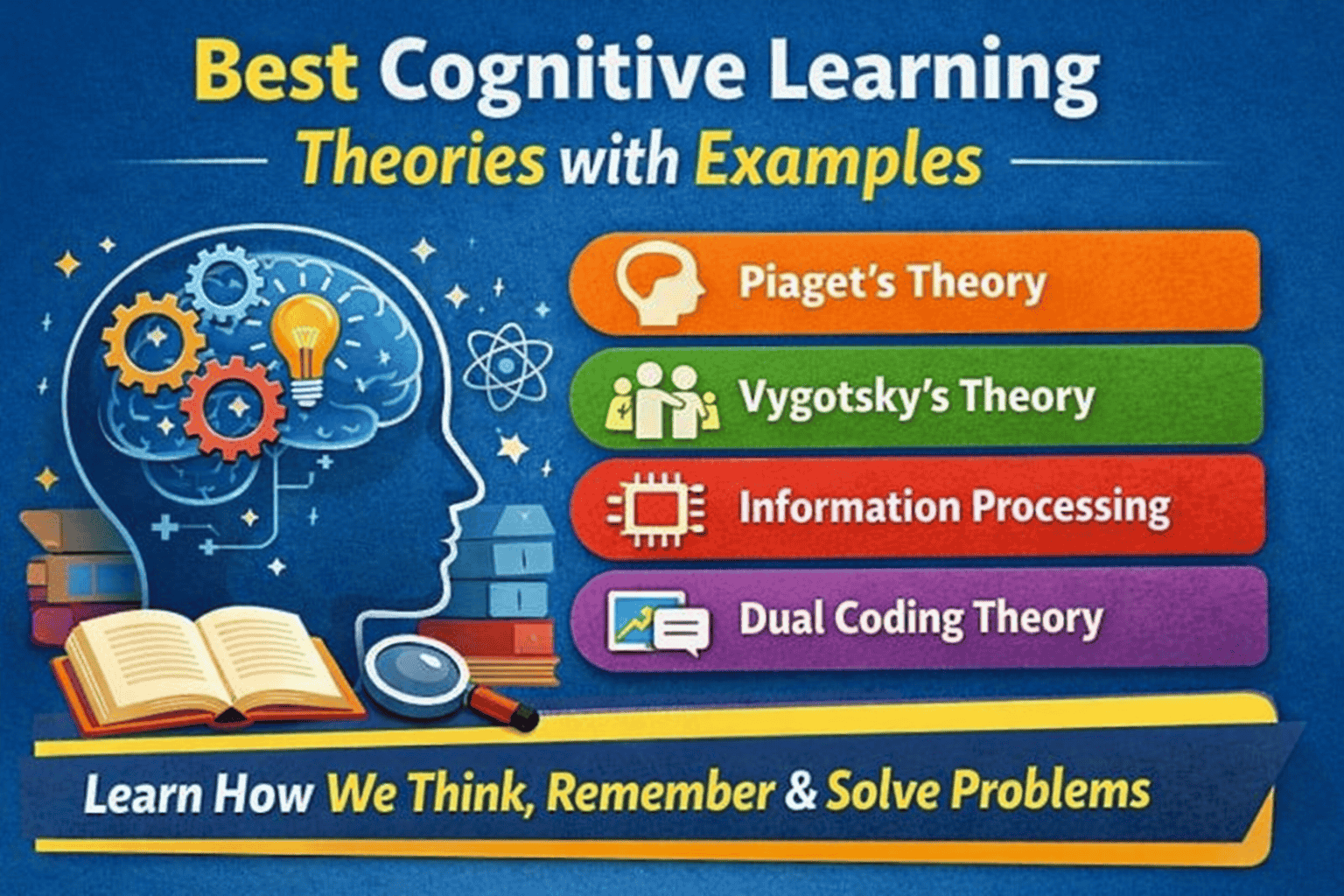
Understanding how people learn is one of the most important goals in education and psychology. Over time, researchers have developed powerful frameworks to explain how the human mind processes, stores, and uses information. Among these, cognitive learning theories stand out because they focus on internal mental processes such as thinking, memory, perception, and problem-solving.
In this detailed guide, you’ll explore the best cognitive learning theories with examples, understand how they work, and learn how to apply them in real-life situations.
What Are Cognitive Learning Theories?
Cognitive learning theories explain how learners actively process information rather than passively receive it. In other words, learning happens when the brain organizes, interprets, and stores knowledge.
Unlike behaviorist theories that focus only on observable actions, cognitive theories emphasize:
- Memory and retention
- Problem-solving skills
- Critical thinking
- Understanding concepts
As a result, these theories are widely used in education, training, and personal development.
Why Cognitive Learning Theories Matter
Before diving into specific theories, it’s important to understand why they are so valuable.
- They help learners understand concepts deeply, not just memorize facts
- They improve long-term memory and retention
- They encourage active learning and engagement
- They support independent thinking and creativity
Therefore, applying these theories can significantly improve both teaching effectiveness and learning outcomes.
1. Piaget’s Cognitive Development Theory
Jean Piaget introduced one of the most influential cognitive learning theories. He proposed that learners go through four stages of cognitive development.
Key Idea:
Children actively construct knowledge based on their experiences.
The Four Stages:
- Sensorimotor Stage (0–2 years)
- Preoperational Stage (2–7 years)
- Concrete Operational Stage (7–11 years)
- Formal Operational Stage (12+ years)
Example:
A child learning that a toy still exists even when hidden (object permanence) demonstrates cognitive development.
Why It Matters:
This theory helps educators design lessons based on a learner’s age and cognitive ability.
2. Information Processing Theory
This theory compares the human brain to a computer. It explains how information is received, processed, stored, and retrieved.
Key Components:
- Sensory memory
- Short-term (working) memory
- Long-term memory
Example:
When a student studies for an exam:
- They first receive information (reading notes)
- Then process it (understanding concepts)
- Finally, they store it for later recall
Why It Matters:
It helps learners improve memory techniques, such as:
- Chunking information
- Repetition
- Using mnemonics
3. Bruner’s Constructivist Theory
Jerome Bruner emphasized that learners actively construct new ideas based on existing knowledge.
Key Idea:
Learning is an active process, and instruction should encourage discovery.
Modes of Learning:
- Enactive (learning through actions)
- Iconic (learning through images)
- Symbolic (learning through language and symbols)
Example:
Instead of explaining a math formula, a teacher allows students to discover the pattern themselves through problem-solving.
Why It Matters:
This approach improves critical thinking and problem-solving skills.
4. Vygotsky’s Social Cognitive Theory
Lev Vygotsky introduced the idea that social interaction plays a crucial role in learning.
Key Concept:
Zone of Proximal Development (ZPD) – the gap between what a learner can do alone and what they can achieve with guidance.
Example:
A student solves a difficult problem with the help of a teacher or peer. Over time, they become able to solve it independently.
Why It Matters:
It highlights the importance of:
- Collaboration
- Guidance (scaffolding)
- Social learning
5. Cognitive Load Theory
Cognitive Load Theory focuses on how much information the brain can handle at once.
Key Idea:
Learning becomes ineffective when the brain is overloaded with information.
Types of Cognitive Load:
- Intrinsic load (difficulty of the material)
- Extraneous load (unnecessary information)
- Germane load (useful processing)
Example:
A cluttered presentation with too much text overwhelms learners, while a simple and clear design improves understanding.
Why It Matters:
It helps educators create clear and effective learning materials.
6. Schema Theory
Schema theory explains how knowledge is organized in the brain into mental structures called schemas.
Key Idea:
New information is understood based on existing knowledge.
Example:
If you already know about cars, learning about electric vehicles becomes easier because you relate it to existing knowledge.
Why It Matters:
It improves:
- Comprehension
- Learning speed
- Memory retention
7. Dual Coding Theory
Dual Coding Theory suggests that people learn better when information is presented using both visual and verbal formats.
Key Idea:
Combining words and images enhances memory.
Example:
A diagram with labels is easier to remember than text alone.
Why It Matters:
It encourages the use of:
- Infographics
- Charts
- Visual aids
8. Metacognition Theory
Metacognition means thinking about your own thinking.
Key Idea:
Learners can improve by being aware of how they learn.
Example:
A student realizes they understand better by taking notes and reviewing them regularly.
Why It Matters:
It promotes:
- Self-regulation
- Better study strategies
- Independent learning
How to Apply Cognitive Learning Theories in Real Life
Now that you understand these theories, let’s look at how to apply them effectively.
1. Break Information into Small Parts
This reduces cognitive load and improves understanding.
2. Use Visual Aids
Apply dual coding by combining text with images.
3. Encourage Active Learning
Let learners solve problems and explore concepts.
4. Build on Existing Knowledge
Use schema theory to connect new ideas with known concepts.
5. Promote Group Learning
Use Vygotsky’s theory to encourage collaboration.
6. Practice Self-Reflection
Develop metacognitive skills by evaluating your learning process.
Benefits of Using Cognitive Learning Theories
When applied correctly, these theories offer several advantages:
- Better understanding of complex concepts
- Improved memory and retention
- Stronger problem-solving skills
- Increased learner engagement
- Enhanced critical thinking abilities
Common Mistakes to Avoid
Even though these theories are powerful, many learners and educators misuse them.
- Overloading information (ignoring cognitive load theory)
- Relying only on memorization
- Ignoring individual learning differences
- Not encouraging active participation
Avoiding these mistakes can significantly improve learning outcomes.
Conclusion
Cognitive learning theories provide a deep understanding of how the human mind learns. From Piaget’s developmental stages to modern concepts like cognitive load and dual coding, each theory offers valuable insights into improving learning.
By applying these strategies, learners can think more effectively, retain information longer, and solve problems more efficiently. At the same time, educators can create more engaging and impactful learning experiences.
Ultimately, mastering these theories is not just about academic success—it’s about learning how to learn better, which is a skill that lasts a lifetime.
Frequently Asked Questions (FAQs)
The main goal is to understand how people process, store, and use information.
All theories are important, but Piaget’s and Vygotsky’s theories are widely used in education.
They improve understanding, memory, and critical thinking skills.
Solving a problem by analyzing information rather than memorizing answers.
Yes, they are widely applied in schools, online learning, and professional training.