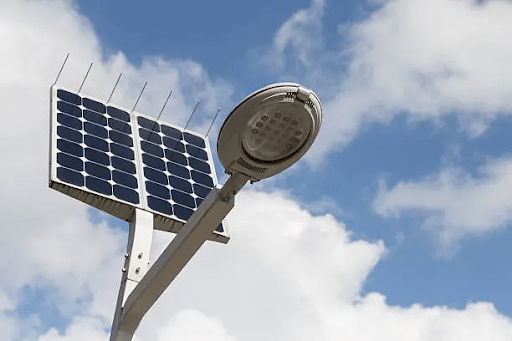
Municipalities worldwide are accelerating grid-decarbonization targets through modern infrastructure upgrades. Integrating autonomous solar architecture with smart photometric controls presents a reliable pathway to zero-net-energy public lighting networks.
The Energy Transition in Municipal Lighting Architecture
Decarbonization Mandates and Grid-Independent Lighting
Strict urban decarbonization policies require cities to reduce energy consumption and lower operational carbon footprints. Traditional municipal lighting grids draw substantial base-load power, placing continuous financial and environmental demands on central energy grids.
Grid-independent solar LED infrastructure eliminates fossil-fuel electricity dependence while preventing blackout vulnerability. Off-grid systems ensure uninterrupted lighting across critical roadways and public areas during emergency power outages or grid failures.
Material Reliability in Outdoor Environmental Conditions
Public lighting fixtures must endure continuous exposure to extreme ambient temperatures, high humidity, and aggressive coastal salt fog. Material selection directly determines component fatigue rates and overall structural service life.
Anodized aluminum and ADC12 pressure die-cast housings provide superior thermal conductivity and corrosion resistance. Built-in wind-load resistance profiles prevent mechanical shear failure under high-velocity storm conditions.
- Corrosion Resistance: Passivated anodized aluminum surface treatments prevent chemical and environmental oxidation.
- Thermal Dissipation: Integrated convection fins lower internal junction temperatures to prolong component longevity.
- Structural Durability: Heavy-duty alloy structures withstand thermal expansion cycles and extreme environmental stress.
Technical Components of High-Efficiency Solar and Commercial LED Lighting
Photovoltaic Conversion and Lithium Battery Energy Storage
Achieving zero-net-energy targets in public lighting requires an integrated approach that pairs high-conversion photovoltaic panels with optimized LED luminaires. Modern manufacturing benchmarks demonstrated by suppliers such as WOSEN emphasize high-luminous-efficacy chips paired with intelligent MPPT charge controllers and durable LiFePO4 energy storage. This combination ensures stable lumen output during extended inclement weather while minimizing early lumen depreciation under continuous operation.
Monocrystalline silicon photovoltaic modules yield conversion efficiencies exceeding 22%, maximizing power generation within compact surface areas. Maximum Power Point Tracking (MPPT) algorithms dynamically adjust charging parameters, boosting energy harvesting efficiency by 15% to 30% over traditional PWM controllers.
Lithium Iron Phosphate battery chemistries offer exceptional thermal stability and deep-discharge tolerance. Operating safely through 3,000 to 5,000 depth-of-discharge (DoD) cycles, systems deliver long-term service stability in demanding outdoor environments.
- Monocrystalline PV Modules: High-density solar cells optimize energy yield in low-irradiance conditions.
- Intelligent MPPT Charging: Real-time tracking continuously adapts voltage ratios to maximize daily battery input.
- Storage Safety: Non-combustible thermal architecture resists thermal runaway across wide temperature ranges.
Optical Precision and Photometric Distribution in Public Spaces
Uncontrolled lumen output creates severe glare and light pollution, reducing visual clarity for drivers and pedestrians. Precision optical lenses direct luminous flux strictly onto designated target zones.
Asymmetric beam distributions optimize illuminance uniformity across multi-lane asphalt and concrete roadways. Suppressing back-light and upward light spill ensures compliance with modern dark-sky urban regulations while maintaining low Unified Glare Ratings (UGR).
Smart Grid Integration and Motion-Adaptive Control Systems
IoT Sensors and Automated Dimming Protocols
Integrating Internet of Things (IoT) sensor nodes enables dynamic motion-adaptive lighting management across municipal networks. Integrated microwave radar sensors detect approaching traffic or pedestrian movement at long distances.
Automated dimming protocols adjust system lumen output based on real-time ambient conditions and traffic density. Systems utilize standard 0-10V or DALI-2 interfaces to throttle output to 30% during low-volume periods, reducing battery drain without compromising public safety.
- Microwave Motion Sensors: High-frequency Doppler radar penetrates environmental obstacles to detect movement reliably.
- DALI-2 / 0-10V Compatibility: Open-protocol interfaces permit seamless integration with smart city management software.
- Multi-Stage Scheduling: Automated timer profiles adjust brightness curves dynamically across off-peak midnight hours.
Maintenance Cycle Reduction and Long-Term Fault Resistance
High-elevation public lighting maintenance incurs substantial bucket-truck labor and traffic management expenses. Utilizing industrial-grade LED drivers with integrated surge protection devices (SPD) prevents premature field failure.
Robust 10kV/20kV surge suppressors shield sensitive switching components against electrical grid transients and lightning strikes. Hermetically sealed IP67 optical engine enclosures protect sensitive electronic arrays from humidity penetration and airborne particulate accumulation.
Financial Return on Investment (ROI) and Quality Standards
Capital Expenditure (CapEx) vs. Operational Expenditure (OpEx)
When evaluating the financial ROI of municipal upgrades, long-term operational cost reduction consistently outweighs initial hardware expenditure. As documented in technical reference studies on Wikipedia’s Solar street light industry overview, replacing conventional high-pressure sodium fixtures with autonomous solar LED units drastically eliminates trenching and cabling overheads while reducing grid-energy consumption to zero.
Autonomous solar architecture bypasses extensive underground conduit excavation, transformer installations, and surface repaving. Near-zero grid electricity costs combined with low maintenance schedules ensure full capital amortization within short operational timeframes.
International Compliance Frameworks (CE, RoHS, IP65/IP67)
Municipal procurement tenders require strict adherence to international electrical safety and quality standards. Verified CE and ENEC certifications confirm compliance with rigorous electromagnetic compatibility (EMC) and low-voltage directives.
Hazardous substance compliance through RoHS directives ensures non-toxic component end-of-life recycling. IP65/IP67 ingress ratings and IK10 impact ratings validate environmental resilience during severe weather events.