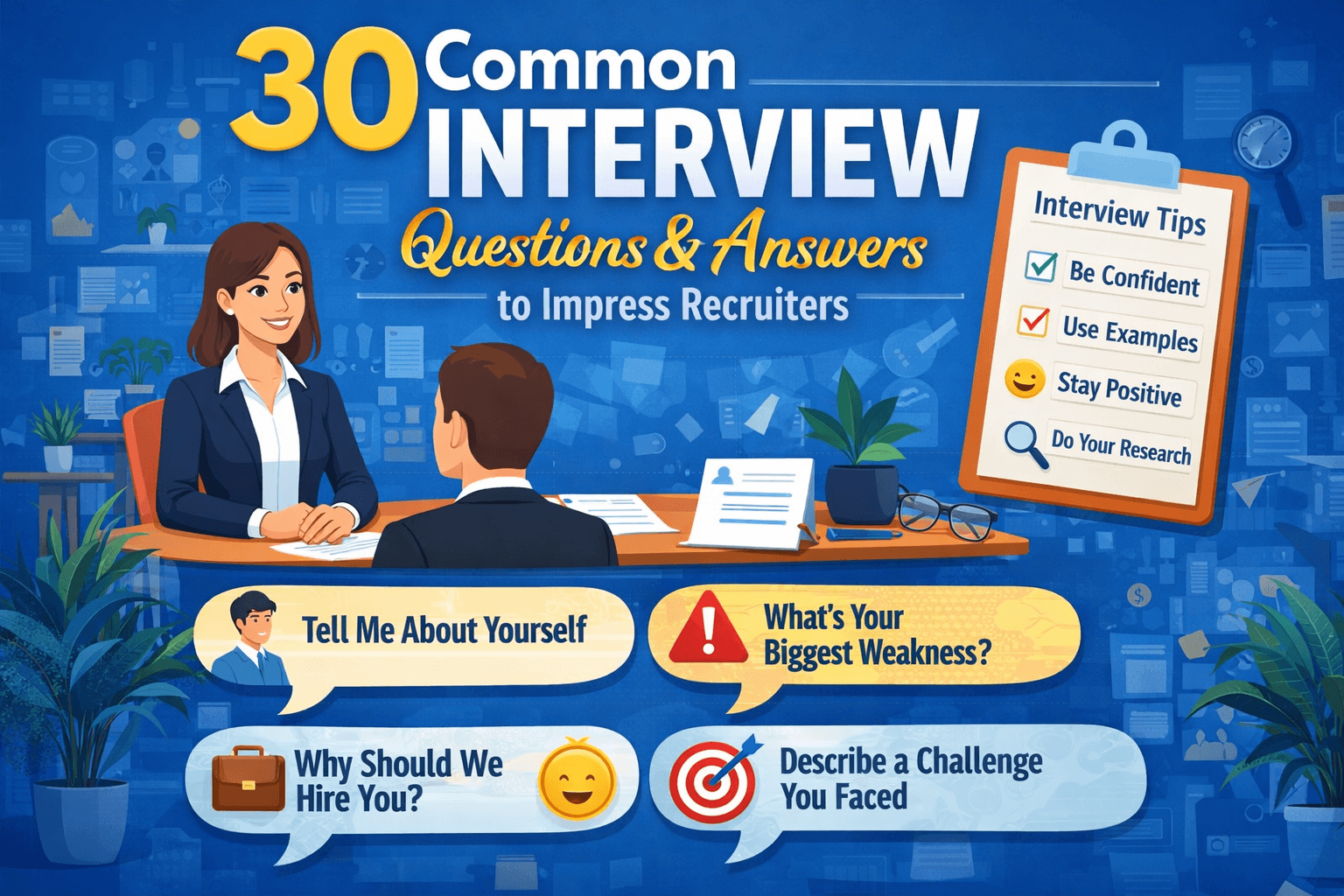
Landing a job interview is already a win, but what truly matters is how you perform when it counts. Many candidates walk in unprepared, assuming their qualifications alone will do the job. In reality, employers are not just evaluating your skills. they’re assessing your mindset, communication, and problem-solving ability by asking interview questions.
That’s exactly why preparing for common interview questions can dramatically increase your chances of success.
In this guide, you’ll find 30 most common interview questions, along with clear, practical, and human-sounding answers that you can adapt to your own experience. Instead of memorizing scripts, you’ll learn how to think, structure, and deliver your responses confidently.
1. Tell Me About Yourself
This is almost always at the top of the interview questions list.
How to answer:
Keep it concise and relevant. Focus on your professional journey, key skills, and current goals.
Example:
“I’m a marketing graduate with two years of experience in digital campaigns. In my previous role, I helped increase social media engagement by 40%. I enjoy working with data and creativity together, and now I’m looking for an opportunity where I can contribute to larger campaigns and grow professionally.”
2. Why Do You Want This Job?
Employers want to know if you’re genuinely interested or just applying everywhere.
Tip: Connect your skills with the company’s needs.
Example:
“I’m excited about this role because it aligns with my experience in project management and my interest in working in a fast-paced environment. I also admire your company’s focus on innovation, which is something I value in my work.”
3. What Are Your Strengths?
Avoid vague answers like “hardworking” without proof.
Example:
“One of my strengths is problem-solving. In my previous role, I identified a workflow issue that was slowing down our team and proposed a solution that reduced task completion time by 20%.”
4. What Is Your Biggest Weakness?
This isn’t a trap—it’s a test of self-awareness.
Example:
“I used to struggle with delegating tasks because I wanted everything to be perfect. However, I’ve learned that trusting team members improves efficiency, and I now focus on clear communication instead.”
5. Why Should We Hire You?
This is your chance to sell yourself confidently.
Example:
“I believe I bring a combination of relevant experience, adaptability, and a strong willingness to learn. I don’t just complete tasks—I look for ways to improve processes and contribute to team success.”
6. Where Do You See Yourself in 5 Years?
Show ambition—but keep it realistic.
Example:
“In five years, I see myself growing within this field, taking on more responsibilities, and possibly leading projects or a team.”
7. Why Did You Leave Your Last Job?
Stay positive—never criticize your previous employer.
Example:
“I was looking for new challenges and opportunities to grow, which my previous role couldn’t fully provide.”
8. Describe a Challenge You Faced
Use the STAR method (Situation, Task, Action, Result).
Example:
“We had a tight deadline for a project (Situation). I was responsible for coordinating tasks (Task). I reorganized priorities and improved communication (Action), which helped us deliver the project on time (Result).”
9. Tell Me About a Failure
Be honest and focus on what you learned.
Example:
“I once underestimated a project timeline, which led to delays. Since then, I’ve improved my planning skills and always include buffer time.”
10. How Do You Handle Stress?
Example:
“I handle stress by staying organized and prioritizing tasks. When things get overwhelming, I break them into smaller steps and focus on one at a time.”
11. What Motivates You?
Example:
“I’m motivated by achieving meaningful results and continuously improving my skills.”
12. How Do You Handle Criticism?
Example:
“I see criticism as an opportunity to grow. I listen carefully, reflect on the feedback, and apply it to improve my performance.”
13. Describe Your Work Style
Example:
“I’m organized, detail-oriented, and collaborative. I like to plan ahead but also stay flexible when priorities change.”
14. Do You Prefer Working Alone or in a Team?
Example:
“I’m comfortable with both. I can work independently when needed, but I also enjoy collaborating and learning from others.”
15. How Do You Prioritize Your Work?
Example:
“I prioritize tasks based on urgency and importance. I often use task lists and deadlines to stay on track.”
16. What Do You Know About Our Company?
Always research beforehand.
Example:
“I know your company focuses on innovation and customer satisfaction. I’ve also seen your recent projects, which are very impressive.”
17. What Are Your Salary Expectations?
Tip: Give a range and stay flexible.
Example:
“I’m open to discussion, but based on my experience and market standards, I’m expecting something in the range of [X–Y].”
18. Are You Willing to Relocate?
Example:
“Yes, I’m open to relocation if the opportunity aligns with my career goals.”
19. How Do You Handle Conflict at Work?
Example:
“I focus on understanding the other person’s perspective and finding a solution that benefits everyone.”
20. What Makes You Unique?
Example:
“I combine analytical thinking with creativity, which helps me approach problems from different angles.”
21. What Are Your Career Goals?
Example:
“My goal is to continuously learn, grow in my field, and take on more responsibilities over time.”
22. Tell Me About a Time You Worked in a Team
Example:
“I worked on a team project where we had different ideas. I helped facilitate discussions, and we reached a solution that worked for everyone.”
23. How Do You Learn New Skills?
Example:
“I learn through online courses, practice, and applying knowledge in real situations.”
24. What Would Your Previous Manager Say About You?
Example:
“They would say I’m reliable, proactive, and always willing to help the team.”
25. How Do You Stay Organized?
Example:
“I use task management tools and set clear deadlines to keep everything organized.”
26. What Are Your Hobbies?
Keep it relevant and positive.
Example:
“I enjoy reading, learning new skills, and staying active.”
27. How Quickly Do You Adapt to Change?
Example:
“I adapt quickly by staying open-minded and focusing on solutions rather than problems.”
28. Do You Have Any Questions for Us?
Always say yes.
Example:
“Yes, I’d love to know more about team culture and growth opportunities in this role.”
29. What Is Your Greatest Achievement?
Example:
“One of my greatest achievements was leading a project that improved efficiency by 30%.”
30. When Can You Start?
Example:
“I can start immediately or after serving my notice period.”
Final Tips to Impress Recruiters
Knowing answers is important—but how you deliver them matters even more.
1. Be Authentic
Don’t try to sound perfect. Be real, clear, and confident.
2. Practice, Don’t Memorize
Understand your answers instead of memorizing them word-for-word.
3. Use Examples
Real experiences make your answers believable and impactful.
4. Maintain Positive Body Language
Smile, maintain eye contact, and sit confidently.
5. Research the Company
This shows genuine interest and gives you an advantage.
Conclusion
Job interviews can feel intimidating—but preparation turns fear into confidence. When you understand the logic behind interview questions, you stop guessing and start answering strategically.
Use these 30 questions as your foundation. Customize your answers, practice them naturally, and walk into your next interview ready to impress.
Because at the end of the day, recruiters aren’t just hiring skills—they’re hiring people who communicate clearly, think effectively, and show potential.