Relocation diffusion is one of the most important concepts in human geography, yet it often feels abstract until you see how it operates in everyday life. From the global spread of cuisines to the movement of languages and cultural traditions, relocation diffusion plays a powerful role in shaping societies.
In this detailed, human-centered guide, you’ll learn what relocation diffusion really means, how it works, how it differs from other types of diffusion, and why it matters in today’s globalized world. Whether you’re a student, researcher, or curious reader, this article will give you a clear and practical understanding of the concept.
What Is Relocation Diffusion?
Relocation diffusion refers to the spread of ideas, cultural traits, innovations, or people when individuals move from one place to another and bring those elements with them.
In simple terms:
When people move, they carry their culture, beliefs, and practices—and these spread to new locations.
Unlike other forms of diffusion, relocation diffusion depends on physical movement. The original area may lose some of the trait, while the new area gains it.
Key Characteristics of Relocation Diffusion
Understanding its core features helps distinguish it from other processes:
1. Movement of People Is Essential
Relocation diffusion only occurs when individuals or groups migrate. Without movement, this type of diffusion does not happen.
2. Trait Travels With the Person
Ideas, customs, languages, or technologies move along with people rather than spreading outward automatically.
3. Origin May Lose Influence
In some cases, the original location may experience a decline in the cultural trait as people leave.
4. New Areas Gain Diversity
The receiving region often becomes more culturally diverse as new elements are introduced.
5. Can Be Local or Global
It can happen:
- Within a country (rural to urban migration)
- Across continents (international migration)
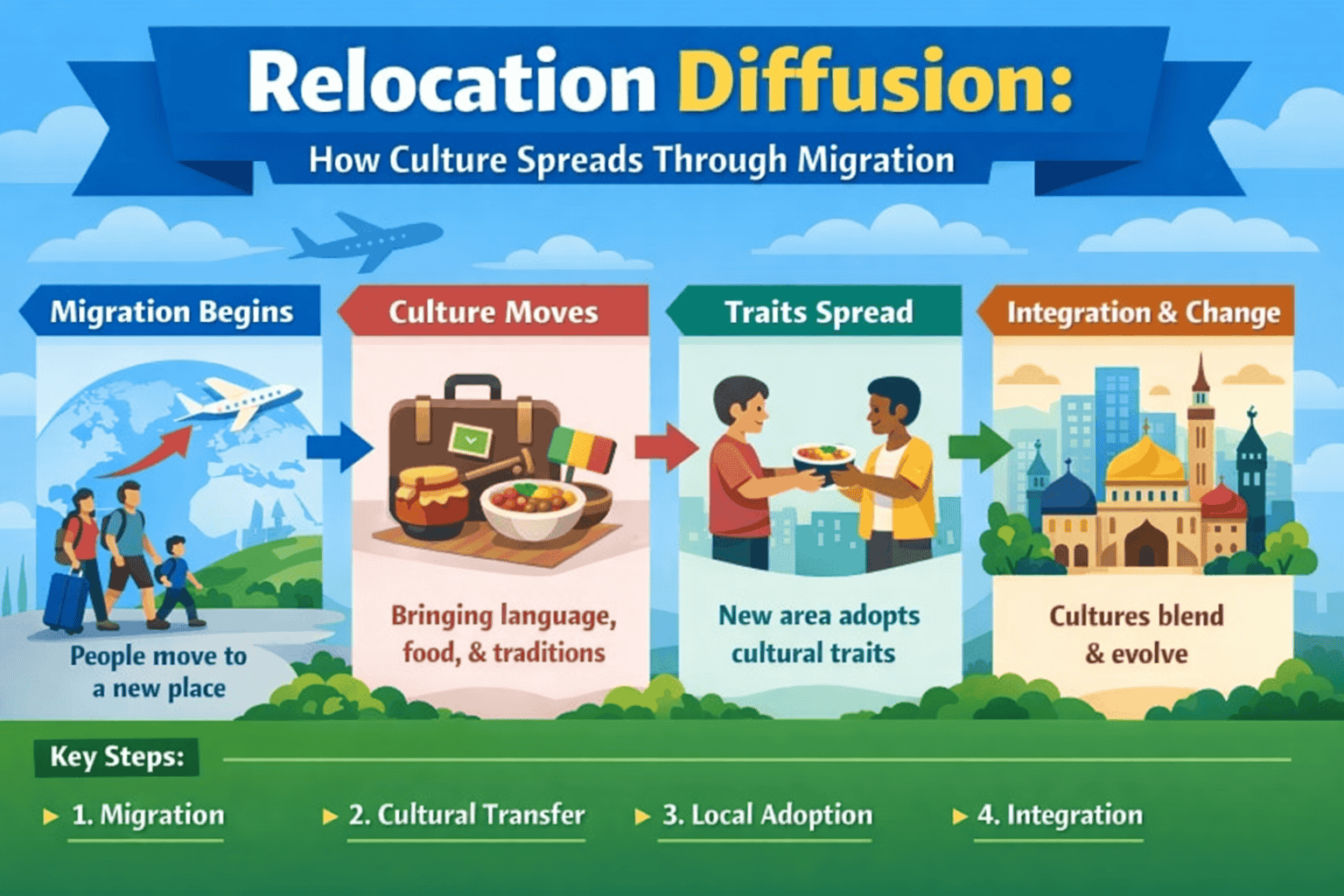
How Relocation Diffusion Works (Step-by-Step)
To understand the process clearly, let’s break it down:
Step 1: Migration Begins
A group of people moves due to reasons like:
- Economic opportunities
- Education
- Conflict or war
- Environmental changes
Step 2: Cultural Traits Travel
Migrants carry:
- Language
- Food habits
- Religious beliefs
- Technology or skills
Step 3: Interaction with New Society
In the new location:
- Locals adopt some traits
- Migrants adapt to local culture
Step 4: Integration and Spread
Over time:
- Cultural exchange occurs
- Traits become part of the local environment
Real-Life Examples of Relocation Diffusion
It is not just a theoretical idea—it shapes the world around us.
1. Spread of Food Cultures
One of the most visible examples is global cuisine:
- Pizza spreading from Italy worldwide
- Sushi becoming popular outside Japan
- South Asian food influencing Western countries
When people migrate, they open restaurants and introduce their traditional dishes.
2. Language Expansion
Languages often spread through migration:
- Spanish across Latin America
- English across North America and beyond
Migrants bring their language, which may become dominant or blend with local dialects.
3. Religious Spread
Relocation diffusion has historically influenced religion:
- Islam spreading through trade and migration
- Christianity expanding through colonization and migration
4. Cultural Traditions
Festivals, clothing styles, and customs travel with people:
- Cultural festivals celebrated globally
- Traditional clothing gaining international recognition
5. Technology and Skills
Migrants often bring expertise:
- Engineers moving to tech hubs
- Medical professionals working abroad
This contributes to knowledge transfer and innovation.
Relocation Diffusion in Human Geography
In human geography, relocation diffusion is a foundational concept used to explain how populations influence spatial patterns.
Geographers analyze:
- Migration routes
- Cultural landscapes
- Population distribution
It helps explain why certain regions have:
- Diverse populations
- Multilingual societies
- Unique cultural blends
Types of Diffusion:
To fully understand relocation diffusion, it’s important to compare it with other types of diffusion.
1. Expansion Diffusion
- Ideas spread outward but remain strong at the origin
- Example: Social media trends
2. Contagious Diffusion
- Rapid, person-to-person spread
- Example: Viral content
3. Hierarchical Diffusion
- Spread through authority or power structures
- Example: Fashion trends promoted by celebrities
4. Relocation Diffusion (Unique Feature)
- Requires physical movement
- Origin may lose the trait
Relocation Diffusion vs Expansion Diffusion
This is one of the most common comparisons in geography.
| Feature | Relocation Diffusion | Expansion Diffusion |
|---|---|---|
| Movement Required | Yes | No |
| Origin Impact | May lose trait | Retains trait |
| Spread Pattern | Discontinuous | Continuous |
| Example | Migration spreading culture | Viral trends |
Understanding this distinction is critical for students and researchers.
Factors That Influence Relocation Diffusion
Not all of it occurs at the same rate. Several factors affect how effectively it spreads:
1. Migration Patterns
The scale and direction of migration determine how far traits spread.
2. Cultural Acceptance
Some societies are more open to new ideas, making diffusion faster.
3. Technology
Modern transportation and communication accelerate diffusion.
4. Government Policies
Immigration laws can either encourage or restrict movement.
5. Economic Opportunities
People move where opportunities exist, spreading their culture along the way.
Impact of Relocation Diffusion on Society
It has both positive and negative effects.
Positive Impacts
1. Cultural Diversity
Cities become multicultural, offering exposure to different traditions.
2. Innovation and Growth
Exchange of ideas leads to creativity and technological progress.
3. Global Connectivity
People develop a broader worldview and understanding.
4. Economic Development
Migrants contribute to labor markets and entrepreneurship.
Negative Impacts
1. Cultural Loss
Original traditions may weaken or disappear over time.
2. Social Tensions
Differences can sometimes lead to conflict or misunderstanding.
3. Brain Drain
Skilled individuals leaving their home country can impact development.
Relocation Diffusion in the Modern World
In today’s globalized era, it is more powerful than ever.
Globalization and Migration
International migration has increased significantly, leading to:
- Cultural blending
- Global cities
- Transnational communities
Digital Influence
Even though relocation diffusion requires movement, technology enhances its impact:
- Migrants stay connected with their origin
- Cultural content spreads faster online
Urbanization
Cities act as hubs where relocation diffusion thrives:
- Diverse populations
- Cultural exchange
- Innovation centers
Case Studies:
Case Study 1: Food Globalization
Immigrant communities introduce traditional cuisines, which then become mainstream.
Case Study 2: Language Spread
Colonial migration spread languages across continents, shaping modern societies.
Case Study 3: Cultural Festivals
Festivals celebrated by migrant communities often gain popularity in host countries.
Why Relocation Diffusion Matters
It is more than just an academic concept—it explains real-world changes.
1. Helps Understand Cultural Change
It shows how traditions evolve and adapt.
2. Explains Population Patterns
Migration trends shape demographics and urban development.
3. Supports Policy Making
Governments use this understanding for:
- Immigration policies
- Urban planning
- Cultural integration
4. Enhances Global Awareness
Understanding diffusion fosters tolerance and appreciation of diversity.
Common Misconceptions:
Misconception 1: It Only Happens Internationally
Reality: It can occur within a country as well.
Misconception 2: It Always Benefits Society
Reality: It has both positive and negative effects.
Misconception 3: It Replaces Local Culture Completely
Reality: Most of the time, cultures blend rather than replace.
Practical Applications:
Relocation diffusion is applied in multiple fields:
Education
Students learn about migration and cultural change.
Business
Companies adapt products for new cultural markets.
Urban Planning
Cities design infrastructure for diverse populations.
Sociology
Researchers study cultural interactions and identity.
How to Identify Relocation Diffusion in Real Life
Ask yourself these questions:
- Did people physically move?
- Did they bring cultural traits with them?
- Is the new area influenced by those traits?
If the answer is yes, you’re likely observing it.
Tips for Students:
If you’re learning this concept for exams:
1. Focus on Definitions
Understand the core meaning clearly.
2. Use Real-Life Examples
Examples make answers stronger and easier to remember.
3. Compare with Other Diffusion Types
Examiners often ask for comparisons.
4. Practice Case Studies
They help develop analytical skills.
Future of Relocation Diffusion
As the world becomes more connected:
- Migration will continue to increase
- Cultural exchange will intensify
- Hybrid identities will become more common
Relocation diffusion will remain a key force shaping global society.
Conclusion
Relocation diffusion is a powerful process that explains how ideas, cultures, and innovations spread through the movement of people. From food and language to religion and technology, its impact is visible everywhere.
By understanding it, you gain insight into:
- Cultural diversity
- Global connections
- Social and economic change
In a rapidly changing world, this concept helps you make sense of how societies evolve and interact.