Human memory is not a single, unified system. it’s a complex network that helps us store, organize, and retrieve different types of information. Among these systems, semantic memory plays a central role in how we understand the world. It allows us to recognize words, concepts, facts, and meanings without recalling when or where we learned them.
In this detailed guide, you’ll learn what semantic memory is, how it works, real-life examples, why it matters, and how you can strengthen it for better learning and thinking.
What Is Semantic Memory?
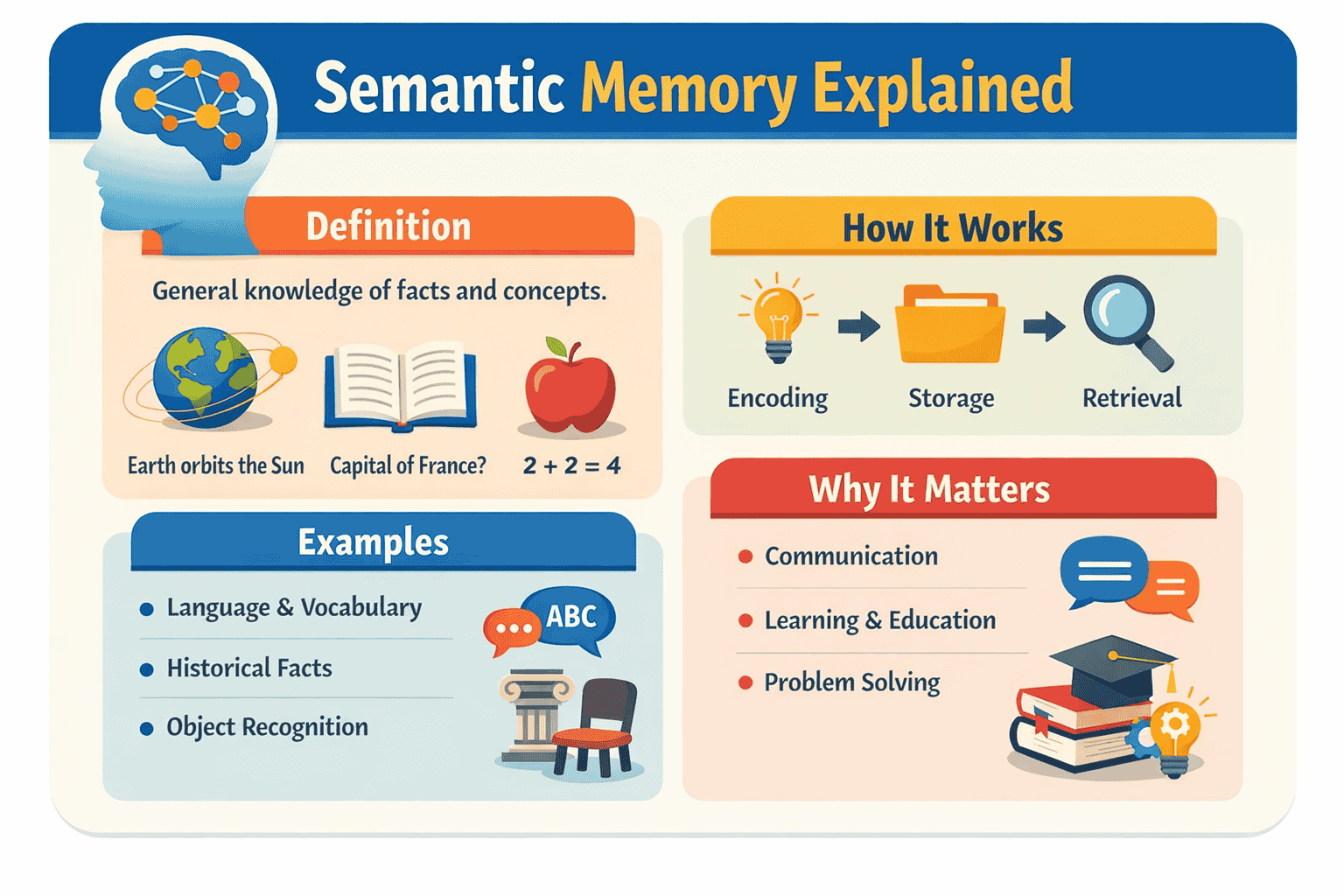
It is a type of long-term memory that stores general knowledge about the world. This includes facts, meanings, concepts, and information that are not tied to personal experiences.
For example:
- Knowing that the Earth revolves around the Sun
- Understanding that a “dog” is an animal
- Recognizing that Paris is the capital of France
You don’t remember when you first learned these facts—they simply exist in your knowledge base. In other words, we can call it screen memory.
Semantic Memory vs Other Types of Memory
To understand it better, it’s important to compare it with other memory systems.
1. Semantic Memory vs Episodic Memory
- Semantic memory: Stores facts and general knowledge
- Episodic memory: Stores personal experiences and events
Example:
- Semantic: “Water boils at 100°C”
- Episodic: “I remember boiling water for tea yesterday”
👉 In short, screen memory is about knowing, while episodic memory is about remembering experiences.
2. Semantic Memory vs Procedural Memory
- Semantic memory: Facts and concepts
- Procedural memory: Skills and actions
Example:
- Semantic: Knowing what a bicycle is
- Procedural: Knowing how to ride a bicycle
Key Characteristics of Semantic Memory
It has several unique features that make it essential for daily life:
1. It Is Not Time-Based
Unlike episodic memory, it doesn’t store when or where information was learned.
2. It Is Organized Conceptually
Information is stored in networks of related ideas. For instance, the concept of “fruit” connects to apples, bananas, and oranges.
3. It Is Stable and Long-Lasting
Semantic knowledge tends to remain stable over time, although it can be updated with new information.
4. It Supports Language and Communication
Without screen memory, understanding words, sentences, and meanings would be impossible.
Real-Life Examples of Semantic Memory
To make things clearer, here are practical examples from our everyday life:
Everyday Knowledge
- Knowing your country’s name
- Recognizing traffic signals
- Understanding basic math (e.g., 2 + 2 = 4)
Language and Vocabulary
- Knowing the meaning of words
- Understanding grammar rules
- Recognizing synonyms and antonyms
General Facts
- Historical dates and events
- Scientific concepts
- Cultural knowledge
Object Recognition
- Identifying common objects like a chair or phone
- Knowing what tools are used for specific tasks
How Semantic Memory Works
It operates through a network-like structure in the brain, where related concepts are connected.
1. Encoding
First, information is learned and processed. This happens when you read, listen, or observe something.
2. Storage
The brain organizes information into categories and relationships. For example, animals are grouped separately from vehicles.
3. Retrieval
When needed, the brain retrieves stored knowledge quickly and efficiently.
👉 For instance, when someone asks, “What is the capital of Italy?” your brain instantly retrieves “Rome” without effort.
The Role of Semantic Memory in Learning
It is the foundation of education and intellectual growth.
1. Helps You Understand Concepts
Without screen memory, learning new topics would be extremely difficult because you wouldn’t have a knowledge base to build upon.
2. Improves Reading Comprehension
Understanding language depends heavily on stored meanings and vocabulary.
3. Supports Problem-Solving
You use previously learned facts to analyze and solve problems.
4. Enables Knowledge Transfer
It allows you to apply learned information in new situations.
Importance of Semantic Memory
it is not just useful—it’s essential for daily functioning and long-term success.
1. Enables Communication
You rely on screen memory to understand and use language effectively.
2. Builds Intelligence
General knowledge contributes to reasoning, decision-making, and critical thinking.
3. Supports Academic Success
Students depend on semantic memory to retain and recall information across subjects.
4. Helps Navigate Daily Life
From recognizing signs to understanding instructions, screen memory is constantly at work.
Semantic Memory in the Brain
It is primarily associated with specific areas of the brain:
1. Temporal Lobes
These regions play a key role in storing and processing factual knowledge.
2. Hippocampus
While mainly linked to episodic memory, it also helps in forming new semantic memories.
3. Prefrontal Cortex
This area assists in retrieving and organizing stored information.
👉 Together, these regions form a network that allows you to access knowledge instantly.
How Semantic Memory Develops
It evolves over time through learning and experience.
Childhood
Children begin forming semantic memory as they learn language, recognize objects, and understand basic concepts.
Adolescence
Knowledge expands through education and social interactions.
Adulthood
Screen memory becomes more refined and detailed, supported by continuous learning.
Common Issues with Semantic Memory
Although it is stable, it can be affected under certain conditions.
1. Aging
Older adults may experience slower retrieval of information, although core knowledge often remains intact.
2. Brain Injuries
Damage to certain brain regions can impair the ability to recall facts.
3. Neurological Disorders
Conditions like dementia can significantly affect screen memory.
How to Improve Semantic Memory
The good news is that it can be strengthened with the right strategies.
1. Active Learning
Engage deeply with information rather than passively reading.
2. Use Association Techniques
Link new knowledge to existing concepts to create stronger connections.
3. Practice Retrieval
Test yourself regularly instead of just reviewing notes.
4. Read Widely
Exposure to diverse topics enhances your knowledge base.
5. Teach Others
Explaining concepts helps reinforce your understanding.
6. Use Visual Aids
Mind maps and diagrams help organize information effectively.
Semantic Memory and Language
It is closely tied to language development.
- It helps you understand word meanings
- It allows you to form sentences
- It supports comprehension of complex ideas
Without screen memory, communication would break down completely.
Semantic Memory in Education
Teachers and educators rely heavily on it’s principles to improve learning outcomes.
Effective Teaching Strategies:
- Repetition and reinforcement
- Concept mapping
- Context-based learning
- Real-world examples
These techniques help students store and retrieve information more effectively.
Semantic Memory vs General Knowledge
Although often used interchangeably, semantic memory is the system, while general knowledge is the content stored within that system.
Think of it as a library, and general knowledge as the books inside it.
Future of Semantic Memory Research
Researchers continue to explore how it works and how it can be improved.
Emerging areas include:
- Artificial intelligence and knowledge systems
- Brain-computer interfaces
- Cognitive enhancement techniques
These advancements could revolutionize how we learn and retain information.
Final Thoughts
Semantic Memory is one of the most powerful tools your brain possesses. It allows you to understand language, process information, and interact with the world meaningfully. From simple facts to complex concepts, this memory system shapes how you think, learn, and communicate.
By understanding how it works and applying effective strategies to strengthen it, you can significantly improve your learning ability, decision-making skills, and overall cognitive performance.
Key Takeaways
- It stores facts, meanings, and general knowledge
- It is different from episodic and procedural memory
- It plays a crucial role in learning, communication, and problem-solving
- It is organized in networks of related concepts
- It can be improved through active learning and practice