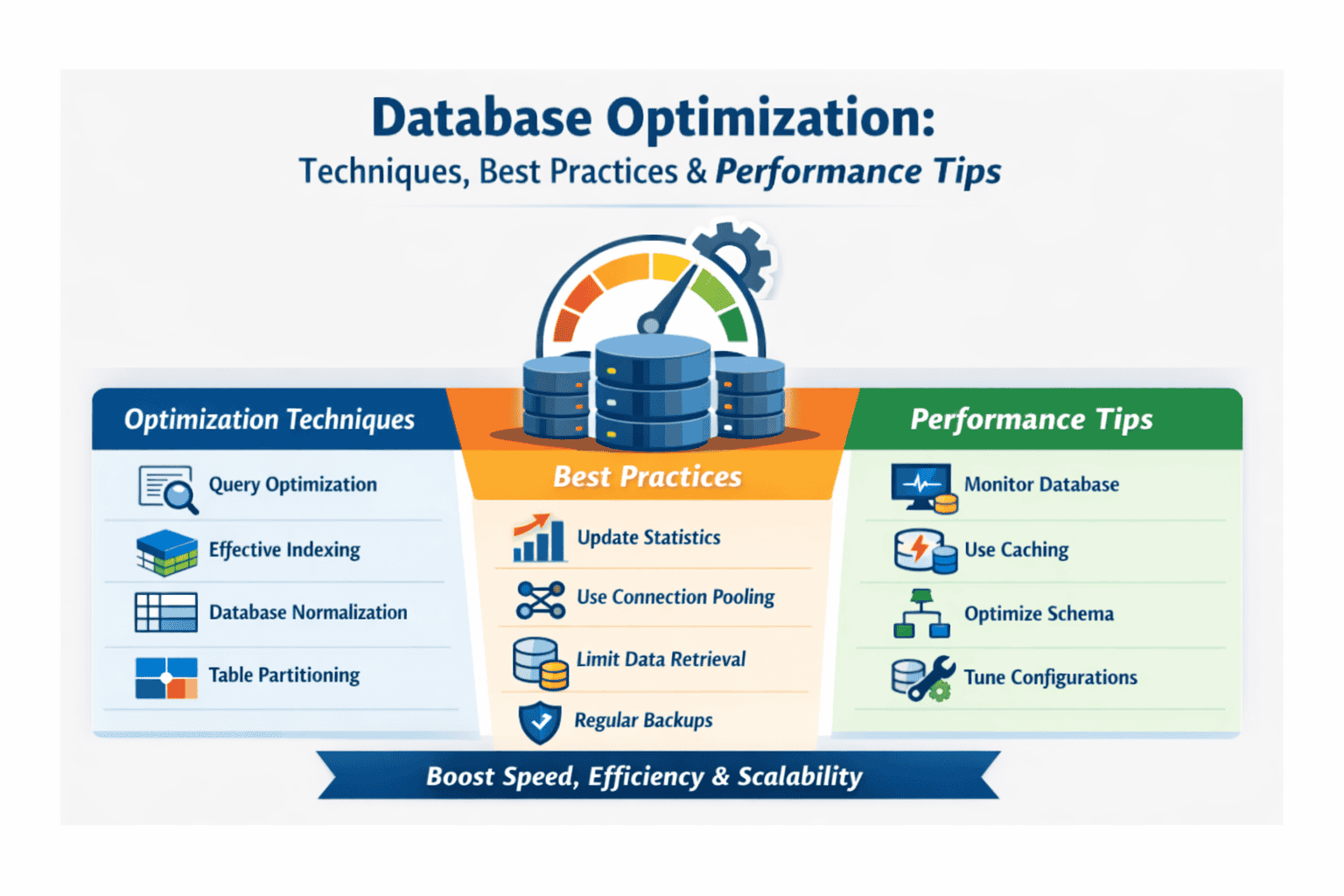
In today’s data-driven world, speed and efficiency are critical. Whether you’re running a small website or managing enterprise-level applications, your database performance directly impacts user experience, scalability, and overall success. This is where database optimization becomes essential.
Simply put, it ensures that your database runs efficiently, retrieves data quickly, and handles increasing workloads without slowing down. In this comprehensive guide, you’ll learn what database optimization is, why it matters, and the most effective techniques and best practices to improve performance.
What Is Database Optimization?
Database optimization is the process of improving the performance, efficiency, and speed of a database system. It involves refining queries, indexing data, structuring tables properly, and managing resources to ensure smooth operations.
In other words, it focuses on:
- Faster query execution
- Reduced resource usage
- Improved scalability
- Better user experience
Without proper database optimization, even powerful systems can become slow, unresponsive, and inefficient.
Why Database Optimization Is Important
Before diving into techniques, it’s important to understand why it matters.
1. Improves Performance
First and foremost, database optimization significantly reduces query execution time. Faster queries mean quicker responses for users.
2. Enhances User Experience
When your application loads quickly, users are more likely to stay engaged. On the other hand, slow databases often lead to higher bounce rates.
3. Supports Scalability
As your data grows, optimized databases can handle increased traffic without performance degradation.
4. Reduces Costs
Efficient databases use fewer system resources, which lowers infrastructure and maintenance costs.
Key Components of Database Optimization
To implement it effectively, you need to understand its core components.
1. Query Optimization
Query optimization involves writing efficient SQL queries that retrieve data quickly.
2. Indexing
Indexes help the database find data faster, similar to an index in a book.
3. Data Structure Design
Well-designed tables and relationships improve data retrieval and storage efficiency.
4. Hardware and Configuration
Optimizing server resources such as memory, CPU, and storage also plays a major role.
Top Database Optimization Techniques
Now, let’s explore practical techniques you can apply to improve performance.
1. Optimize SQL Queries
One of the most effective database optimization strategies is improving your SQL queries.
Best Practices:
- Avoid using
SELECT * - Retrieve only necessary columns
- Use proper filtering with
WHEREclauses - Limit results using
LIMIT
👉 For example, instead of:
SELECT * FROM users;
Use:
SELECT name, email FROM users WHERE status = 'active';
As a result, your queries become faster and more efficient.
2. Use Indexing Effectively
Indexing is a cornerstone of database optimization. It allows the database to locate data quickly without scanning entire tables.
Types of Indexes:
- Primary Index
- Secondary Index
- Composite Index
However, while indexes improve read performance, too many indexes can slow down write operations. Therefore, balance is key.
3. Normalize Your Database
Normalization organizes data to reduce redundancy and improve consistency.
Benefits:
- Eliminates duplicate data
- Improves data integrity
- Enhances query efficiency
However, excessive normalization can lead to complex queries. In such cases, partial denormalization may be useful.
4. Denormalization for Performance
Although normalization is important, sometimes denormalization improves performance.
When to Use:
- Frequent read operations
- Complex joins causing slow queries
By combining tables, you can reduce the need for joins and speed up data retrieval.
5. Optimize Database Schema
A well-structured schema is crucial for database optimization.
Tips:
- Use appropriate data types
- Avoid unnecessary columns
- Define relationships clearly
For instance, using INT instead of VARCHAR for numeric data improves performance.
6. Implement Caching
Caching reduces the load on your database by storing frequently accessed data.
Benefits:
- Faster data retrieval
- Reduced database queries
- Improved application performance
Popular caching methods include in-memory caching and distributed caching systems.
7. Use Proper Database Index Maintenance
Over time, indexes can become fragmented, which reduces performance.
Maintenance Techniques:
- Rebuild indexes
- Reorganize indexes
- Monitor index usage
Regular maintenance ensures your database optimization efforts remain effective.
8. Partition Large Tables
Partitioning divides large tables into smaller, manageable parts.
Advantages:
- Faster query performance
- Easier data management
- Improved scalability
For example, you can partition data by date or region.
9. Monitor and Analyze Performance
Continuous monitoring is essential for effective database optimization.
Tools and Methods:
- Query performance analysis
- Execution plans
- Database logs
By analyzing performance metrics, you can identify bottlenecks and resolve them quickly.
10. Optimize Database Configuration
Database configuration settings can significantly impact performance.
Key Areas:
- Memory allocation
- Connection pooling
- Disk I/O optimization
Proper configuration ensures efficient resource utilization.
Database Optimization Best Practices
In addition to techniques, following best practices ensures long-term success.
1. Regularly Update Statistics
Database engines rely on statistics to optimize query execution plans. Keeping them updated improves accuracy and performance.
2. Avoid Over-Indexing
Although indexing is important, excessive indexes can slow down insert and update operations.
3. Use Connection Pooling
Connection pooling reduces the overhead of creating new database connections, improving efficiency.
4. Optimize Joins
Joins are often performance bottlenecks.
Tips:
- Use indexed columns in joins
- Avoid unnecessary joins
- Use appropriate join types
5. Limit Data Retrieval
Fetching large datasets unnecessarily slows down performance. Always retrieve only what you need.
6. Perform Regular Backups
Although backups don’t directly improve performance, they ensure data safety and system reliability.
Common Database Optimization Mistakes
Even experienced developers can make mistakes. Here are some common ones to avoid:
1. Ignoring Indexing
Failing to use indexes leads to slow queries.
2. Poor Query Design
Inefficient queries can drastically reduce performance.
3. Overloading the Database
Running too many operations simultaneously can overwhelm the system.
4. Lack of Monitoring
Without monitoring, performance issues go unnoticed.
Database Optimization for Different Systems
Different database systems require tailored optimization strategies.
1. SQL Databases
Focus on indexing, query optimization, and normalization.
2. NoSQL Databases
Optimize data models and distribution strategies.
3. Cloud Databases
Leverage auto-scaling, caching, and managed services.
How Database Optimization Improves Scalability
As your application grows, database optimization becomes even more critical.
Key Benefits:
- Handles increased traffic
- Maintains consistent performance
- Reduces downtime
By implementing scalable optimization techniques, you ensure long-term success.
Future Trends in Database Optimization
The field of database optimization continues to evolve.
Emerging Trends:
- AI-driven query optimization
- Automated performance tuning
- Cloud-native database solutions
These innovations are making it more efficient and accessible.
Practical Example of Database Optimization
Let’s consider a real-world scenario.
Problem:
A website experiences slow loading times due to large database queries.
Solution:
- Add indexes to frequently searched columns
- Optimize SQL queries
- Implement caching
Result:
Faster load times and improved user experience
Final Thoughts
Database optimization is not a one-time task—it’s an ongoing process that ensures your database performs efficiently under all conditions. By applying the right techniques, following best practices, and continuously monitoring performance, you can significantly improve speed, scalability, and reliability.
Whether you’re a beginner or an experienced developer, mastering this skillset will give you a strong advantage in building high-performing applications.
Key Takeaways
- Database optimization improves speed, efficiency, and scalability
- Query optimization and indexing are fundamental techniques
- Proper schema design enhances performance
- Monitoring and maintenance are essential for long-term success
- Avoid common mistakes like over-indexing and poor query design