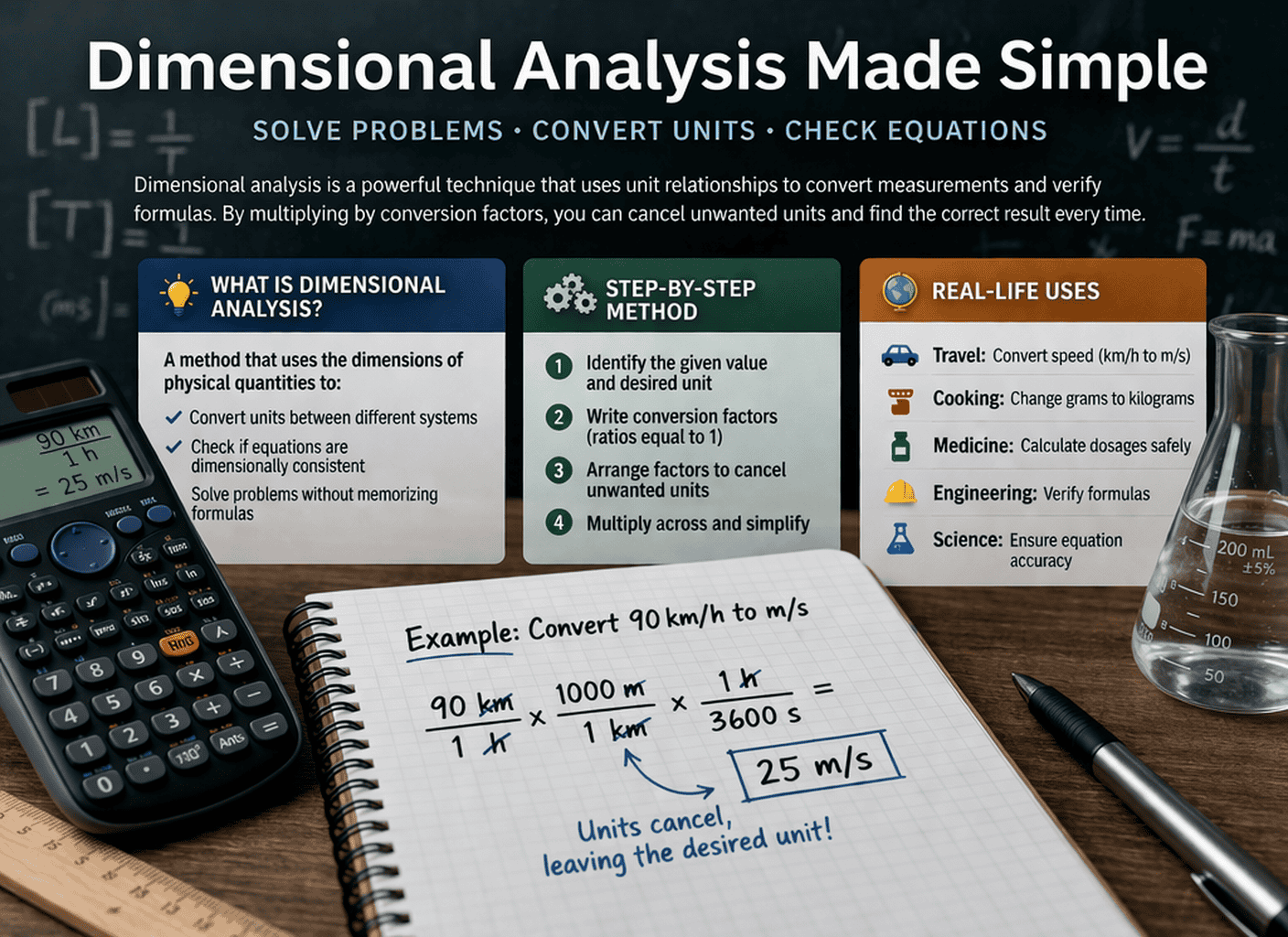
Dimensional analysis is one of the most powerful problem-solving tools in science and mathematics. Whether you’re converting units, checking equations, or solving complex physics problems, this method helps you stay accurate and confident.
In this detailed, easy-to-understand guide, you’ll learn what dimensional analysis is, why it matters, and how to use it step by step—with real-life examples, worked problems, and practice exercises.
🧠 What Is Dimensional Analysis?
Dimensional analysis is a mathematical technique used to convert units and check the consistency of equations. It involves multiplying quantities by conversion factors so that unwanted units cancel out, leaving only the desired unit.
📌 Simple Definition:
Dimensional analysis is the process of using unit relationships to solve problems and verify equations.
🌍 Why Dimensional Analysis Is Important
Dimensional analysis plays a critical role in subjects like physics, chemistry, and engineering. Here’s why it matters:
- ✅ Ensures accurate unit conversions
- ✅ Helps verify correct formulas
- ✅ Reduces calculation errors
- ✅ Builds strong problem-solving skills
- ✅ Applies to real-life scenarios (travel, cooking, science, etc.)
🔑 Key Concepts You Must Understand
Before diving into examples, let’s cover the basics.
1. Units and Dimensions
- Units: Measurement standards (meter, second, kilogram)
- Dimensions: Nature of a quantity (length, time, mass)
For example:
- Speed → meters/second → dimension: length/time
2. Conversion Factors
A conversion factor is a ratio equal to 1, used to convert units.
Example:
- 1 km = 1000 m
- Conversion factor:
- 1000 m / 1 km OR 1 km / 1000 m
3. Unit Cancellation
The goal is to cancel unwanted units.
Example:1km1000m×5km=5000m
“km” cancels out → leaving meters.
⚙️ Step-by-Step Method of Dimensional Analysis
Follow these simple steps:
1: Identify given and required units
2: Write conversion factors
3: Arrange them to cancel unwanted units
4: Multiply and simplify
📊 Worked Examples (Step-by-Step)
Let’s make this crystal clear with practical examples.
✅ Example 1: Convert Kilometers to Meters
Problem: Convert 7 km to meters
Solution:7km×1km1000m=7000m
✔ Final Answer: 7000 meters
✅ Example 2: Convert Hours to Seconds
Problem: Convert 2 hours into seconds
Solution:2hr×1hr60min×1min60s=7200s
✔ Final Answer: 7200 seconds
✅ Example 3: Speed Conversion
Problem: Convert 90 km/h to m/s
Solution:90×36001000=25m/s
✔ Final Answer: 25 m/s
✅ Example 4: Real-Life Cooking Example
Problem: A recipe needs 500 grams of flour. Convert it into kilograms.500g×1000g1kg=0.5kg
✔ Final Answer: 0.5 kg
✅ Example 5: Fuel Efficiency
Problem: Convert 15 km/l to m/km15km/l=15000m/l
✔ Demonstrates how units shift depending on context.
🌟 Real-Life Applications of Dimensional Analysis
Dimensional analysis isn’t just academic—it’s everywhere.
🚗 1. Travel and Speed
- Converting km/h to m/s
- Calculating travel time
🍳 2. Cooking
- Grams to kilograms
- Liters to milliliters
🏥 3. Medicine
- Dosage calculations
- Unit conversions (mg, ml)
🏗️ 4. Engineering
- Checking formulas
- Designing systems with correct measurements
🌍 5. Science Experiments
- Ensuring equations are dimensionally correct
- Avoiding unit errors
⚠️ Common Mistakes to Avoid
Even though dimensional analysis is simple, students often make mistakes:
❌ 1. Wrong Conversion Factor Direction
Always ensure units cancel properly.
❌ 2. Skipping Steps
Write each step clearly to avoid confusion.
❌ 3. Ignoring Units
Units are just as important as numbers.
❌ 4. Mixing Unit Systems
Avoid mixing SI and non-SI units without conversion.
🧠 Dimensional Analysis in Physics and Chemistry
Dimensional analysis is widely used in:
🔬 Physics
- Checking equations like force:
F=ma
⚗️ Chemistry
- Mole conversions
- Concentration calculations
🎯 Advanced Concept: Dimensional Consistency
A valid equation must have same dimensions on both sides.
Example:Distance=Speed×Time
LHS → Length
RHS → Length/Time × Time = Length ✔
📝 Practice Problems (With Answers)
Test your understanding with these problems.
🔹 Problem 1
Convert 5 km to meters
✔ Answer: 5000 m
🔹 Problem 2
Convert 3 hours into seconds
✔ Answer: 10,800 s
🔹 Problem 3
Convert 72 km/h into m/s
✔ Answer: 20 m/s
🔹 Problem 4
Convert 2500 grams into kilograms
✔ Answer: 2.5 kg
🔹 Problem 5
A car travels at 60 km/h. How many meters per second?
✔ Answer: 16.67 m/s
🧩 Practice Challenge (Try Yourself)
- Convert 120 minutes into seconds
- Convert 10 m/s into km/h
- Convert 2.5 liters into milliliters
- Convert 5000 mg into grams
✔ Answers:
- 7200 s
- 36 km/h
- 2500 ml
- 5 g
💡 Tips to Master Dimensional Analysis
- ✔ Always write units clearly
- ✔ Use step-by-step conversions
- ✔ Practice daily with real-life examples
- ✔ Double-check unit cancellation
- ✔ Understand concepts—not just formulas
🧠 Expert Insight
Dimensional analysis is not just a beginner tool. it’s a fundamental scientific method used by professionals. Scientists and engineers rely on it to validate equations, design experiments, and avoid costly errors.
For example, one famous engineering failure (NASA’s Mars Climate Orbiter) happened due to unit conversion errors, highlighting the real-world importance of mastering this concept.
🚀 Final Thoughts
Dimensional analysis is simple, logical, and incredibly useful. Once you understand how units cancel and conversion factors work, you can solve almost any unit-related problem with ease.
Instead of memorizing formulas blindly, this method empowers you to think critically and solve problems step by step.
So keep practicing, apply it in real life, and you’ll master it in no time.