Understanding the concept of congruence is a cornerstone in mathematics, especially in geometry. Whether you’re a student learning shapes for the first time or someone revising key concepts, mastering congruent helps you build a strong foundation for more advanced topics.
This guide will break everything down in a simple, clear, and practical way. You’ll learn what congruence means, how to identify it’s shapes, the rules behind it, and how to apply it in real-life and exam problems.
What Does “Congruent” Mean?
In mathematics, It means exactly equal in shape and size.
Two objects are congruent if one can be placed on top of the other and match perfectly, without any resizing or distortion.
Simple Definition:
Two figures are congruent if they have the same shape and the same dimensions.
Key Idea:
- Same shape ✅
- Same size ✅
- Orientation (rotation/flip) does NOT matter ❗
Real-Life Examples of Congruence
Before diving into formulas and rules, let’s connect this concept to everyday life.
1. Coins
Two coins of the same denomination (e.g., two identical 10-rupee coins) are congruent.
2. Printed Photos
If you print the same photo twice in the same size, both copies are congruent.
3. Floor Tiles
Tiles used in flooring are usually congruent to ensure a perfect pattern.
4. Playing Cards
All cards in a deck have identical size and shape → congruent rectangles.
Congruent Shapes in Geometry
Congruence is most commonly used when studying geometric shapes.
Types of Congruent Shapes:
- triangles
- rectangles
- circles
- polygons
Important Note:
Even if shapes are rotated, flipped, or moved, they can still be it as long as size and shape remain unchanged.
Congruent vs Equal: What’s the Difference?
This is a common confusion.
| Term | Meaning |
|---|---|
| Equal | Same value (usually numbers) |
| Congruent | Same shape and size (usually figures) |
Example:
- Two lines of length 5 cm → equal and congruent
- Two shapes with same area but different shapes → equal but NOT congruent
Congruent Triangles
Triangles are the most important shapes when studying congruence.
Definition:
Two triangles are congruent if all their corresponding sides and angles are equal.
Notation:
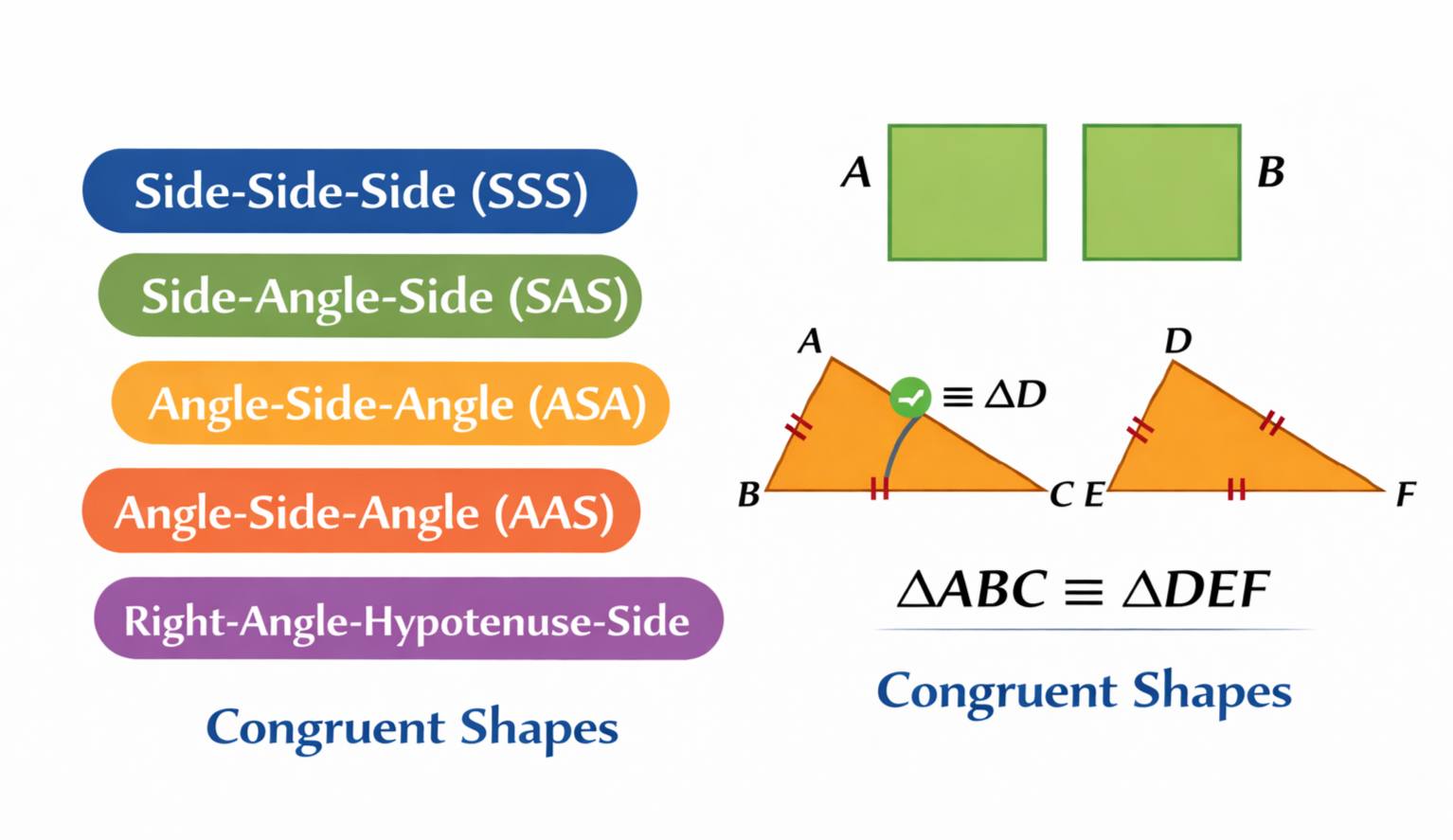
If triangle ABC is congruent to triangle DEF, we write:
△ABC ≅ △DEF
Rules for Triangle Congruence
Instead of checking all sides and angles every time, mathematicians developed shortcut rules.
1. SSS (Side-Side-Side)
If all three sides of one triangle equal the three sides of another triangle, they are congruent.
✔ Example:
- AB = DE
- BC = EF
- CA = FD
→ Triangles are congruent
2. SAS (Side-Angle-Side)
If two sides and the included angle are equal, triangles are congruent.
✔ Example:
- AB = DE
- ∠B = ∠E
- BC = EF
3. ASA (Angle-Side-Angle)
If two angles and the included side are equal.
✔ Example:
- ∠A = ∠D
- AB = DE
- ∠B = ∠E
4. AAS (Angle-Angle-Side)
If two angles and a non-included side are equal.
5. RHS (Right Angle-Hypotenuse-Side)
Used only for right-angled triangles.
✔ If:
- Right angle = right angle
- Hypotenuse = hypotenuse
- One side = one side
→ Triangles are congruent
Why Congruence Matters
Understanding congruence is not just about passing exams. It has real applications.
1. Construction & Engineering
Engineers rely on congruent parts to ensure stability and precision.
2. Architecture
Buildings require identical shapes and measurements for symmetry and balance.
3. Manufacturing
Machines produce congruent components for assembly lines.
4. Computer Graphics
Designing identical objects in animations and games uses congruence principles.
Congruent Transformations
Congruence is closely linked to transformations in geometry.
These transformations preserve congruence:
1. Translation
Sliding a shape without rotating or resizing.
2. Rotation
Turning a shape around a fixed point.
3. Reflection
Flipping a shape across a line (mirror image).
Key Insight:
These transformations do not change size or shape, so the figure remains congruent.
Congruent Circles
Two circles are congruent if they have the same radius.
Example:
- Circle A radius = 5 cm
- Circle B radius = 5 cm
→ Congruent circles
Congruent Rectangles
Rectangles are congruent if:
- Lengths are equal
- Widths are equal
Example:
- Rectangle 1: 10 × 5
- Rectangle 2: 10 × 5
→ Congruent
How to Prove Shapes Are Congruent
Step-by-Step Approach:
- Identify corresponding parts
- Compare sides and angles
- Apply a congruence rule (SSS, SAS, etc.)
- Write a proper statement
Worked Examples
Example 1: Triangle Congruence
Given:
- AB = DE
- BC = EF
- AC = DF
Solution:
All three sides match → SSS rule applies
✔ Conclusion:
△ABC ≅ △DEF
Example 2: Angle-Based Congruence
Given:
- ∠A = ∠D
- ∠B = ∠E
- AB = DE
Solution:
Two angles and included side → ASA rule
✔ Conclusion:
Triangles are congruent
Example 3: Real-Life Shape Matching
You have two tiles:
- Same size
- Same shape
✔ They are congruent, even if rotated differently.
Practice Problems
Try solving these to test your understanding.
Problem 1
Two triangles have:
- Two equal sides
- Included angle equal
Which rule applies?
👉 Answer: SAS
Problem 2
Two circles have different radii. Are they congruent?
👉 Answer: No
Problem 3
Two rectangles have same area but different dimensions. Are they congruent?
👉 Answer: No
Common Mistakes to Avoid
1. Confusing Similar with Congruent
- Similar: Same shape, different size
- Congruent: Same shape AND size
2. Ignoring Orientation
Rotation or flipping does NOT affect congruence.
3. Using Wrong Rules
Always ensure the correct order of sides and angles.
Congruent vs Similar Shapes
| Feature | Congruent | Similar |
|---|---|---|
| Shape | Same | Same |
| Size | Same | Different allowed |
| Scale Factor | 1 | Not equal to 1 |
Visualizing Congruence (Mental Trick)
Imagine cutting a shape out of paper:
- If it fits perfectly over another → congruent
- If it needs resizing → not congruent
Advanced Insight: Congruence in Algebra
Congruence also appears in number theory.
Example:
a ≡ b (mod n)
This means:
a and b leave the same remainder when divided by n.
✔ Example:
17 ≡ 5 (mod 12)
Summary
Let’s quickly recap everything:
- Congruent means same shape and same size
- Orientation doesn’t matter (rotation/flip allowed)
- Triangle congruence rules:
- SSS, SAS, ASA, AAS, RHS
- Congruence is used in real life (engineering, design, etc.)
- Congruent ≠ similar
Final Thoughts
Congruence is one of the most fundamental ideas in geometry. Once you truly understand it, many other concepts—like similarity, symmetry, and transformations—become much easier.
Instead of memorizing rules, focus on visual understanding. Ask yourself:
“Can one shape perfectly fit over the other?”
If yes—you’ve found congruence.