Language is more than just a tool for communication, it’s a powerful way to express emotions, create vivid imagery, and connect with readers on a deeper level. That’s where figurative language comes in. Instead of using words in their literal sense, figurative language adds creativity, color, and depth to writing and speech.
In this detailed guide, you’ll learn what figurative language is, why it matters, and how to use different types effectively—with clear explanations and practical examples you can apply immediately.
What Is Figurative Language?
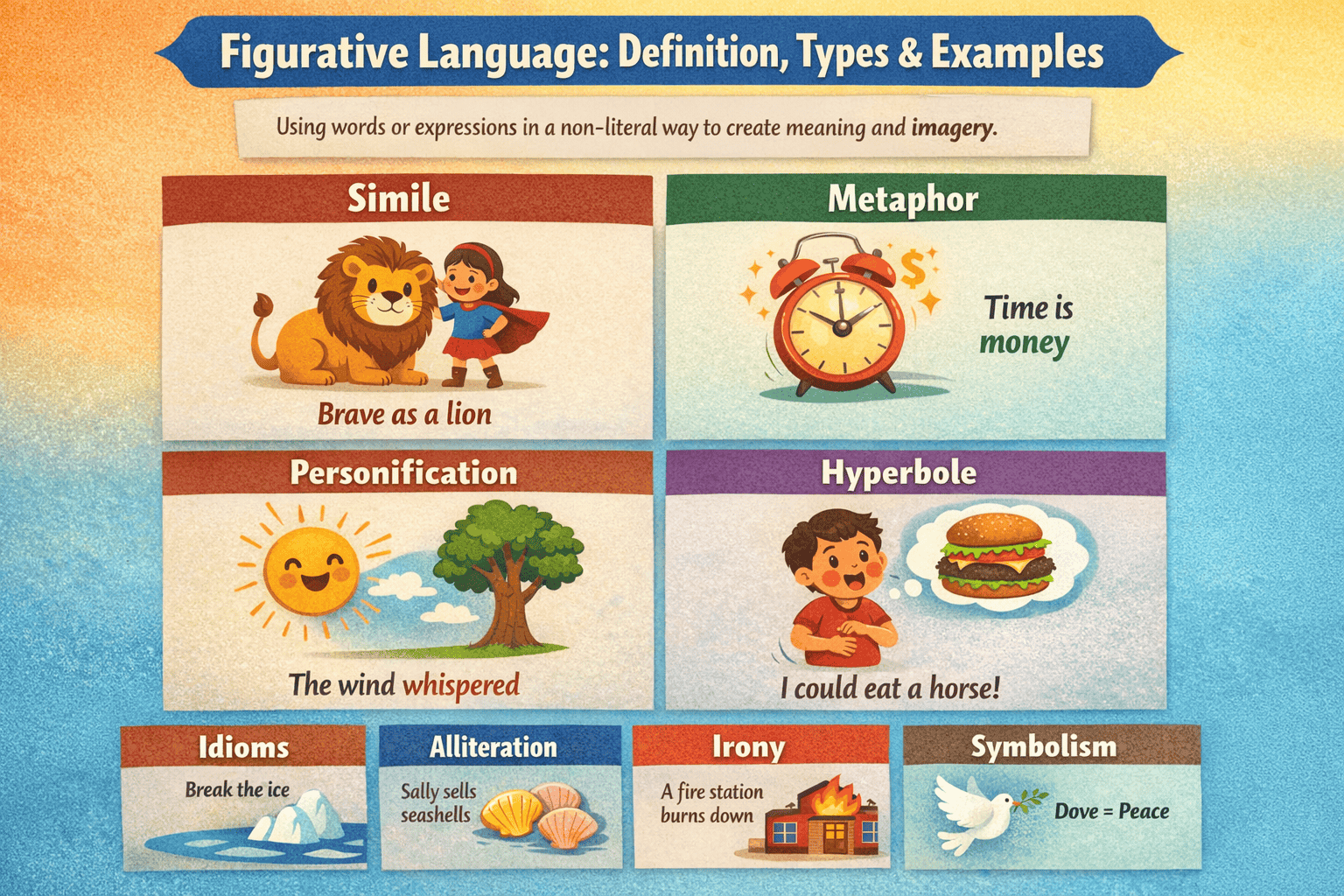
Figurative language refers to words or expressions that go beyond their literal meaning to convey ideas, emotions, or imagery in a more creative and impactful way.
Instead of saying exactly what you mean in a straightforward manner, you use comparisons, exaggerations, or symbolic meanings to make your message more engaging.
Simple Definition:
Figurative language is the use of words in a non-literal way to create meaning, emphasis, or imagery.
Why Is Figurative Language Important?
Figurative language plays a vital role in both writing and speaking. Here’s why it matters:
1. Makes Writing More Engaging
Instead of dull, plain sentences, figurative language adds life and personality.
- Plain: The room was quiet.
- Figurative: The room was as silent as a grave.
2. Creates Strong Imagery
It helps readers visualize scenes clearly.
3. Enhances Emotional Impact
Writers can express feelings more effectively.
4. Improves Communication
Complex ideas become easier to understand through comparisons and symbolism.
5. Boosts Creativity
It allows writers to think beyond literal meanings.
Types of Figurative Language (With Examples)
Now, let’s explore the most important types of figurative language you should know.
1. Simile
A simile compares two different things using the words like or as.
Structure:
- A is like B
- A is as ___ as B
Examples:
- She is as brave as a lion.
- His mind works like a computer.
- The water was as cold as ice.
Why It Works:
Similes make descriptions clearer by relating them to familiar things.
2. Metaphor
A metaphor directly compares two things without using like or as.
Examples:
- Time is money.
- The classroom was a zoo.
- Her voice is music to my ears.
Key Difference:
- Simile: uses like/as
- Metaphor: direct comparison
3. Personification
Personification gives human qualities to non-human objects or ideas.
Examples:
- The wind whispered through the trees.
- The sun smiled down on us.
- The alarm clock screamed at me.
Why It Matters:
It makes descriptions more vivid and relatable.
4. Hyperbole
Hyperbole is an exaggerated statement used for emphasis or effect.
Examples:
- I’ve told you a million times.
- This bag weighs a ton.
- I’m so hungry I could eat a horse.
Tip:
Hyperbole is not meant to be taken literally.
5. Alliteration
Alliteration is the repetition of the same initial consonant sound in nearby words.
Examples:
- Peter Piper picked a peck of pickled peppers.
- She sells seashells by the seashore.
- Big brown bears bounce boldly.
Use Case:
Often used in poetry, branding, and slogans.
6. Onomatopoeia
Onomatopoeia refers to words that imitate natural sounds.
Examples:
- Buzz
- Bang
- Splash
- Tick-tock
Why It’s Effective:
It adds a sensory experience to writing.
7. Idiom
An idiom is a phrase whose meaning is different from the literal meaning of its words.
Examples:
- Break the ice (start a conversation)
- Hit the nail on the head (be exactly right)
- Spill the beans (reveal a secret)
Tip:
Idioms are commonly used in everyday speech.
8. Oxymoron
An oxymoron combines two contradictory words.
Examples:
- Deafening silence
- Bitter sweet
- Jumbo shrimp
Purpose:
It creates a striking or thought-provoking effect.
9. Irony
Irony occurs when the actual meaning is different from what is expected.
Types:
- Verbal Irony: Saying the opposite of what you mean
- Situational Irony: Outcome is unexpected
- Dramatic Irony: Audience knows something characters don’t
Examples:
- A fire station burns down (situational irony)
- Saying “Great job!” after a mistake (verbal irony)
10. Symbolism
Symbolism uses symbols to represent deeper meanings.
Examples:
- Dove = peace
- Red rose = love
- Darkness = evil or mystery
Why It Matters:
It adds layers of meaning to writing.
11. Metonymy
Metonymy replaces a word with something closely related to it.
Examples:
- The White House issued a statement (government)
- Hollywood loves sequels (film industry)
12. Synecdoche
Synecdoche is when a part represents the whole or vice versa.
Examples:
- All hands on deck (hands = people)
- Wheels (car)
13. Euphemism
A euphemism is a polite or mild expression used instead of something harsh.
Examples:
- Passed away (died)
- Let go (fired)
- Economical with the truth (lying)
14. Litotes
Litotes is a form of understatement using double negatives.
Examples:
- Not bad (good)
- Not uncommon (common)
- He’s not wrong
How to Use Figurative Language Effectively
Although figurative language is powerful, using it incorrectly can confuse readers. Here’s how to use it effectively:
1. Know Your Audience
Choose expressions your audience will understand.
2. Avoid Overuse
Too much figurative language can make writing cluttered.
3. Keep It Relevant
Make sure comparisons make sense.
Bad example:
- Her smile was like a spaceship. (confusing)
Good example:
- Her smile was like sunshine. (clear)
4. Use Variety
Mix different types to keep writing interesting.
5. Stay Consistent
Avoid mixing unrelated metaphors.
Example of poor usage:
- He’s a shining star who sailed through the exam jungle.
Figurative Language vs Literal Language
Understanding the difference is crucial.
| Literal Language | Figurative Language |
|---|---|
| Words mean exactly what they say | Words mean something different |
| Clear and direct | Creative and expressive |
| Example: It is raining heavily | It’s raining cats and dogs |
Real-Life Examples of Figurative Language
You encounter figurative language every day:
Advertising:
- “Red Bull gives you wings” (metaphor)
Songs:
- “You are my sunshine” (metaphor)
Conversations:
- “I’m drowning in work” (hyperbole)
Literature:
Authors use it to create emotion, imagery, and depth.
Common Mistakes to Avoid
1. Mixing Metaphors
- Incorrect: He’s climbing the ladder of success but swimming in opportunities.
2. Overcomplicating
- Keep it simple and clear.
3. Using Clichés Too Much
Examples:
- Busy as a bee
- Cold as ice
Try to create fresh expressions instead.
Tips to Improve Your Figurative Language Skills
Practice Regularly
Write sentences using different figures of speech.
Read More
Books, poems, and articles expose you to creative language.
Observe Everyday Language
Notice how people speak and use idioms.
Experiment
Try creating your own metaphors and similes.
Quick Summary of Key Types
- Simile → comparison using like/as
- Metaphor → direct comparison
- Personification → human traits to objects
- Hyperbole → exaggeration
- Idiom → non-literal phrase
- Irony → contrast between expectation and reality
- Symbolism → deeper meanings
Conclusion
Figurative language transforms ordinary communication into something powerful, vivid, and memorable. Whether you’re writing an article, telling a story, or simply having a conversation, using figurative expressions can make your message clearer and more engaging.
However, balance is key. Use figurative language thoughtfully—choose the right type, keep it relevant, and avoid overloading your writing.
By understanding and practicing these techniques, you can significantly improve your writing style, connect better with your audience, and communicate ideas more effectively.
Frequently Asked Questions (FAQS)
It enhances expression by making language more vivid, emotional, and engaging.
No, it’s used in everyday conversations, advertising, speeches, and media.
A simile uses like/as, while a metaphor makes a direct comparison.
Yes. It improves readability, engagement, and user experience, which can indirectly boost rankings.