Modern software development doesn’t end when the code works. it ends when the code is successfully, safely, and efficiently deployed to users. That’s where deployment strategies come in.
If you’ve ever experienced downtime after a release, broken features in production, or user complaints right after an update, chances are your deployment approach needs refinement.
In this detailed guide, you’ll learn what deployment strategies are, why they matter, and which ones top developers rely on—with practical examples, use cases, and best practices you can apply immediately.
What Are Deployment Strategies?
Deployment strategies are structured methods used to release new code or updates into a production environment.
Instead of simply pushing code live, developers use these strategies to:
- Minimize downtime
- Reduce risk of failure
- Ensure smooth user experience
- Enable quick rollback if needed
In short, deployment strategies help you ship software with confidence.
Why Deployment Strategies Matter in 2026
Today’s software landscape demands:
- Continuous delivery (CI/CD pipelines)
- High availability (near-zero downtime)
- Fast iteration cycles
- Global scalability
A poor deployment strategy can lead to:
- Revenue loss from downtime
- Damaged user trust
- Costly bug fixes
- Performance issues
On the other hand, the right strategy allows teams to:
- Release updates faster
- Test features in real environments
- Reduce deployment risks
- Improve system reliability
Key Types of Deployment Strategies
Let’s explore the most important deployment strategies every developer should understand.
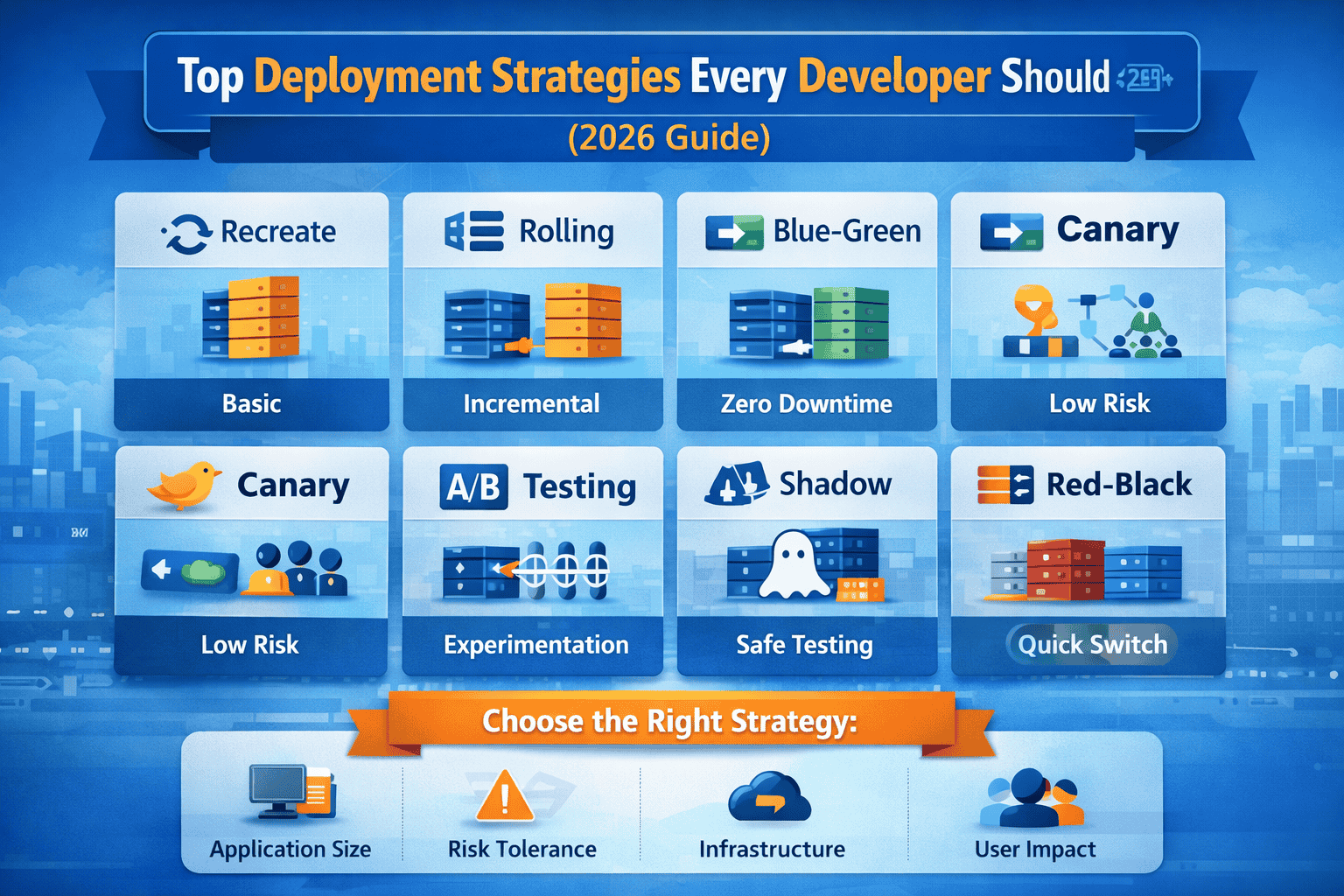
1. Recreate Deployment (Basic Strategy)
What It Is
This is the simplest deployment strategy. The old version is completely shut down, and the new version replaces it.
How It Works
- Stop the current application
- Deploy new version
- Restart the system
Pros
- Easy to implement
- No infrastructure complexity
Cons
- Causes downtime
- Risky if new version fails
Best Use Case
- Internal tools
- Low-traffic applications
Think of this as a “hard reset” approach.
2. Rolling Deployment
What It Is
Rolling deployment gradually replaces instances of the old version with the new one.
How It Works
- Update servers one by one
- Keep part of the system running during deployment
Pros
- No downtime
- Resource-efficient
Cons
- Mixed versions may cause inconsistencies
- Harder rollback
Best Use Case
- Web applications with multiple servers
- Microservices architecture
Ideal for maintaining uptime during updates.
3. Blue-Green Deployment
What It Is
Two identical environments are maintained:
- Blue = current live version
- Green = new version
How It Works
- Deploy new version in the Green environment
- Test thoroughly
- Switch traffic from Blue to Green
Pros
- Zero downtime
- Instant rollback
Cons
- Requires double infrastructure
- Higher cost
Best Use Case
- Mission-critical systems
- High-traffic platforms
One of the safest deployment strategies used in production environments.
4. Canary Deployment
What It Is
The new version is released to a small subset of users first, then gradually expanded.
How It Works
- Deploy to 5–10% of users
- Monitor performance
- Gradually increase rollout
Pros
- Reduces risk
- Real-world testing
- Easy to detect issues early
Cons
- Requires monitoring tools
- More complex setup
Best Use Case
- Large-scale applications
- Feature testing
Popular among companies practicing continuous delivery.
5. A/B Testing Deployment
What It Is
Two versions (A and B) are deployed simultaneously to compare performance.
How It Works
- Split traffic between versions
- Measure user behavior
- Choose the better-performing version
Pros
- Data-driven decisions
- Improves user experience
Cons
- Requires analytics setup
- Not purely for deployment (also for experimentation)
Best Use Case
- UI/UX improvements
- Product optimization
6. Shadow Deployment (Dark Launch)
What It Is
The new version runs in parallel with the live system but does not affect users.
How It Works
- Mirror real traffic to the new system
- Analyze performance silently
Pros
- No user impact
- Safe testing environment
Cons
- Resource-intensive
- Complex setup
Best Use Case
- Testing major architectural changes
Great for validating performance under real load.
7. Feature Toggle (Feature Flags)
What It Is
Features are deployed but controlled using flags, allowing selective activation.
How It Works
- Deploy code with features hidden
- Enable/disable features dynamically
Pros
- No redeployment required
- Fast rollback
- Flexible releases
Cons
- Adds code complexity
- Requires management
Best Use Case
- Continuous delivery environments
- Gradual feature rollouts
8. Red-Black Deployment
What It Is
Similar to blue-green but focuses more on version switching with minimal downtime.
Key Difference
- Red = old version
- Black = new version
Often used interchangeably with blue-green deployment.
9. Immutable Deployment
What It Is
Instead of updating existing servers, new servers are created with updated code.
How It Works
- Launch new instances
- Destroy old ones
Pros
- Eliminates configuration drift
- Highly reliable
Cons
- Requires cloud infrastructure
- Higher resource usage
Best Use Case
- Cloud-native applications
- DevOps environments
Real-World Examples of Deployment Strategies
Example 1: E-Commerce Platform
Uses canary deployment to test new checkout features on a small user group before global rollout.
Example 2: SaaS Product
Uses feature flags to release new features gradually without redeploying.
Example 3: Streaming Service
Uses blue-green deployment to ensure zero downtime during updates.
How to Choose the Right Deployment Strategy
There is no one-size-fits-all solution. Choose based on:
1. Application Size
- Small apps → Recreate
- Large apps → Canary or Blue-Green
2. Risk Tolerance
- High risk → Canary or Shadow
- Low risk → Rolling
3. Infrastructure
- Limited resources → Rolling
- Cloud-based → Immutable
4. User Impact
- Critical systems → Zero downtime strategies
Best Practices for Deployment Strategies
1. Automate Everything
Use CI/CD pipelines for consistent deployments.
2. Monitor in Real-Time
Track performance, errors, and user behavior.
3. Always Have a Rollback Plan
Prepare for failure before deploying.
4. Test in Production Safely
Use canary or shadow deployments.
5. Keep Deployments Small
Smaller changes reduce risk.
Common Mistakes to Avoid
- Deploying without monitoring
- Ignoring rollback strategies
- Releasing large updates at once
- Not testing in real environments
- Choosing overly complex strategies
Future Trends in Deployment Strategies (2026 & Beyond)
1. AI-Driven Deployments
AI will predict deployment risks and automate rollouts.
2. GitOps Adoption
Infrastructure managed through Git repositories.
3. Edge Deployments
Faster deployments closer to users.
4. Autonomous CI/CD Pipelines
Self-healing systems with minimal human intervention.
Final Thoughts
Deployment strategies are not just technical choices—they are business-critical decisions.
The best developers in 2026 don’t just write great code—they deploy it safely, efficiently, and intelligently.
Whether you’re working on a small app or a global platform, understanding and applying the right deployment strategies will help you:
- Deliver faster
- Reduce risks
- Improve user experience
- Build reliable systems