Software development has evolved rapidly over the past few decades. As applications grow more complex, developers need better ways to build, manage, and scale systems efficiently. One of the most effective approaches today is Component-Based Software Engineering (CBSE).
This guide will help you understand CBSE from the ground up—what it is, why it matters, how it works, and how you can apply it in real-world projects.
What is Component Based Software Engineering?
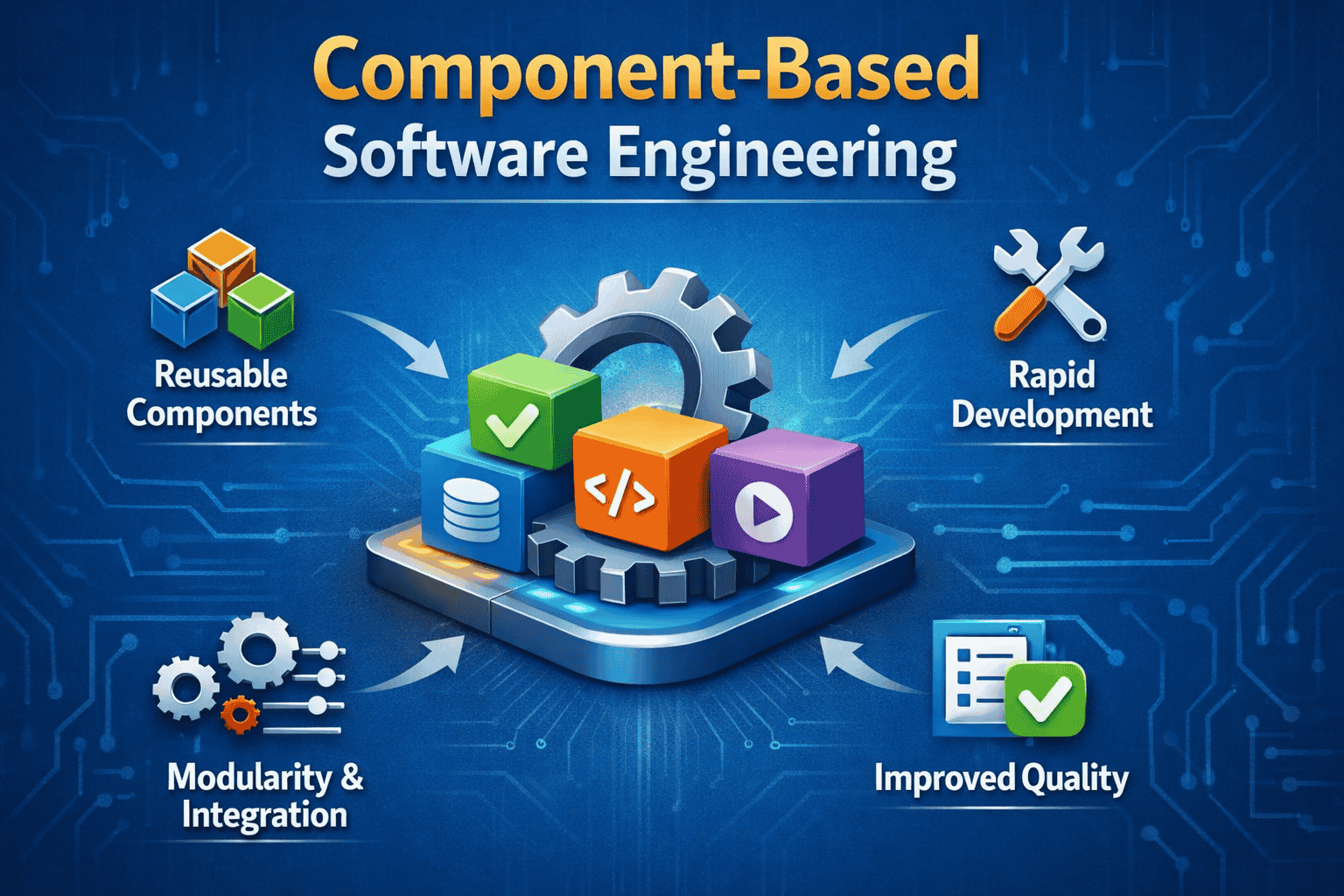
Component-Based Software Engineering (CBSE) is a development approach that focuses on building software systems by combining independent, reusable components.
A component is a self-contained unit of functionality with a well-defined interface. Each component performs a specific task and can be reused across different applications.
Simple Example Of Component Based Software Engineering
Think of building software like assembling a car:
- Engine → Component
- Wheels → Component
- Brakes → Component
Each part works independently but contributes to the whole system.
Similarly, in CBSE:
- A login system can be a component
- A payment gateway can be a component
- A notification system can be a component
Why Component-Based Software Engineering Matters
Modern applications demand speed, scalability, and flexibility. CBSE addresses these challenges effectively.
1. Reusability
You can reuse components across multiple projects, saving time and effort.
2. Faster Development
Instead of building everything from scratch, developers use pre-built components.
3. Easy Maintenance
You can update or fix a single component without affecting the entire system.
4. Scalability
Systems built with components can grow easily by adding new components.
5. Improved Quality
Reusable components are often tested and refined, leading to more reliable systems.
Key Concepts of CBSE
To fully understand CBSE, you need to know its core concepts.
Components
Independent modules with:
- Defined functionality
- Clear interfaces
- Minimal dependencies
Interfaces
Interfaces define how components communicate with each other.
Composition
The process of combining multiple components to form a complete system.
Loose Coupling
Components should depend on each other as little as possible.
High Cohesion
Each component should focus on a single responsibility.
Types of Software Components
Different types of components serve different purposes.
1. Business Components
Handle core business logic (e.g., order processing, billing).
2. UI Components
Manage user interface elements like buttons, forms, and layouts.
3. Data Components
Handle data access and storage operations.
4. System Components
Provide system-level services such as logging, security, and communication.
CBSE Architecture Explained
Component-based systems follow a structured architecture.
Layered Architecture
- Presentation Layer (UI components)
- Business Logic Layer
- Data Access Layer
Component Interaction
Components communicate using:
- APIs
- Message queues
- Events
Example Flow
- User submits a form
- UI component sends data to business component
- Business component processes data
- Data component stores it in a database
Advantages of Component-Based Software Engineering
CBSE offers many practical benefits.
✔ Reduced Development Time
Developers use ready-made components instead of building from scratch.
✔ Cost Efficiency
Less development time means lower costs.
✔ Better Testing
You can test components individually.
✔ Flexibility
You can replace or upgrade components easily.
✔ Parallel Development
Teams can work on different components simultaneously.
Challenges of CBSE
While CBSE is powerful, it comes with some challenges.
1. Component Integration
Combining components from different sources can be complex.
2. Version Compatibility
Different versions of components may not work together.
3. Performance Overhead
Too many components can slow down performance if not optimized.
4. Security Risks
Third-party components may introduce vulnerabilities.
5. Dependency Management
Managing dependencies across components can become difficult.
CBSE vs Traditional Software Development
| Feature | Traditional Approach | CBSE |
|---|---|---|
| Development Style | Monolithic | Modular |
| Reusability | Low | High |
| Maintenance | Difficult | Easier |
| Scalability | Limited | High |
| Development Speed | Slower | Faster |
Real-World Examples of CBSE
CBSE is widely used in modern technologies.
Web Development
Frameworks like:
- React (component-based UI)
- Angular
- Vue.js
These frameworks rely heavily on reusable components.
Microservices Architecture
Each microservice acts like a component with a specific responsibility.
Enterprise Systems
Large systems use components for:
- Authentication
- Payment processing
- Reporting
Best Practices for Component-Based Development
To get the most out of CBSE, follow these proven practices.
1. Design Small and Focused Components
Keep components simple and dedicated to a single task.
2. Use Clear Interfaces
Define how components interact to avoid confusion.
3. Maintain Loose Coupling
Avoid tight dependencies between components.
4. Ensure Reusability
Design components so they can be reused in different projects.
5. Document Everything
Good documentation makes components easier to use and maintain.
6. Version Control
Track changes and manage versions carefully.
7. Test Independently
Test each component before integrating it.
Tools and Technologies Supporting CBSE
Several tools and technologies support component-based development.
Frontend Tools
- React
- Vue.js
- Angular
Backend Technologies
- Node.js
- Spring Boot
- .NET
Package Managers
- npm
- Yarn
Containerization
- Docker
How to Implement CBSE in Your Project
Here’s a step-by-step approach.
Step 1: Identify Components
Break your system into smaller parts.
Step 2: Define Interfaces
Decide how components will communicate.
Step 3: Develop Components
Build each component independently.
Step 4: Test Components
Ensure each component works correctly.
Step 5: Integrate Components
Combine components into a system.
Step 6: Monitor and Improve
Continuously optimize performance and reliability.
CBSE and Modern Software Trends
CBSE plays a key role in modern development trends.
Microservices
Each service acts as a reusable component.
Cloud Computing
Cloud platforms support scalable component-based systems.
DevOps
CI/CD pipelines make it easier to deploy and update components.
API-First Development
APIs act as interfaces between components.
Common Mistakes to Avoid
Even experienced developers make mistakes with CBSE.
Over-Componentization
Too many small components can make the system complex.
Poor Interface Design
Bad interfaces lead to integration issues.
Ignoring Documentation
Without documentation, components become hard to use.
Tight Coupling
Strong dependencies reduce flexibility.
Future of Component-Based Software Engineering
CBSE will continue to grow as systems become more complex.
Emerging trends include:
- AI-powered component generation
- Serverless architectures
- Low-code and no-code platforms
- Increased use of reusable APIs
The demand for modular, scalable, and efficient systems ensures that CBSE will remain a key development approach.
Conclusion
Component-Based Software Engineering is a powerful approach that helps developers build scalable, maintainable, and efficient systems.
By focusing on reusable components, you can:
- Reduce development time
- Improve code quality
- Build flexible and scalable applications
Whether you are a beginner or an experienced developer, adopting CBSE can significantly improve your workflow and project outcomes.
Start small. Build a few reusable components. Over time, you will create a powerful library that speeds up development and improves consistency across projects.
If you apply the concepts in this guide, you will not just write code—you will build systems that are easy to manage, scale, and evolve.