Serverless computing has moved from a niche trend to a mainstream cloud strategy. In 2026, businesses of all sizes—from startups to global enterprises—are adopting serverless architectures to build faster, reduce operational overhead, and scale applications effortlessly.
But what exactly makes serverless computing so powerful? And more importantly, is it the right choice for your projects?
In this in-depth guide, I have explained the benefits of serverless computing, along with its drawbacks, real-world challenges, and practical solutions—so you can make informed decisions.
What Is Serverless Computing?
Serverless computing is a cloud execution model where the cloud provider manages infrastructure, automatically provisions resources, and scales applications as needed. Developers focus purely on writing code, while the platform handles servers, maintenance, and scaling.
Despite the name, servers still exist—they’re just abstracted away.
Popular Serverless Platforms
- AWS Lambda
- Google Cloud Functions
- Azure Functions
- Cloudflare Workers
These platforms allow developers to deploy functions that run in response to events, such as HTTP requests, database updates, or file uploads.
Why Serverless Computing Matters in 2026
The demand for faster digital experiences, microservices, and real-time applications has pushed serverless into the spotlight. Businesses now prioritize:
- Speed of development
- Cost efficiency
- Scalability without complexity
- Reduced operational burden
Serverless computing directly addresses all of these needs.
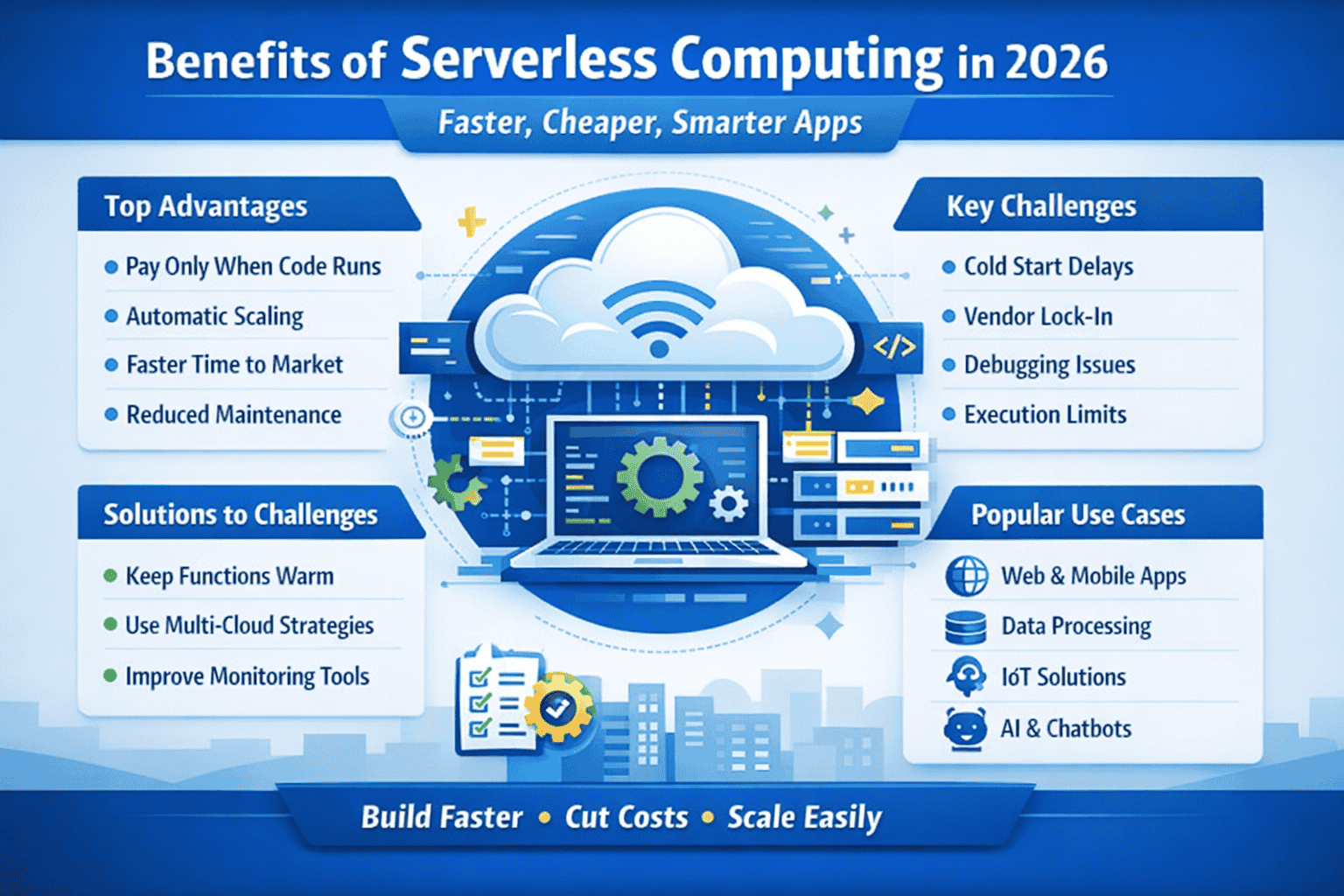
Key Benefits of Serverless Computing
Let’s break down the most impactful advantages of serverless computing.
1. Cost Efficiency (Pay Only for What You Use)
One of the biggest benefits of serverless computing is its pay-as-you-go pricing model.
Unlike traditional servers, where you pay for uptime regardless of usage, serverless charges you only when your code runs.
Why this matters:
- No idle server costs
- Reduced infrastructure expenses
- Ideal for unpredictable workloads
Example:
An eCommerce website handling seasonal traffic spikes can save thousands by paying only during peak activity.
2. Automatic Scalability
Serverless platforms automatically scale your application up or down based on demand.
Key advantages:
- Handle sudden traffic spikes effortlessly
- No manual scaling required
- Global scalability out of the box
This makes serverless perfect for:
- Viral apps
- APIs with fluctuating demand
- Event-driven systems
3. Faster Time to Market
Developers no longer need to configure servers or manage infrastructure.
Result:
- Faster development cycles
- Rapid prototyping
- Quick deployment
Teams can focus entirely on building features instead of worrying about backend systems.
4. Reduced Operational Overhead
With serverless, cloud providers manage:
- Server provisioning
- Maintenance
- Patching
- Monitoring (to some extent)
This significantly reduces DevOps workload.
Outcome:
- Smaller teams can build complex applications
- Less need for infrastructure expertise
5. Improved Developer Productivity
Developers can concentrate on writing business logic instead of managing infrastructure.
Benefits:
- Cleaner code
- Modular architecture (functions)
- Easier debugging and updates
Serverless also aligns well with microservices architecture, improving flexibility.
6. Built-In High Availability
Serverless platforms are designed with redundancy and failover mechanisms.
What you get:
- High uptime
- Fault tolerance
- Automatic recovery
This ensures your application remains available even during failures.
7. Event-Driven Architecture
Serverless thrives on event-based triggers.
Examples:
- User uploads a file → function processes it
- Database change → triggers analytics pipeline
- API request → executes business logic
This allows you to build highly responsive and efficient systems.
8. Better Resource Utilization
Traditional servers often run below capacity. Serverless eliminates this inefficiency.
Advantages:
- No wasted resources
- Optimized compute usage
- Lower environmental impact
9. Seamless Integration with Cloud Services
Serverless platforms integrate easily with:
- Databases
- Storage systems
- AI/ML services
- Authentication tools
This makes it easier to build full-stack applications without managing multiple systems manually.
10. Enhanced Security (When Configured Properly)
Cloud providers handle infrastructure-level security.
Benefits:
- Reduced attack surface
- Automatic updates
- Built-in access controls
However, application-level security still remains your responsibility.
Please read this blogpost If you want to explore a detailed guide about Improving Cloud security.
Disadvantages of Serverless Computing
While serverless offers many advantages, it’s not perfect. Understanding its limitations is crucial.
1. Cold Start Latency
Serverless functions may experience delays when invoked after inactivity.
Impact:
- Slower response times
- Poor user experience in some cases
2. Vendor Lock-In
Switching between providers can be difficult due to proprietary services and architectures.
Risk:
- Limited flexibility
- Migration challenges
3. Limited Execution Time
Serverless functions often have execution limits (e.g., a few minutes).
Problem:
- Not suitable for long-running tasks
4. Debugging and Monitoring Complexity
Traditional debugging tools may not work effectively in distributed serverless systems.
Challenges:
- Harder to trace issues
- Limited visibility
5. Performance Variability
Performance can vary depending on:
- Cold starts
- Shared infrastructure
- Network latency
6. Security Concerns (Misconfigurations)
Although infrastructure is secure, misconfigured permissions can expose vulnerabilities.
7. Not Ideal for All Workloads
Serverless may not suit:
- High-performance computing
- Long-running processes
- Stateful applications
Common Challenges in Serverless Computing
Let’s explore real-world challenges developers and businesses face.
1. Managing Distributed Systems
Serverless applications often consist of multiple functions interacting with each other.
Challenge:
- Increased complexity
- Harder system design
2. Observability and Monitoring
Tracking logs across multiple functions is difficult.
3. Cost Management at Scale
While serverless is cost-efficient, high usage can lead to unexpected costs.
4. Cold Start Optimization
Latency issues can affect user experience.
5. Security and Compliance
Meeting compliance standards requires careful configuration.
Practical Solutions to Serverless Challenges
Here’s how to overcome the most common issues.
1. Reduce Cold Starts
Solutions:
- Use provisioned concurrency
- Keep functions warm
- Optimize code size
2. Avoid Vendor Lock-In
Solutions:
- Use open standards
- Adopt multi-cloud strategies
- Abstract business logic
3. Improve Monitoring and Debugging
Tools:
- Centralized logging systems
- Distributed tracing tools
- Observability platforms
4. Optimize Costs
Strategies:
- Monitor usage regularly
- Set budget alerts
- Optimize function execution time
5. Enhance Security
Best practices:
- Use least privilege access
- Encrypt sensitive data
- Regular security audits
6. Handle Long-Running Tasks
Solutions:
- Break tasks into smaller functions
- Use queues and workflows
- Combine with containers if needed
Real-World Use Cases of Serverless Computing
Serverless is widely used across industries.
1. Web Applications and APIs
Build scalable backend systems without managing servers.
2. Data Processing
Process large datasets in real-time.
3. IoT Applications
Handle millions of device events efficiently.
4. Chatbots and AI Applications
Run AI models on demand.
5. Event Streaming
Process events from multiple sources in real time.
Serverless vs Traditional Cloud: Key Differences
| Feature | Serverless | Traditional Cloud |
|---|---|---|
| Infrastructure | Managed | User-managed |
| Scaling | Automatic | Manual |
| Cost Model | Pay-per-use | Pay for uptime |
| Deployment Speed | Fast | Slower |
| Maintenance | Minimal | High |
Best Practices for Serverless in 2026
To maximize benefits:
- Design for statelessness
- Use microservices architecture
- Monitor performance continuously
- Optimize function size and execution time
- Implement strong security policies
Future of Serverless Computing
Serverless is evolving rapidly with innovations like:
- Edge computing integration
- AI-powered automation
- Improved developer tools
- Reduced cold start latency
In 2026 and beyond, serverless will play a central role in modern application development.
Final Thoughts
Serverless computing offers a powerful way to build faster, scalable, and cost-efficient applications. Its benefits—such as automatic scaling, reduced operational overhead, and improved developer productivity—make it a compelling choice for modern businesses.
However, it’s not a one-size-fits-all solution. Understanding its disadvantages and challenges is essential for successful adoption.
If you approach it strategically—using best practices and addressing limitations—you can unlock the full potential of serverless computing and build smarter, future-ready applications.
Frequently Asked Question (FAQ)
Yes, in most cases. You only pay for actual usage, which reduces idle costs significantly.
Absolutely. It reduces infrastructure costs and speeds up development.
Not entirely. Some workloads still require traditional or hybrid solutions.
Cold starts and vendor lock-in are among the most common concerns.