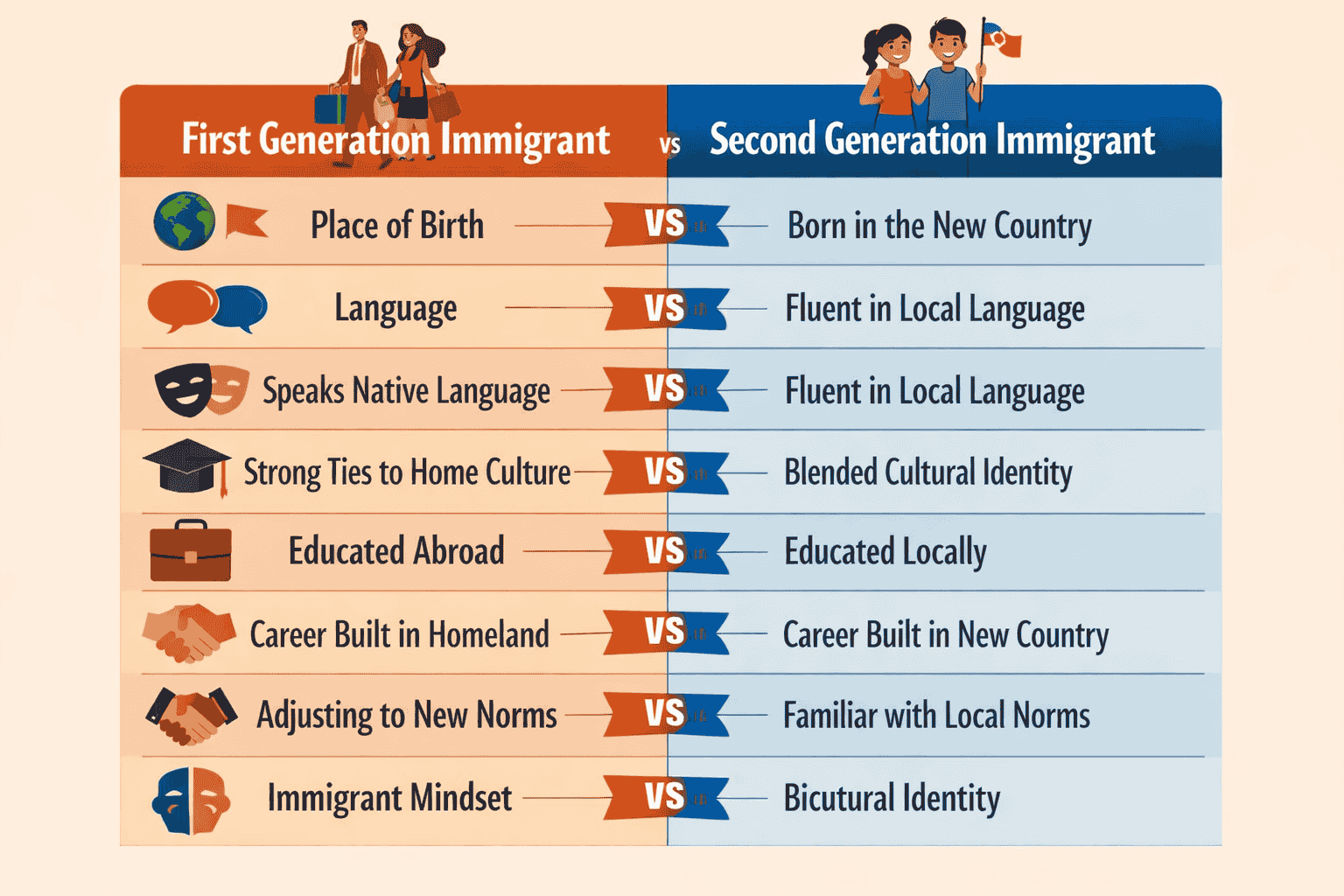
You’ve probably heard both terms used in the same breath. “first generation immigrant, second generation immigrant” — but do they actually mean the same thing? Not even close.
The difference between a first and second generation immigrant goes far deeper than a number. It shapes how a person speaks, what they believe, how they raise their children, what career they pursue, and most fundamentally, how they answer the question: “Where are you really from?”
If you are an immigrant yourself, the child of immigrants, or a researcher – this guide cuts through the confusion. We cover the exact definitions where the debate lies, how these two generations differ across language, culture, identity, economics, mental health, and family life. None of the textbooks tell you about the messy, beautiful in-between.
What Is a First Generation Immigrant?
A first generation immigrant is a person who was born in one country and chose — or was compelled — to permanently relocate to another. They made the move themselves, packed their lives into suitcases. They crossed the border, the ocean, or both.
In academic and government research, the U.S. Census Bureau uses a clear definition: a first generation immigrant is a foreign-born individual residing in a new country. This person was not born a citizen of their new country — they either naturalized, obtained permanent residency, or are in the process of doing so.
Common examples include:
- A woman who leaves Mexico at age 30 to build a life in the United States
- A software engineer who moves from India to Germany on a work visa and eventually settles there
- A Somali refugee who resettles in Canada after leaving their country of origin due to conflict
What all first generation immigrants share is the act of migration. They remember life before. They carry the accent, the cooking, the rituals, the prayers, and sometimes the grief of a home they left behind.
The Confusing Part: The Definition Isn’t Universal
Here is where things get murky, and this confuses people constantly. Merriam-Webster actually lists two definitions for “first-generation”:
- Born in the U.S. to immigrant parents (i.e., what most people would call the second generation)
- Foreign-born — a naturalized American who immigrated to the country
Both definitions appear in mainstream usage, which is exactly why the debate persists in everyday conversation. However, in academic literature, immigration policy, and institutions like Harvard’s Immigration Initiative, the foreign-born individual is the first generation and their American-born children are the second generation. This guide follows that standard.
What Is a Second Generation Immigrant?
A second generation immigrant is born in the new country — but to at least one parent who immigrated from abroad. 1. They hold citizenship by birth, 2. grew up eating their parents’ food while watching the same television shows as their classmates. 3. They exist, from day one, in two cultural worlds simultaneously.
According to Harvard’s Immigration Initiative, second generation immigrants are born in the host country to first generation immigrant parents, and they are exposed to both their heritage culture and the host culture from birth. Today, the immigrant-origin child population in the United States has grown to nearly 20 million — roughly 27% of the entire U.S. child population.
That is not a small demographic. That is a generation redefining what it means to be American, German, British, or Canadian.
The 1.5 Generation: The Category Nobody Talks About Enough
Between first and second lies a group that defies clean categorization: the 1.5 generation.
These are individuals born in their country of origin who immigrated to the new country as children — typically between ages 6 and 12. They are too young to be considered true first generation immigrants (they didn’t choose to leave, their parents did) but too old and too shaped by their birth country to be considered second generation.
2. They start school in a new language mid-childhood, Carry memories of a homeland but are still forming their identity when they arrive. They often end up serving as translators for their own parents — a role that creates a peculiar, premature kind of adulthood.
Further sub-categories exist too:
- Generation 1.75 — children who arrive before age 5, retaining virtually no memory of their birth country and assimilating almost like a true second generation
- Generation 1.25 — teenagers who arrive around ages 13–17, whose experiences more closely mirror those of first generation adults, complete with strong cultural attachments and language ties to their home country
The 1.5 generation is arguably the most emotionally complex cohort in the immigrant family tree — old enough to grieve what they left, young enough to fully become someone new.
Key Differences: First vs. Second Generation Immigrant
1. Language: One World vs. Two
This is the most immediately visible difference between generations.
First generation immigrants typically arrive speaking the language of their home country. They may learn the language of their new country, but they rarely reach native fluency without an accent. Language remains, for many, the most persistent marker of their foreignness — and often the source of the deepest loneliness. When you can’t find the exact word in your new language for a feeling you know perfectly in your mother tongue, you understand what gets lost in migration.
Second generation immigrants grow up bilingual by environment, even if not by formal instruction. They hear their parents’ language at home and the country’s dominant language at school, with friends, and in media. Over time, however, research shows that heritage language proficiency weakens with each passing generation — while emotional attachment to it remains. Many second generation adults describe knowing enough of their parents’ language to feel culturally connected, but not enough to be fully fluent. It becomes a language of the heart, not of fluency.
This language gap creates one of the most commonly reported friction points in immigrant families: a parent who expresses love, discipline, and tradition in a language their child increasingly struggles to fully understand.
2. Cultural Identity: Rooted vs. Navigating
First generation immigrants carry their culture of origin with them deliberately. Research published in Self and Identity found that first generation adult immigrants identified strongly with their culture of origin and only moderately with their new country of residence — even after years of living there. They maintain traditions because those traditions are not historical for them — they are present, lived, and deeply personal.
For second generation immigrants, cultural identity is a negotiation that never fully ends. They grow up with one set of values at home (collectivism, filial duty, specific gender expectations, religious practices) and a different set at school and among peers (individualism, independence, secular norms). Research shows that second generation immigrants tend to develop a bicultural identity — they don’t simply assimilate into the new culture or cling entirely to the heritage culture. They build something new from both.
A 2013 Pew Research Center survey found that roughly six in ten second generation adults consider themselves a “typical American” — about double the share of first generation immigrants who say the same. That shift in self-perception represents one of the most significant emotional and cultural leaps between generations.
3. The Acculturation Gap: When Parents and Children Live in Different Worlds
One of the most studied and most emotionally loaded differences between the generations is the acculturation gap — the growing cultural distance between immigrant parents and their children.
According to researchers from the Child Encyclopedia on Immigration and Early Childhood Development, the acculturation process begins the moment immigrants arrive in a new country and involves changes in language, behavior, attitudes, and values. Children become involved in the new culture rapidly — especially through school — while their parents may never acquire the same level of comfort with the language or social norms of the new country.
The result: immigrant parents and their second generation children increasingly live in different cultural worlds, even under the same roof.
This gap shows up in real, daily ways:
- A Pakistani mother believes her daughter should be home by 9 PM; her second generation daughter argues her American friends don’t have the same rules
- A Chinese father dismisses therapy as weakness; his second generation son recognizes that he needs professional mental health support
- A Nigerian couple expects their child to study medicine or law; their second generation child wants to pursue graphic design
Researchers call this intergenerational cultural dissonance — and it is not unique to any one ethnic group. It plays out in immigrant families across every background, every continent, and every destination country.
4. Economic and Educational Outcomes
The economic trajectory between first and second generation immigrants is one of the most documented stories in immigration research — and it tells a genuinely hopeful arc.
According to Pew Research Center analysis, the differences are striking:
| Measure | First Generation | Second Generation |
|---|---|---|
| Median household income | $46,000 | $58,000 |
| College degree holders | 29% | 36% |
| Homeownership rate | 51% | 64% |
| Living in poverty | 18% | 11% |
| Did not finish high school | 28% | 10% |
Second generation Americans are not just doing better than their parents — on most measures, they match or exceed the U.S. adult population overall.
Why does this happen? First generation immigrants often arrive in low-wage, labor-intensive industries — construction, food service, manufacturing, agriculture. They pour their energy into stability, not mobility. But they invest relentlessly in their children’s education, precisely because they made sacrifices to make that investment possible.
The second generation inherits that investment — combined with native language fluency, U.S.-born social networks, and citizen status — and translates it into upward mobility.
It is worth noting that this trajectory is not uniform. Research shows significant variance by ethnicity. Second generation Asians report a median household income of $67,500 compared to $48,400 for second generation Hispanics — a gap that reflects differences in the human capital first generation parents brought with them upon arrival, as well as structural barriers faced by different groups.
5. Sense of Belonging and National Identity
First generation immigrants navigate a persistent tension: they left a place that was home, and arrived somewhere that doesn’t yet feel like it. Many describe themselves using hyphenated identities — Mexican-American, Indian-British, Somali-Canadian — because neither label alone captures their full reality.
Research on first generation adult immigrants found that their identification with their new country remained moderate, even after extended periods of residence. Home is a word with a complicated definition when you’ve chosen to leave it.
Second generation immigrants, by contrast, grow up having never experienced that original displacement. The new country is their country. Yet they still navigate questions about where they “really” come from — often from people who look at their face, hear their last name, or notice their parents’ accent and decide that “here” isn’t entirely their answer.
This creates a different kind of belonging problem: not homesickness, but being made to feel foreign in the only home you’ve ever known.
A Pew survey of Hispanic and Asian Americans found that one third of first generation Hispanics and 30% of first generation Asian immigrants consider themselves to be “typical Americans.” In the second generation, that figure soared to 61% of both groups — a remarkable shift that speaks to how powerfully the experience of growing up (not just living) in a country shapes one’s sense of self.
6. Mental Health Experiences
Mental health outcomes differ meaningfully across immigrant generations, and the patterns challenge some common assumptions.
Research published in Social Forces found that first generation immigrants actually experience less depression and greater positive wellbeing than their native-born peers of similar backgrounds. Researchers attribute this to what they call the healthy immigrant effect — the protective influence of close family bonds, strong cultural values, community solidarity, and the high motivation that drives the decision to migrate in the first place. You don’t uproot your entire life unless you believe deeply in what you’re building.
Second generation immigrants, interestingly, do not show the same mental health advantage. Research suggests their wellbeing begins to converge with the native-born population — and in some studies, falls below it. The stress of navigating two cultural identities, managing family expectations, and facing racial discrimination while lacking the same community protective factors can take a real toll.
Acculturative stress — the psychological strain of adapting to a new cultural environment — hits both generations, but in different ways:
- First generation immigrants face it head-on as adults, with fully formed identities they must now adapt
- Second generation immigrants experience a subtler, more internalized version: the pressure to represent their parents’ culture while fully participating in the dominant culture around them
Neither experience is easy. But they are different experiences of the same inherited difficulty.
7. Family Roles and Dynamics
In first generation immigrant households, family structure often mirrors the norms of the home country. Collectivist values tend to remain strong — the family unit takes priority over individual desires, elder parents hold significant authority, and children are expected to contribute to the family’s success and reputation.
Second generation children grow up inside this structure while simultaneously being shaped by the more individualistic norms of their new country’s culture. This creates the conditions for the intergenerational conflict that researchers have documented extensively among immigrant families.
The conflict isn’t simply rebellion — it’s the collision of two genuinely different worldviews operating in the same kitchen. Second generation children often carry a dual responsibility: to honor what their parents sacrificed while also claiming the self-determination that their new country tells them is their right.
This dynamic also produces a phenomenon researchers call parentification — where second generation children, due to their language fluency and cultural knowledge, take on adult responsibilities like translating at doctor’s appointments, navigating bureaucracy, or mediating between their parents and institutions. It accelerates maturity. It also creates emotional burdens that no child should carry.
8. Political Views and Immigration Attitudes
Even political attitudes shift between generations in measurable ways. Pew Research data on Latino immigrants shows that 52% of first generation Latinos believed the U.S. should allow more immigrants to work legally — compared to 34% of second generation Latinos who held the same view.
Similarly, 81% of first generation Latinos said undocumented immigrants help the economy. Among second generation Latinos, that figure dropped to 57%.
This isn’t hypocrisy — it reflects a natural shift in lived experience. First generation immigrants know the stakes of immigration from the inside. Second generation immigrants grew up in the host country and have absorbed a broader range of political influences. Their views on immigration, like their views on everything else, are shaped by the culture they were raised in, not just the culture they were born into.
A Quick-Reference Comparison Table
| Category | First Generation | Second Generation |
|---|---|---|
| Born in | Country of origin | New (host) country |
| Language | Native language dominant; new language acquired | Bilingual but heritage language often weakens |
| Cultural identity | Strongly tied to origin culture | Bicultural; negotiates between two worlds |
| National identity | Often sees self as from origin country | More likely to identify as “typical American” (or British, Canadian, etc.) |
| Median household income (U.S.) | ~$46,000 | ~$58,000 |
| College graduation rate (U.S.) | 29% | 36% |
| Homeownership (U.S.) | 51% | 64% |
| Mental health | Healthy immigrant effect; lower depression rates | Converges with native-born population |
| Key challenge | Language barriers, cultural adjustment, legal status | Dual identity, family expectations, intergenerational conflict |
| Family role | Establishes new life; transmits heritage culture | Navigates two cultures; often acts as family bridge |
The Bridge Role: Why Second Generation Immigrants Are Uniquely Powerful
Here is something the data doesn’t capture fully but lived experience confirms: second generation immigrants often become the most powerful cultural bridges in their families and communities.
They hold fluency in two worlds. They translate — not just language, but meaning, context, and emotional nuance — between their parents and the society around them. Researchers studying migrant cultural skills found that second generation immigrants with what they call an integrated identity (a well-balanced combination of heritage and mainstream culture) demonstrate the highest degree of cultural and language bridging skills of any immigrant sub-group. They don’t abandon either world — they use both.
This gives second generation immigrants a distinct set of capabilities that increasingly matter in global workplaces, multicultural cities, and politically complex societies: empathy across cultural divides, comfort with ambiguity, and an instinctive awareness of how profoundly context shapes communication.
What the Labels Miss: The Human Reality
Numbers and categories help us understand patterns. They don’t capture the moment a first generation mother realizes her child no longer dreams in her language. They don’t describe the ache a second generation adult feels when their parents can’t fully understand their mental health struggles, because in their parents’ culture, those struggles don’t have a name.
Both generations carry something irreplaceable. The first generation carries the origin — the food, the music, the memory, the reason the family left in the first place. The second generation carries the future — the language, the access, the bridge between what was and what will be.
Neither generation has it easy. And neither generation is a monolith.
Frequently Asked Questions
Is a first generation immigrant the same as a first generation American? Not always. The terms are sometimes used interchangeably, but technically they can mean opposite things depending on who’s using them. In most academic and policy contexts, the immigrant is the first generation and their U.S.-born child is the second generation American.
What is a 1.5 generation immigrant? A person who was born in their home country but immigrated as a young child (typically ages 6–12). They share characteristics of both the first and second generation — they remember their birth country but were largely socialized in their new one.
Do second generation immigrants face discrimination? Yes. Despite growing up in the new country and often holding citizenship, second generation immigrants regularly face discrimination based on their appearance, last name, or their parents’ background. Many describe being asked “where are you really from?” — a question that signals they aren’t perceived as fully belonging.
Why do second generation immigrants earn more than first generation immigrants? Second generation immigrants benefit from native language fluency, U.S. citizenship, domestic educational credentials, and the cultural capital their parents worked to provide. They enter the labor market without the barriers — credential recognition issues, language gaps, legal documentation uncertainty — that constrain many first generation workers.
Is the second generation always more assimilated than the first? Generally, yes — but “assimilation” is a spectrum, not a switch. Many second generation individuals maintain strong connections to their heritage culture, particularly through family, food, religion, and community. The more useful concept is biculturalism: the ability to move fluidly between two cultural systems rather than abandoning one for the other.
Final Thoughts
The journey from first generation to second generation is one of the most profound transformations a family makes. It happens in one lifetime — sometimes in a single household, between parents and children who love each other deeply but increasingly see the world through different lenses.
Understanding the real differences between these generations matters — not to rank one experience above another, but to recognize what each carries, what each faces, and what each contributes.
First generation immigrants take the leap. Second generation immigrants land it. And somewhere in the middle, across kitchen tables and language classes and family arguments and late-night translations, a new kind of person — and a new kind of community — comes into being.
That story deserves to be understood.