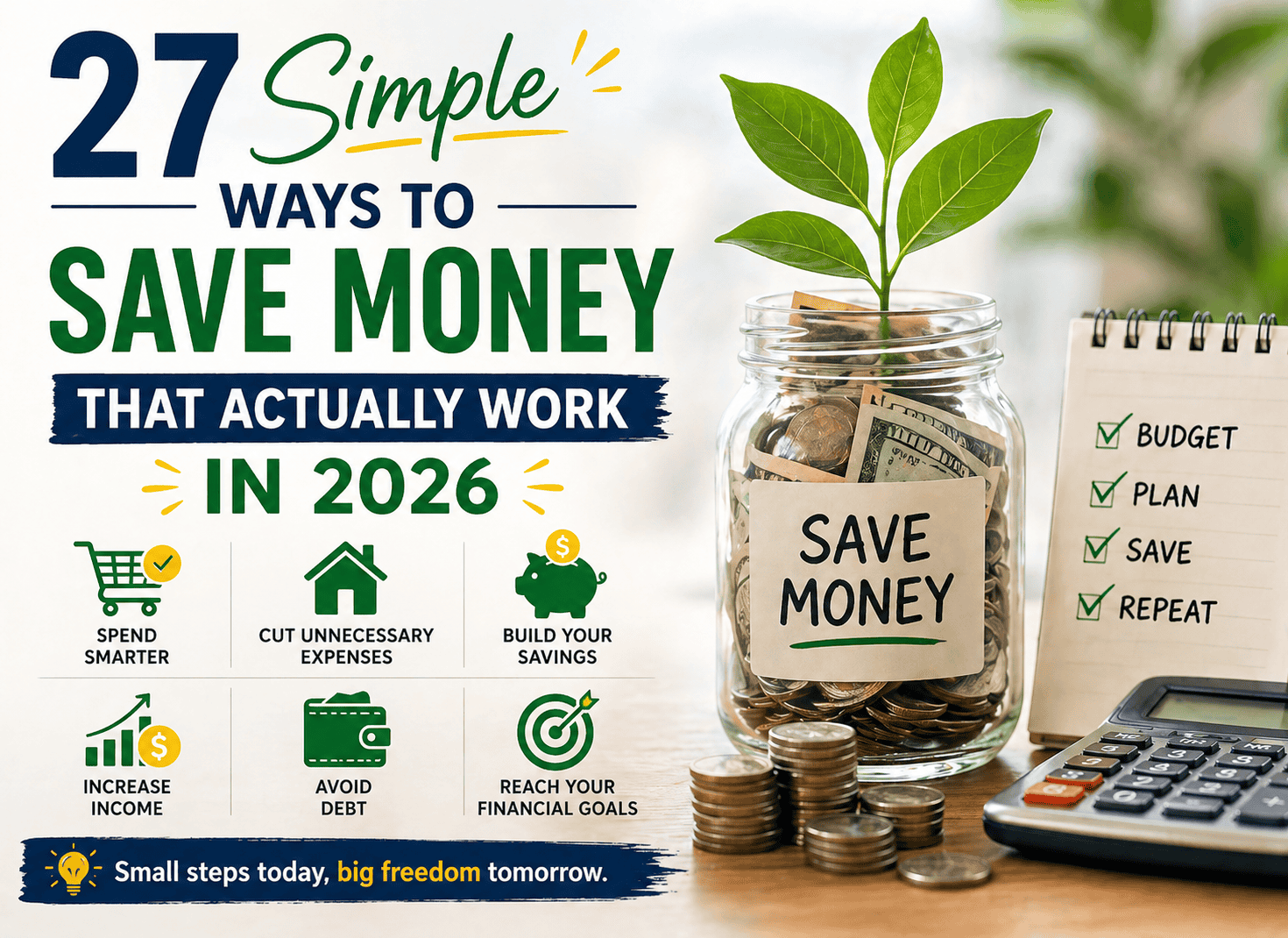
Saving money doesn’t have to feel like punishment. With the right habits, the right tools, and a few smart mindset shifts, you can keep more of what you earn — starting today.
This guide gives you 27 practical, proven ways to save money that fit real life in 2026. No extreme budgeting. No deprivation. Just strategies that work.
Why Saving Money Feels Hard (And How to Fix That)
Most people don’t fail at saving because they’re bad with money. They fail because they try to change everything at once.
The most effective savers pick two or three small habits, build momentum, and stack new wins on top of old ones. That’s the approach this article takes — small actions, real results.
Quick Navigation
| Category | Tips |
|---|---|
| Everyday Spending | #1 – #7 |
| Bills & Subscriptions | #8 – #13 |
| Food & Groceries | #14 – #18 |
| Big Purchases | #19 – #22 |
| Mindset & Habits | #23 – #27 |
Everyday Spending
1. Use the 24-Hour Rule Before Every Non-Essential Purchase
Before you buy anything that isn’t food, medicine, or a bill — wait 24 hours.
This single habit eliminates a massive percentage of impulse spending. Most urges fade overnight. The ones that don’t? Those are worth buying.
Try this: Add items to your cart, then close the tab. Come back tomorrow. You’ll be surprised how often you don’t go back.
2. Pay With Cash for Variable Spending Categories
Research consistently shows that people spend less when they physically hand over cash compared to tapping a card.
Pick your most impulsive categories — dining out, entertainment, clothing — and use cash envelopes for those only. When the cash is gone, you stop spending.
Why it works: Cash creates a psychological “pain of paying” that digital payments erase entirely.
3. Delete Saved Payment Info From Shopping Apps
Frictionless buying is designed to empty your wallet. One-click checkout, saved cards, and auto-fill make spending effortless — and that’s the problem.
Delete your saved payment information from Amazon, food delivery apps, and clothing sites. Requiring yourself to manually enter card details slows you down just enough to reconsider.
4. Turn Off Push Notifications From Retail Apps
Retail apps send you sale alerts, “last chance” warnings, and “just for you” deals — all engineered to trigger spending.
Turn them off. You don’t need to know when there’s a flash sale. Real needs don’t require a notification.
5. Track Every Purchase for 30 Days
You can’t fix what you can’t see. Tracking your spending for one month reveals patterns you had no idea existed.
Use any method that works for you — a budgeting app, a spreadsheet, or even a small notebook. The point is awareness.
Most people discover: At least one or two spending leaks they immediately want to fix.
6. Batch Your Errands to Cut Fuel and Impulse Costs
Every extra trip to the store is an opportunity to spend more than planned. Combining errands into one efficient trip reduces fuel costs and limits exposure to in-store temptations.
Plan your week on Sunday. Make one comprehensive grocery run. Consolidate other errands into a single outing.
7. Set a Weekly Spending Check-In
Once a week — Sunday evening works well for most people — spend 10 minutes reviewing what you spent. No judgment, just data.
This habit keeps your money front of mind and helps you course-correct before small overspending becomes a bigger problem.
Bills & Subscriptions
8. Audit Every Subscription You Pay For
The average person pays for 4–6 subscriptions they’ve forgotten about or rarely use.
Go through your bank and credit card statements line by line. List every recurring charge. Then ask yourself honestly: Did I use this in the past 30 days?
Cancel anything you didn’t use. You can always re-subscribe if you actually miss it.
Common culprits: Old streaming services, fitness apps, news paywalls, cloud storage plans, and forgotten free trials that converted to paid.
9. Negotiate Your Internet and Phone Bill
Most people assume these bills are fixed. They aren’t.
Call your provider, mention a competitor’s current offer, and ask if they can match it or offer a loyalty discount. Providers often have retention deals they don’t advertise.
Script to use: “I’ve been a customer for [X years] and I’m seeing better rates elsewhere. Is there anything you can do to keep my business?”
This takes 10 minutes and often saves $15–$40 per month.
10. Share Subscriptions Wherever Possible
Streaming services, password managers, cloud storage, and even some software subscriptions allow family or household sharing.
Split the cost with a family member or trusted friend. You get the same service for half the price.
11. Use Free Tiers Before Paying for Premium
Before upgrading any app or tool to a paid plan, ask: Am I actually hitting the limits of the free version?
Most free tiers are more than sufficient for casual users. Try the free version for 60 days before committing to a subscription.
12. Review Your Insurance Policies Annually
Insurance is one of the most overlooked money-saving opportunities. Rates change, your situation changes, and loyalty doesn’t always pay.
Every year, get comparison quotes on your car insurance, home or renters insurance, and health insurance. Even a 10% reduction adds up to hundreds of dollars annually.
13. Lower Your Energy Bills With These Simple Fixes
You don’t need an energy audit to cut utility costs. A few easy habits make a real difference:
- Set your thermostat 2–3 degrees lower in winter and higher in summer
- Wash clothes in cold water
- Unplug devices and chargers when not in use (phantom load adds up)
- Replace old bulbs with LED alternatives
- Run the dishwasher and laundry at off-peak hours if your provider charges variable rates
Food & Groceries
14. Meal Plan Before You Shop — Every Single Week
Meal planning is the most reliable way to cut grocery spending. When you know exactly what you’re cooking, you buy exactly what you need. Food waste drops. Impulse purchases drop.
How to start: Every Saturday or Sunday, plan five to six dinners. Write your grocery list based only on those meals plus staples you’re running low on.
Households that meal plan typically spend 20–30% less on groceries than those that don’t.
15. Shop With a List and Stick to It
A grocery list only works if you actually follow it. Walking the aisles without a list is how a $60 shop turns into $110.
Write your list organized by store section (produce, dairy, pantry, etc.) so you move efficiently and don’t backtrack through tempting aisles.
16. Buy Generic Brands for Staple Items
For most staple goods — flour, rice, pasta, canned tomatoes, cleaning supplies, medications, and basic pantry items — the generic version is manufactured in the same facilities as the name brand.
Switch to generic or store-brand for the basics. Keep the name brand only where you genuinely notice a quality difference. Most people find that list is very short.
17. Cook in Bulk and Freeze Portions
Batch cooking saves both time and money. When you cook a large portion of a meal, the cost per serving drops significantly compared to cooking small amounts daily.
Make large batches of soups, curries, sauces, grains, and proteins. Freeze in individual or family-sized portions. On busy nights, you have a home-cooked meal ready without resorting to expensive takeout.
18. Treat Restaurants as an Occasion, Not a Habit
Eating out isn’t inherently bad — but making it a routine is one of the fastest ways to drain your savings.
If you currently eat out five times a week, reduce it to two. Keep dining out as something to look forward to, not a daily default.
The math: Swapping three restaurant meals per week for home cooking can save $200–$400 per month depending on your city.
Big Purchases
19. Always Compare Prices Before You Buy
For any purchase over $30, spend five minutes checking competitor prices and reading reviews.
Use tools like Google Shopping, browser extensions that automatically compare prices, or manufacturer websites. Cashback browser extensions can also return a percentage of your purchase at thousands of retailers.
Don’t forget: Check if your credit card offers purchase protection or an extended warranty — it might already include benefits you’re not using.
20. Buy Quality Items Once Instead of Cheap Items Repeatedly
Cheap products that break and need replacing cost more over time than one quality purchase.
For items you use daily — shoes, kitchen tools, bags, electronics — research the most reliable option in the mid-price range. Buy it once, use it for years.
This is called the “cost per use” mindset and it’s one of the most underused money-saving strategies.
21. Wait for Major Sales Cycles Instead of Buying at Full Price
Most product categories follow predictable discount cycles:
- Electronics: Black Friday, Amazon Prime Day, back-to-school
- Appliances: Presidents’ Day, Labor Day
- Clothing: End-of-season clearance (January and July)
- Furniture: Memorial Day, Presidents’ Day, and Labor Day weekends
If the purchase isn’t urgent, wait for the right window. You can easily save 20–40% by timing it correctly.
22. Use the Library, Borrow, or Rent Before You Buy
Before you buy something you’ll use infrequently — a book, a tool, a piece of equipment — ask whether you can borrow or rent it first.
Public libraries now offer far more than books. Many lend tools, museum passes, seeds, and even cake pans. Libraries also provide free access to audiobooks, e-books, magazines, and streaming services like Kanopy.
Renting tools and equipment for one-time projects is almost always cheaper than buying.
Mindset & Habits
23. Automate Your Savings So You Never Have to Think About It
The most reliable way to save consistently is to remove the decision entirely.
Set up an automatic transfer from your checking account to a savings account on payday — before you spend anything else. Even $25 or $50 per paycheck builds momentum.
The principle: Pay yourself first. Savings shouldn’t be what’s left over after spending. It should be the first thing you allocate.
24. Define Your “Why” Behind Saving
Saving money in the abstract is hard. Saving money for something specific is much easier.
What does financial security actually mean to you? A house? Freedom to leave a job you dislike? A trip you’ve been putting off? A cushion that eliminates financial anxiety?
Write it down. Make it specific. Put it somewhere visible. Your “why” is what keeps you consistent when spending is tempting.
25. Stop Trying to Keep Up With Other People’s Lifestyles
Lifestyle comparison is one of the biggest hidden drivers of overspending. Social media amplifies it. People spend money they don’t have on things they don’t need to impress people they barely know.
Other people’s spending habits are not your benchmark. Build a life based on your values and your goals — not someone else’s highlight reel.
26. Build a Small Emergency Fund Before Anything Else
Without an emergency fund, every unexpected expense — a car repair, a medical bill, a broken appliance — goes on a credit card and accumulates interest.
Start with a goal of $500 to $1,000. Once you have that, build it toward one month of expenses, then three.
A small emergency fund doesn’t just save you from debt — it changes how you feel day-to-day. Financial stress decreases significantly once you have a buffer.
27. Review Your Progress Monthly and Celebrate Small Wins
Saving money is a long game. If you only focus on how far you have to go, it feels overwhelming and you give up.
Instead, track your monthly progress and acknowledge every small win. You cancelled two subscriptions, meal-planned for the first time and waited 24 hours – didn’t buy something. You saved $80 this month.
These wins matter. They build the identity of someone who is good with money — and that identity leads to bigger results over time.
How to Get Started Right Now
You don’t need to implement all 27 of these today. Pick three that feel most relevant to your life:
- One spending habit (the 24-hour rule is a great starting point)
- One bill or subscription fix (audit your subscriptions or call your internet provider)
- One food or grocery strategy (start meal planning this week)
Do those three consistently for 30 days. Then add more.
The goal isn’t perfection — it’s progress. Small, consistent action compounds into meaningful savings over months and years.
Frequently Asked Questions
How much should I try to save each month? A common guideline is to save at least 20% of your take-home pay, but any consistent savings habit is better than none. Start where you are and increase gradually.
What’s the fastest way to save money? Audit your subscriptions and negotiate your recurring bills first. These are one-time actions that immediately free up money every month with no ongoing effort.
Should I pay off debt or save money first? Do both if you can. Build a small emergency fund ($500–$1,000) first, then focus heavily on paying off high-interest debt. Once that’s clear, shift more toward saving.
What’s the best app for tracking spending in 2026? The best app is one you’ll actually use. Popular options include YNAB (You Need a Budget), Monarch Money, and built-in bank budgeting tools. Many people also find a simple spreadsheet works just as well.
Can I save money on a low income? Yes — though it requires prioritizing ruthlessly. Focus on reducing your largest expenses first (housing, food, transportation), automate even small savings amounts, and build the habit even if the numbers start small.
Final Thoughts
Saving money isn’t about being cheap. It’s about being intentional — choosing what your money does instead of letting it disappear without purpose.
The 27 strategies in this article won’t all apply to your situation. Pick the ones that do, act on them this week, and build from there.
You already know more than enough to start. The only thing that separates people who save successfully from those who don’t is taking the first step — and then the next one.
Start today. Your future self will thank you.
Last updated: 2026 | Estimated reading time: 10 minutes