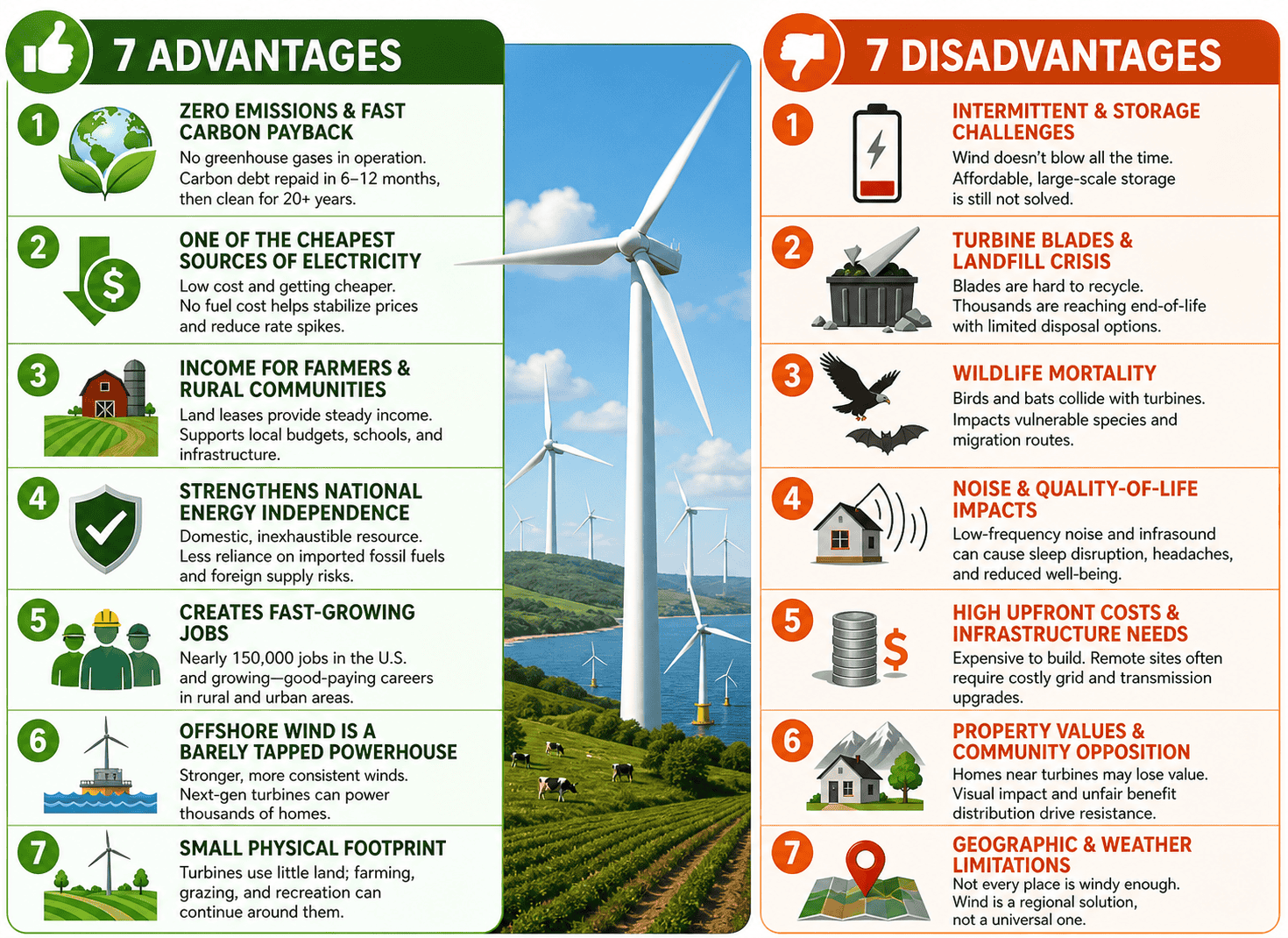
Wind energy is growing faster than almost any other power source on Earth. Wind accounts for roughly 5% of global electricity production and about 8% of the U.S. electricity supply, with a globally installed capacity surpassing 743 gigawatts.
But is it truly the clean, affordable solution it’s made out to be? Or does it come with hidden trade-offs that rarely make the headlines?
This guide gives you both sides — no sugarcoating, no fear-mongering. Just a clear, honest breakdown of the 7 most compelling advantages and 7 most significant disadvantages of wind energy in 2026 — including angles most articles completely ignore.
Let’s get into it.
7 Advantages of Wind Energy
1. It Produces Zero Emissions During Operation — And Pays Back Its Carbon Debt Fast
Wind turbines generate electricity without burning a single drop of fuel. Wind energy does not emit greenhouse gases like carbon dioxide, methane, or nitrous oxide when generating electricity. That alone puts it miles ahead of coal, gas, and even some “clean” alternatives.
But here’s what most articles skip: the carbon payback period. Yes, manufacturing and transporting turbines does release some emissions upfront. However, studies show that wind energy’s carbon footprint is quickly offset by the electricity it generates, placing it among the lowest of any energy source.
In practical terms, a modern wind turbine typically repays its full carbon debt within 6 to 12 months — then runs cleanly for another 20+ years. That’s an extraordinarily efficient return on your emissions “investment.” For a world racing against a climate deadline, this fast payback makes wind one of the most immediately impactful tools available.
2. It’s One of the Cheapest Sources of Electricity Available Today
Wind energy has gone from expensive to impressively affordable in a short span of time. Land-based, utility-scale wind turbines now provide one of the lowest-priced energy sources available today, and wind energy’s cost competitiveness continues to improve with advances in science and technology.
What makes this especially significant for everyday consumers is a benefit that rarely gets discussed: energy price stabilization. Wind energy helps stabilize energy prices, and as wind becomes more prevalent, it should help reduce rate spikes and volatile electricity pricing.
When the wind blows, it pushes cheaper electricity onto the grid — which pulls down the average price consumers pay. Unlike natural gas, which is subject to geopolitical shocks and supply disruptions, the wind has no fuel cost. Zero. That price floor is a major structural advantage for households and businesses planning long-term energy budgets.
3. Farmers and Rural Communities Earn Income From the Same Land They Already Use
This is one of wind energy’s most underrated advantages, and most articles barely mention it. Wind turbines don’t require exclusive land use. Wind energy generation fits well in agricultural and multi-use working landscapes, and is easily integrated in rural or remote areas such as farms and ranches.
A farmer can lease just a small patch of their land to host a turbine, collect a steady annual payment, and continue farming the rest of the field as normal. As droughts, floods, tariffs, and fluctuating prices have become commonplace for farmers, wind energy has allowed them to persevere through the uncertainty by providing a consistent income stream. Perch Energy
Beyond individual farmers, wind projects deliver an estimated $2 billion in state and local tax payments and land-lease payments each year, with communities using the revenue for school budgets, reducing the tax burden on homeowners, and addressing local infrastructure projects. For many rural communities, this is genuinely life-changing economic support.
4. Wind Energy Strengthens National Energy Independence
Here’s a geopolitical angle most wind energy articles completely ignore. Every kilowatt-hour generated by a wind turbine is a kilowatt-hour a country doesn’t need to import as oil or natural gas. That has serious implications for national security and economic resilience.
Countries heavily dependent on fossil fuel imports are vulnerable to supply shocks, price manipulation, and political leverage from exporting nations. Wind energy, by contrast, is generated domestically from a resource that no country can control or embargo. Wind industry growth fosters energy independence and diversification of energy sources, ensuring a more sustainable and secure energy supply for future generations. Everglades University
This advantage becomes especially important for developing nations with limited fossil fuel reserves. Building domestic wind capacity means building long-term economic sovereignty. In a world where energy is increasingly used as a geopolitical weapon, that’s not a small thing.
5. It Creates the Fastest-Growing Jobs in the Energy Sector
There are nearly 150,000 people working in the U.S. wind industry across all 50 states, and wind turbine service technicians are the fastest-growing U.S. job of the decade according to the Bureau of Labor Statistics. U.S. Department of Energy
These aren’t low-paying, temporary positions either. Wind industry roles range from blade fabricators and electrical engineers to data analysts running predictive maintenance systems. Many of these jobs are located in rural areas where well-paying employment opportunities are historically scarce.
Wind energy is predicted to support more than 600,000 manufacturing, maintenance, and installation jobs by 2050. At a time when many traditional energy sectors are shedding jobs due to automation and declining demand, wind is moving in the opposite direction — and bringing economic opportunity to communities that need it most.
6. Offshore Wind Represents a Barely Tapped Powerhouse
While onshore wind gets most of the headlines, offshore wind is where the real scale lives — and it’s barely been developed yet. Offshore wind turbines can capture the energy of stronger, more consistent winds while occupying space that doesn’t compete with land use.
The scale of next-generation offshore turbines is staggering. One type of offshore wind turbine currently in development stands 853 feet tall — four-fifths the height of the Eiffel Tower — and can produce 13 megawatts of power, enough to consistently power thousands of homes.
Offshore wind also complements solar energy geographically. Coastal regions where solar potential is lower due to cloud cover and latitude can still access strong, consistent offshore winds. Wind energy has added value in areas that are too cloudy or dark for strong solar energy production, especially at higher latitudes. This makes offshore wind a critical piece of the global clean energy puzzle — not a niche technology, but a cornerstone resource.
7. Wind Turbines Have a Surprisingly Small Physical Footprint
Many people picture wind farms as sprawling, land-gobbling industrial zones. The reality is more nuanced. Wind turbines can’t be placed too close to one another, which is what makes wind farms appear large — but the turbines themselves don’t take up that much physical space.
The land between turbines remains fully usable for agriculture, grazing, hiking trails, or conservation. A wind farm and a working farm are not mutually exclusive — they coexist regularly across the American Midwest, Scandinavia, and parts of South Asia.
Compare this to coal mining, which permanently scars landscapes, or nuclear power plants, which require significant exclusion zones. Wind turbines occupy a narrow vertical footprint, leaving the horizontal landscape largely intact. For land-constrained nations, this dual-use efficiency is a meaningful structural advantage.
7 Disadvantages of Wind Energy
1. Wind Is Intermittent — And the Storage Problem Is Still Not Solved
This is the single biggest challenge facing wind energy today, and it’s more complex than most articles admit. Wind energy cannot be produced consistently — energy is only generated when the wind blows, making it poorly suited as a standalone base-load energy source. SolarReviews
The deeper issue is energy storage. When the wind blows strongly at 2 a.m. but demand peaks at 6 p.m., the grid needs a way to store that surplus energy for later use. Battery storage technology is improving, but it’s still not cost-effective or scalable enough to fully bridge that gap. Wind turbines currently need to be used in tandem with other energy sources to meet electricity demands.
Until affordable large-scale storage arrives — whether through advanced batteries, green hydrogen, or pumped hydro — wind energy will remain a supplementary power source rather than the backbone of any grid. This isn’t a dealbreaker, but it’s an honest limitation that energy planners cannot ignore.
2. Turbine Blades Are Creating a Silent Landfill Crisis
Here’s the environmental dark side that almost no mainstream article covers in depth. Wind turbine blades are enormous — some stretching over 100 meters — and they’re built from fiberglass-reinforced composites designed for durability, not recyclability.
While turbine towers can be recycled, turbine blades are not easily recyclable. In hopes of developing low-to-zero-waste wind farms, scientists are working to design new reuse and disposal strategies and recyclable plastic turbine blades.
Thousands of blades from first-generation wind farms are now reaching end-of-life, and many are being cut into sections and buried in landfills. This is a genuine contradiction in the “clean energy” narrative. The industry is aware of the problem — research into thermoplastic blade materials and chemical recycling processes is actively underway — but as of 2026, there is no widely deployed, cost-effective solution. It’s a disadvantage that deserves far more attention than it gets.
3. Wildlife Mortality Is a Real and Measurable Problem
Wind turbines can be fatal to wildlife — birds and bats collide with them, and turbines interfere with bat sonar navigation. Certain species with low reproductive rates are especially impacted, as are migratory birds.
This isn’t just an anecdotal concern. Studies have documented turbine-related bird and bat deaths in the hundreds of thousands annually in the U.S. alone, with raptors — including eagles — among the casualties. For species already under conservation pressure, even relatively small additional mortality rates can have population-level consequences.
Researchers are developing mitigation strategies — including radar-triggered blade shutdowns, ultrasonic bat deterrents, and more careful site selection away from migration corridors. Audubon, a bird conservation group, now supports well-planned wind farms. The key phrase is “well-planned.” Poorly sited wind farms near critical habitats remain a legitimate environmental concern that the industry must continue to take seriously.
4. Nearby Residents Report Health and Quality-of-Life Impacts
This is a disadvantage that’s systematically undercovered in pro-wind content. Residents living within 1–2 kilometers of wind turbines frequently report sleep disruption, headaches, and a phenomenon sometimes called “wind turbine syndrome” — associated with low-frequency noise and infrasound emitted by spinning blades.
Wind turbines generate both aerodynamic noise from blades slicing through the air and mechanical noise from power-generating machinery. The noise can affect wildlife but is generally not a factor unless you are standing nearby.
The science on infrasound and human health remains contested, but the lived experience of affected communities is not. In several countries, legal challenges from residents near wind farms have successfully blocked or delayed new installations. Dismissing these concerns as NIMBYism misses a genuine quality-of-life issue that urban planners and energy developers must address with proper setback distances, noise modeling, and community consultation before turbines are installed.
5. High Upfront Costs Create Barriers — Especially in Developing Nations
Wind farms and individual turbines can be expensive to install, though once up and running, operating costs are relatively low since the fuel is free and turbines don’t require significant maintenance over their lifetime.
However, the upfront capital requirement is no small barrier. A single utility-scale onshore turbine can cost $2–4 million. A modest wind farm capable of powering a small city runs into hundreds of millions of dollars. For developing nations with limited access to capital markets, this creates a significant inequality in who gets to benefit from wind energy’s long-term cost advantages.
There’s also the hidden cost of grid infrastructure upgrades. Ideal wind sites are often in remote locations, creating installation challenges in bringing electricity from wind farms to urban areas where it is needed to meet demand. Building transmission lines across hundreds of kilometers adds enormous expense that’s often left out of headline cost comparisons.
6. Wind Farms Can Negatively Impact Property Values and Face Community Opposition
The relationship between wind farms and nearby property values is complex and often contentious. Multiple studies across the U.S., UK, and Australia have found measurable decreases in residential property values for homes within 2–5 kilometers of wind turbines — particularly those with direct line-of-sight to the turbines.
Because wind turbines need to be built high enough to capture a good amount of wind, they can often interrupt otherwise scenic landscapes such as mountain ranges, lakes, oceans, and coastlines. Visual intrusion in areas prized for natural beauty — popular tourism destinations, conservation zones, historic landscapes — generates real and justified resistance from local communities.
This opposition isn’t always irrational or uninformed. When communities aren’t meaningfully consulted in the planning process, or when economic benefits flow primarily to outside investors rather than local residents, resistance grows. The wind industry’s long-term social license depends on genuinely sharing both the burdens and the rewards of wind development with the people who live alongside these installations.
7. Geographic and Meteorological Dependency Limits Where Wind Can Work
Not every region is a viable candidate for wind energy. Wind power won’t work everywhere — you need areas where wind blows strong and steady to make the investment worthwhile. Even in ideal locations on coasts, hills, and open fields, the wind doesn’t blow all the time. Constellation
Wind projects may not be cost-competitive in some locations that are not windy enough. Landlocked regions with complex terrain, dense forests, or consistently low wind speeds simply cannot replicate the wind resource available in coastal or plains environments. This geographic lottery means wind energy will always be a regional solution rather than a universal one. U.S. Department of Energy
Engineers also face the challenge of creating systems that start generating energy at relatively low wind speeds while also surviving extremely strong winds — a strong gale contains 1,000 times more power than a light breeze, and engineers don’t yet know how to design generators that can efficiently capture such a broad range of input power. Until that engineering problem is solved, wind will underperform in highly variable or extreme-weather environments. Caltech Science Exchange
Final Verdict: Is Wind Energy Worth It?
| Factor | Score |
|---|---|
| Environmental benefit | ⭐⭐⭐⭐⭐ |
| Long-term cost savings | ⭐⭐⭐⭐⭐ |
| Job creation | ⭐⭐⭐⭐ |
| Grid reliability | ⭐⭐⭐ |
| Community impact | ⭐⭐⭐ |
| Wildlife safety | ⭐⭐⭐ |
| Recyclability | ⭐⭐ |
Wind energy is not a perfect solution — but no energy source is. Its advantages in cost, climate impact, and energy independence are genuinely powerful. Its disadvantages in intermittency, blade waste, and community impact are real challenges that deserve honest attention, not dismissal.
The smartest energy future isn’t wind-only. It’s wind paired with solar, storage, and smart grid technology — each covering the other’s gaps. Wind energy earns its place in that mix. The key is deploying it thoughtfully, with communities rather than at them.