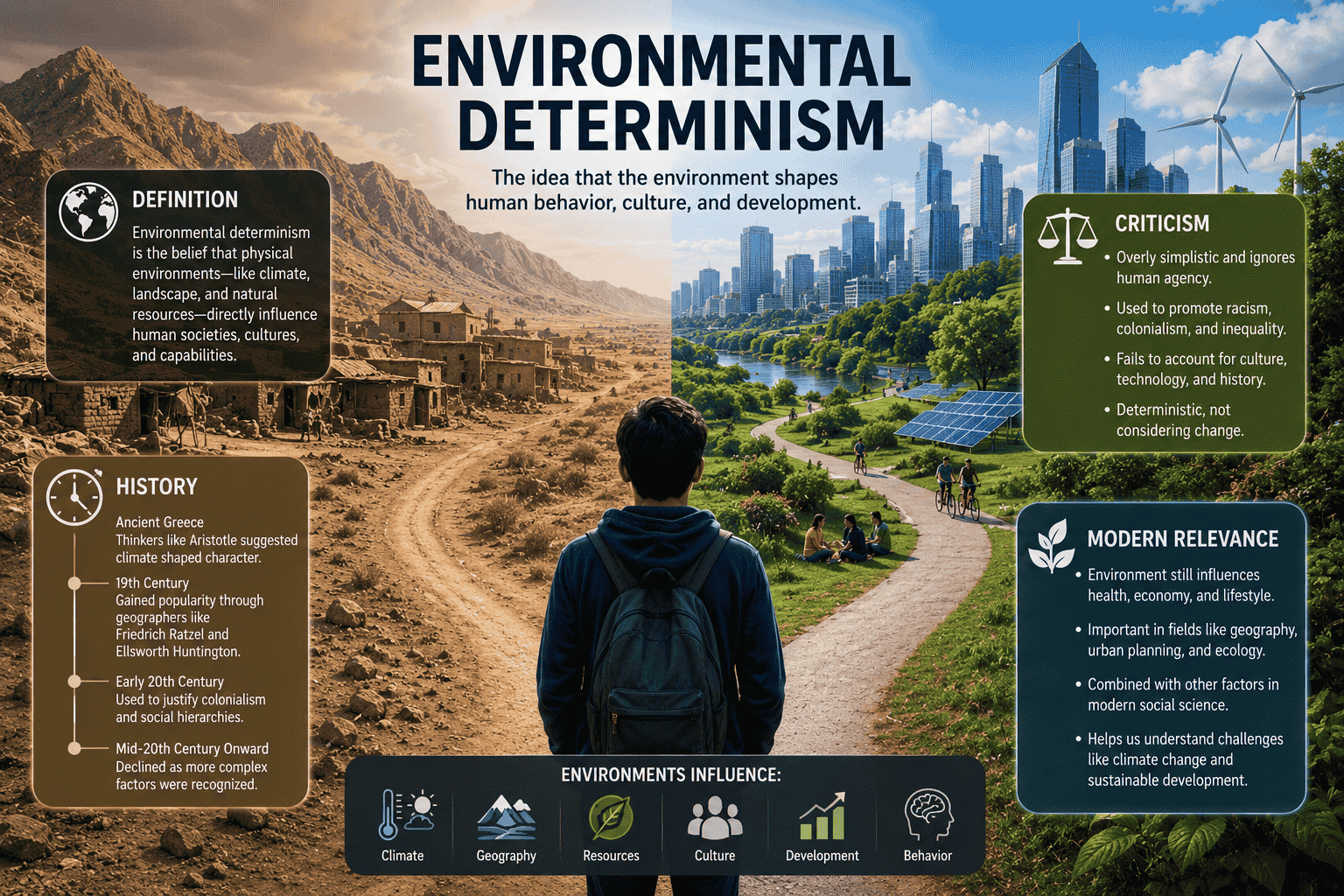
Here’s a theory that shaped empires, justified colonialism, and got one of the most popular science books of the 1990s accused of racism — all while containing a kernel of genuine truth that scientists still argue about today.
That theory is environmental determinism.
It sounds reasonable on the surface: the physical world around you — your climate, your geography, your terrain — shapes who you become. As individuals, sure. But also as civilizations.
The problem is where that idea went, the damage it did, and why it keeps coming back in new clothes.
What Is Environmental Determinism?
Environmental determinism (also called geographical determinism or climatic determinism) is the theory that the physical environment — climate, landscape, natural resources, geography — primarily determines the cultural, economic, and social development of human societies.
In its strongest form, it doesn’t just say the environment influences people. It says the environment determines them. Where you live dictates who you become. Geography is destiny.
The theory applies at the civilizational scale: why did some societies develop agriculture, writing, and complex institutions, while others didn’t? Environmental determinists answer: because of where they happened to live.
It also applied — and this is where things got ugly — to individual character. For over a century, prominent scholars argued that people born in certain climates were inherently more industrious, more intelligent, more morally developed than those born elsewhere.
A Brief History: From Ancient Greece to the 20th Century
The idea is ancient. Greek philosophers, including Aristotle and Hippocrates, argued that climate shapes human temperament. People in cold northern regions, they reasoned, were hardy and spirited but lacked intellect. People in hot southern regions were intelligent but passive. The Greeks, conveniently situated in the Mediterranean middle, had both qualities in perfect balance.
This self-serving logic resurfaced constantly throughout history.
In the 18th century, French philosopher Montesquieu argued in The Spirit of the Laws that climate directly influences human character and political systems. Hot climates breed servility and despotism, he claimed. Cold climates breed vigor and freedom. It was tidy, influential, and largely wrong.
The theory reached its academic peak between 1870 and 1930, when it became the central organizing framework of modern geography. German geographer Friedrich Ratzel expanded it into a systematic theory after Darwin’s Origin of Species reshaped how scholars thought about human development. His student Ellen Churchill Semple brought it to the United States in her 1911 book Influences of Geographic Environment, one of the most widely assigned geography textbooks of its era.
Ellsworth Huntington pushed it further — and further into racism. He argued not just that geography shaped societies, but that temperate climates produced superior civilizations. Tropical and arid climates, he claimed, produced lethargy, low intelligence, and cultural backwardness.
By the 1930s, environmental determinism had become so tangled with Social Darwinism, eugenics, and the ideological scaffolding of colonialism that its academic reputation was irreparably damaged. The theory peaked. Then it collapsed.
Why Environmental Determinism Was Rejected
The collapse was both ethical and empirical.
Empirically, the theory couldn’t survive scrutiny. If harsh northern climates produce superior civilizations, why did the world’s earliest complex societies — Mesopotamia, the Indus Valley, the Nile — emerge in warm regions? Why did China develop sophisticated civilization in diverse climates simultaneously? Why did Japan, sharing a similar climate with Siberia, develop so differently from its neighbors?
Counter-examples mounted faster than proponents could explain them away.
Ethically, environmental determinism was used to justify some of the most destructive ideologies in modern history. The claim that tropical climates produced inferior peoples mapped directly onto colonial hierarchies. It gave scientific-sounding cover to the subjugation of Africa, Asia, and the Americas. It aligned comfortably with racist theories of civilizational superiority.
After World War II, the connection between deterministic thinking and the atrocities of Nazi racial science — which borrowed heavily from biological and environmental determinism — made the framework academically toxic.
UNESCO explicitly rejected biological and environmental determinism in human differences. Universities purged determinist textbooks. A new generation of geographers, led by Carl Sauer, built the field of cultural geography on an explicit rejection of environmental determinism, emphasizing human agency and cultural practice instead.
What Replaced It: Possibilism and Cultural Ecology
The primary alternative to environmental determinism is possibilism — developed most prominently by French geographer Paul Vidal de la Blache.
Possibilism accepts that environments set real constraints on human societies. A desert civilization can’t grow rice. A landlocked society can’t build a maritime empire. Geography matters.
But possibilism insists that within those constraints, humans make choices. The environment presents possibilities and limitations — humans decide which possibilities to pursue. Culture, politics, ingenuity, and historical contingency fill in the rest.
Cultural ecology, developed in the mid-20th century, took this further: humans don’t just respond to environments, they actively transform them. Agriculture, irrigation, urbanization, deforestation — humans have been reshaping their physical environments for thousands of years. The relationship flows both ways.
The Modern Revival: Neo-Environmental Determinism
Environmental determinism was supposed to be dead. Then Jared Diamond published Guns, Germs, and Steel in 1997, and the debate roared back to life.
Diamond’s argument: the reason European societies colonized the Americas and not the reverse wasn’t European superiority — it was geography. Eurasia’s east-west axis allowed crops and animals to spread across similar climates. Its stock of domesticable plants and animals was richer. These geographic advantages compounded over millennia into the military and biological advantages that proved decisive in colonial encounters.
Diamond explicitly framed this as an anti-racist argument. He wasn’t saying Europeans were better. He was saying they got lucky with geography.
The book sold millions of copies and won the Pulitzer Prize. It also attracted fierce criticism from geographers and historians who argued Diamond was simply environmental determinism in a more sophisticated coat — still reducing complex history to a single causal variable, still ignoring human agency, political choices, and the role of institutions.
Critics like James Blaut argued that Diamond’s framework, despite its anti-racist intent, still had the effect of naturalizing European dominance by making it seem inevitable — the product of geography rather than of specific decisions, violence, and power structures that could have gone otherwise.
The debate remains unresolved and genuinely interesting. Diamond’s defenders argue his critics misread him — he’s not claiming geography is the only factor, but the ultimate factor that set the initial conditions. That’s a meaningful distinction.
Where the theory stands in 2025: A 2025 academic review identified what researchers call “neo-environmental determinism” persistently resurfacing in climate change research — particularly in studies of climate-driven migration and conflict. The concern is that framing climate change as the cause of migration or conflict strips out the political, economic, and institutional factors that actually mediate how societies respond to environmental stress. The physical environment creates pressure. Human systems determine outcomes.
Real-World Examples
Fertile Crescent: The ancient Middle East had a uniquely dense concentration of domesticable plants (wheat, barley, lentils) and animals (cattle, horses, sheep, goats). This geographic advantage — not any inherent superiority — allowed civilizations there to develop agriculture earlier, which enabled population growth, specialization, and eventually writing and complex institutions.
Saharan nomads: Traditional nomadic cultures of the Sahara developed social structures, trade routes, and survival strategies shaped tightly around their desert environment — but also transformed that environment through herding and trade patterns.
Island nations: Japan and Britain are both island nations that developed strong naval traditions and distinct national identities partly shaped by geographic separation from continental powers. Same environmental logic, two very different civilizational outcomes — which is exactly the kind of complexity environmental determinism struggles to explain.
Climate change and migration (today): Rising sea levels threaten Pacific Island nations. Desertification is pushing communities off farmland in sub-Saharan Africa. These are real environmental pressures — but whether they produce migration, adaptation, conflict, or innovation depends on political systems, economic resources, and institutional capacity far more than on geography alone.
The Honest Verdict
Environmental determinism in its classical form is wrong — empirically, historically, and morally. The idea that geography locks societies into fixed developmental trajectories ignores the overwhelming evidence of human adaptability, cultural diversity, and political agency.
But the kernel of truth it contains is real: physical environments create genuine constraints and affordances that matter. The Fertile Crescent’s plant and animal wealth mattered. Island geography mattered. Climate patterns matter.
The difference between environmental determinism and a more defensible position isn’t whether geography matters. It’s whether geography determines outcomes or shapes the range of possibilities within which humans then make consequential choices.
Geography deals the hand. Humans play it.
Frequently Asked Questions
What is environmental determinism in simple terms? Environmental determinism is the theory that the physical environment — climate, geography, terrain, natural resources — primarily determines the cultural and social development of human societies. In its strong form, it argues that geography is destiny: where you live determines who you become.
Who are the key figures in environmental determinism? The main figures are Friedrich Ratzel (who modernized the theory in the 19th century), Ellen Churchill Semple (who popularized it in the United States), and Ellsworth Huntington (who linked it most explicitly to racial hierarchy). Jared Diamond’s Guns, Germs, and Steel is the most widely read modern work associated with neo-environmental determinism, though Diamond himself rejects the label.
Why was environmental determinism rejected? It was rejected for two main reasons. Empirically, it couldn’t explain the enormous counter-evidence — complex civilizations emerging in warm climates, similar climates producing radically different societies. Ethically, it was used to justify colonialism, racial hierarchy, and imperialism by framing the domination of non-Western societies as a natural outcome of geography.
What is the difference between environmental determinism and possibilism? Environmental determinism says the environment controls human development. Possibilism says the environment sets constraints and possibilities, but humans exercise real agency in choosing how to respond. Possibilism is the dominant view in modern geography.
Is environmental determinism still relevant today? In its classical form, no. But neo-environmental determinism resurfaces regularly — most recently in climate change research, where some framings attribute migration and conflict directly to environmental conditions without accounting for the political and institutional factors that determine how societies actually respond to environmental stress.
What is the difference between environmental determinism and biological determinism? Environmental determinism locates the determining force outside the person — in climate, geography, and landscape. Biological determinism locates it inside the person — in genes, hormones, and biology. Both theories have been used to naturalize inequality, and both have been largely rejected in their strong forms.
This article is part of our series on the 6 Types of Determinism. Previously: Nominative Determinism — Does Your Name Really Predict Your Career? — Next up: Linguistic Determinism vs. Linguistic Relativity — The Sapir-Whorf Hypothesis Unpacked