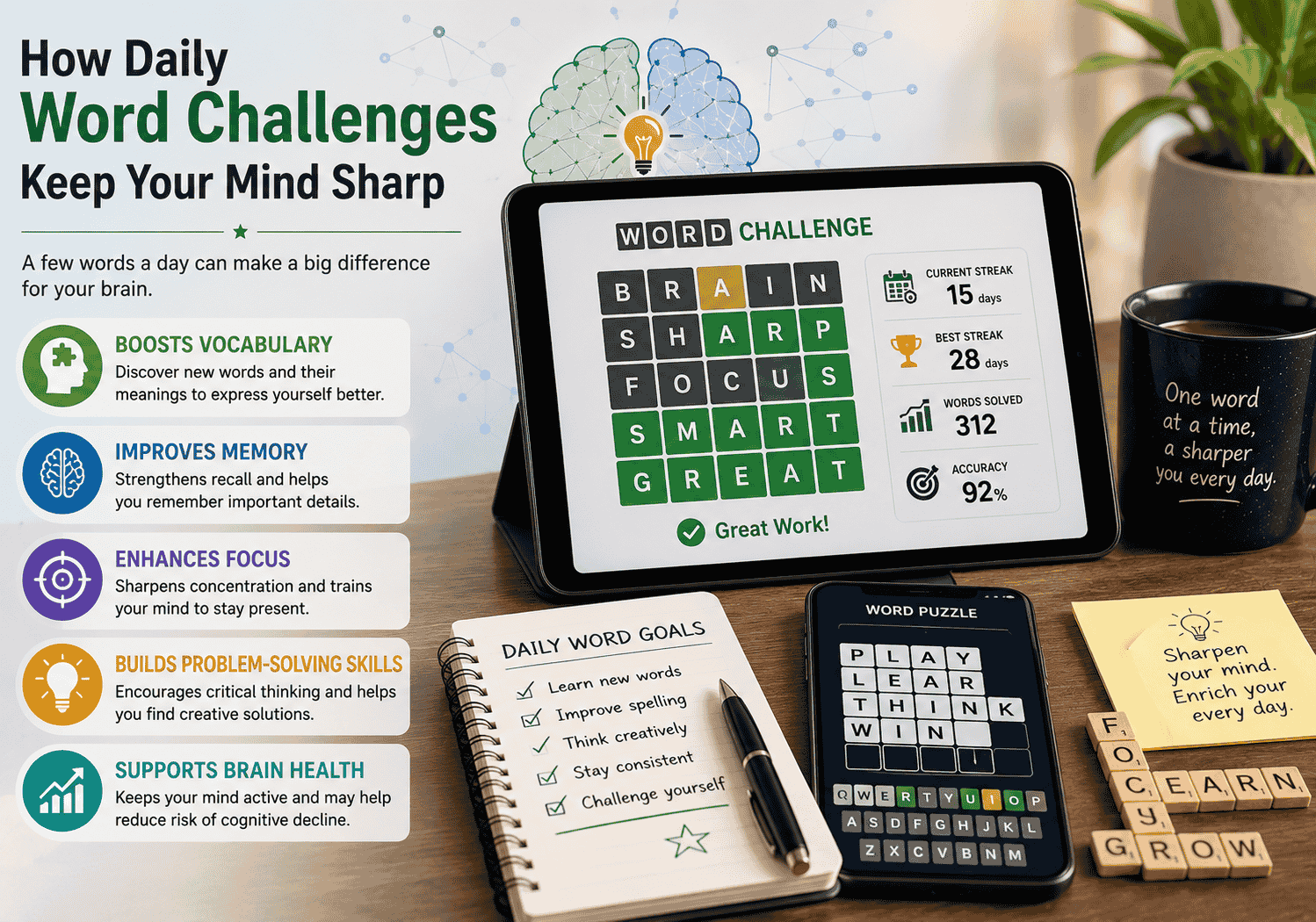
Most people do not need another complicated task in their daily routine. What they often need is something small, enjoyable, and mentally engaging. That is one reason daily word challenges have become such a popular habit.
A few minutes spent finding words may look like simple entertainment, but the activity requires attention, memory, pattern recognition, and decision-making. You are not simply watching something happen on a screen. You are actively searching, testing ideas, remembering words, and adjusting your approach when something does not work.
A well-designed Spelling Bee Game takes this idea and turns it into a daily challenge. The rules are usually easy to understand, but finding every possible word can become surprisingly difficult. That combination of simplicity and challenge is what keeps many players coming back.
The best part is that you do not need a long gaming session. A few focused minutes can be enough to give your mind something different to work on.
Why Daily Word Challenges Are So Engaging
The appeal of word challenges comes from the way they combine familiarity with uncertainty.
Everyone knows words. We use them every day when speaking, reading, texting, and working. Yet when a puzzle gives us a limited collection of letters and asks us to discover as many words as possible, something familiar suddenly becomes a problem to solve.
That change in perspective is surprisingly engaging.
You might recognize several words immediately, then reach a point where nothing seems to fit. A moment later, a word you had completely overlooked suddenly appears. That small discovery creates a sense of progress.
The Brain Has to Stay Actively Involved
A daily word puzzle requires continuous attention.
Players may need to:
- Remember words they already know
- Recognize familiar letter combinations
- Search for possible word patterns
- Compare different possibilities
- Reject combinations that do not work
- Recall unusual or less frequently used vocabulary
The challenge is not necessarily about knowing thousands of difficult words. Often, it is about looking at ordinary letters from different angles.
That is what makes these games more interesting than they first appear.
How Word Puzzles Encourage Pattern Recognition
Pattern recognition is an important part of solving word challenges.
When players become familiar with common word endings, beginnings, and letter combinations, they begin to notice possibilities more quickly. A particular group of letters may remind them of several words they have seen before.
For example, once you recognize a familiar ending, you may start testing other words that use the same structure.
This creates a useful solving habit:
Notice a pattern → remember related words → test possibilities → discover new combinations
The more frequently someone plays, the more naturally these patterns may come to mind.
Vocabulary Makes the Challenge More Interesting
Word games have another advantage: they can expose players to vocabulary they might not encounter during normal conversations.
Some words are common. Others are less familiar. When an unfamiliar word appears in a puzzle, players often become curious about what it means and where it comes from.
That curiosity can turn a simple game into an informal learning experience.
Instead of memorizing a vocabulary list, the player discovers a word because they needed it to solve a problem. That context can make the word more memorable.
Learning Without Feeling Like Studying
Traditional vocabulary practice can sometimes feel repetitive.
A word game approaches the same activity differently. Instead of asking someone to memorize a list, it asks them to retrieve information and experiment with possibilities.
The player is focused on solving a puzzle, not completing a lesson.
That distinction matters because enjoyable activities are easier to return to consistently.
The Role of Memory in Daily Word Games
Memory plays an obvious role in word challenges.
Players may remember a word from a previous puzzle, recall a spelling they have seen before, or recognize a combination that appeared in another context.
Over time, players also develop a personal collection of useful word patterns.
For example, after encountering a particular word several times, a player may start recognizing its structure immediately. The next time a similar pattern appears, the possibility may come to mind much faster.
This does not mean that playing a word game guarantees dramatic improvements in memory. The more realistic benefit is that the activity gives people a reason to practice recalling and manipulating information regularly.
Why a Daily Routine Makes a Difference
One puzzle is fun. A daily puzzle can become a habit.
The difference is consistency.
A player who spends a few minutes solving a word challenge every morning develops a predictable routine. The activity becomes something they expect rather than something they occasionally remember to do.
Daily routines are powerful because they reduce the effort required to get started.
You do not have to decide whether you want to play every day. The new challenge is simply there.
Small Challenges Are Easier to Maintain
A ten-minute activity is much easier to maintain than a one-hour commitment.
This is especially useful for people with busy schedules. A daily word challenge can fit into small gaps in the day without taking over the person’s routine.
Someone might solve it with their morning coffee, during a lunch break, or while relaxing at home.
The goal is not to spend hours playing. The value comes from making a small amount of active thinking a regular part of the day.
How Competition Adds Motivation
Not every player cares about competition, but rankings can make a familiar puzzle more exciting.
Some platforms use scores, achievements, streaks, or Spelling Bee Ranks to give players a way to measure their progress.
A ranking system changes the question from:
“Can I solve today’s puzzle?”
to:
“Can I do better than I did yesterday?”
That small change can create additional motivation.
What Spelling Bee Ranks Can Show
A ranking system may help players understand where they stand based on factors such as:
- Number of words discovered
- Total score
- Puzzle completion
- Streak consistency
- Longer words found
- Special achievements
The exact system varies from one game to another, but the principle remains the same: progress becomes visible.
Seeing improvement can be satisfying even when the player is competing only against their previous performance.
The Psychology of Finding “One More Word”
There is a particular moment that makes word puzzles addictive.
You have already found several words, but you suspect there is another one hiding somewhere.
So you try again.
You change the starting letter. You think about longer words. You reconsider a combination you rejected earlier.
Then you find it.
That single discovery can be more satisfying than solving several obvious words because it required persistence.
This is one of the strongest elements of a daily word challenge: the feeling that the solution is close, even when you cannot immediately see it.
Why Short Challenges Can Feel Rewarding
Modern digital entertainment often competes for attention. Short puzzles offer a different experience because they have a clear beginning and end.
You start with a challenge.
You work through it.
You reach a result.
That sense of completion can feel satisfying, especially when the puzzle requires genuine effort.
Unlike endless scrolling, there is a specific goal to accomplish.
Comparing Different Types of Daily Brain Challenges
Not all brain games require the same skills. Some focus on words, while others rely on numbers, memory, logic, or visual patterns.
| Challenge Type | Main Skill Involved | Typical Player Experience |
| Word puzzles | Vocabulary and pattern recognition | Finding and forming words |
| Spelling challenges | Word recall and attention | Identifying possible spellings |
| Number puzzles | Calculation and logic | Finding numerical relationships |
| Memory games | Recall | Remembering locations or information |
| Logic puzzles | Reasoning | Connecting clues and possibilities |
| Pattern games | Observation | Identifying sequences and structures |
This variety explains why brain games appeal to different personalities. Someone who dislikes mathematical puzzles may genuinely enjoy word challenges, while another person may prefer logic or memory games.
The important factor is finding an activity that is challenging enough to hold your attention without becoming frustrating.
How to Make Daily Word Challenges More Useful
There is no need to turn a casual puzzle into a serious study session. A few simple habits can make the experience more rewarding.
1. Start Without Looking for the Solution
Give yourself a reasonable amount of time to solve the puzzle independently.
The struggle is part of the experience. If you immediately look for every answer, you remove much of the discovery process.
2. Think in Patterns
Do not always look at individual letters separately.
Consider common beginnings, endings, repeated structures, and familiar combinations. Sometimes recognizing one pattern can unlock several possible words.
3. Try Different Word Lengths
If you have already found many short words, start looking for longer ones.
Longer words can sometimes reveal combinations that lead you back to smaller words you had overlooked.
4. Keep Track of Difficult Words
If you encounter an unfamiliar word, take a moment to learn what it means.
You do not need to memorize every word you see. Simply paying attention to interesting vocabulary can gradually expand your word knowledge.
5. Review Your Missed Words
When you finish a puzzle, looking at words you missed can be more valuable than simply checking your final score.
Ask yourself:
- Was the word unfamiliar?
- Did I overlook a common pattern?
- Did I stop searching too early?
- Was there a letter combination I did not consider?
This turns the result into a learning opportunity.
Why Consistency Matters More Than Speed
Many players naturally want to solve puzzles quickly. Speed can be fun, but it is not necessarily the most important measure.
A player who takes a little longer but discovers more words may get more enjoyment from the experience than someone who rushes through the puzzle.
Consistency is often more meaningful.
Playing regularly gives you more opportunities to encounter different words and patterns. Over time, you may notice that certain combinations become easier to recognize.
The improvement can be subtle, but that is exactly how many useful habits develop.
Daily Word Games Can Become a Social Activity
Although word puzzles are often played alone, they can easily become social.
Friends can compare scores. Family members can challenge one another. Colleagues can discuss a particularly difficult puzzle.
Even a simple conversation such as, “How many words did you find today?” can create friendly competition.
Some players enjoy sharing their results without revealing the solution because it gives others a reason to try the puzzle themselves.
This social element adds another reason to return.
Why Digital Word Games Are So Accessible
A major advantage of online word games is convenience.
Players can access them from a phone, tablet, laptop, or desktop computer. There is no need for a dedicated gaming setup.
The rules can usually be learned within moments.
That simplicity makes word games suitable for a broad audience, including people who would never describe themselves as gamers.
A parent can solve a puzzle during a quiet moment. A student can play between study sessions. An office worker can take a short mental break. An older player can enjoy a vocabulary challenge without learning complicated controls.
The Difference Between Challenge and Frustration
A good puzzle should make you think, but it should not make you feel completely lost.
There is a sweet spot between easy and impossible.
If every answer is obvious, players quickly become bored. If the puzzle is consistently beyond their ability, they may stop playing.
Hints, progress indicators, rankings, and difficulty levels can help maintain that balance.
The best experience gives players enough confidence to continue while leaving enough uncertainty to make the next discovery satisfying.
Why Players Become Attached to Daily Challenges
A daily puzzle can eventually become more than a game.
It can become a small personal ritual.
The player recognizes the format, knows a new challenge is coming, and enjoys seeing how well they perform compared with previous days.
For some people, maintaining a streak becomes motivating. For others, the goal is simply to find every possible word.
Some players enjoy learning unfamiliar vocabulary. Others care about rankings.
There is no single reason people return. The flexibility of the experience is part of its appeal.
What Makes the Spelling Bee Game Experience Unique?
A Spelling Bee Game is particularly effective at creating a balance between simplicity and depth.
The basic concept is easy enough for a new player to understand quickly. The real difficulty appears when the player tries to find more and more words.
That creates different levels of engagement.
A beginner may be happy after finding a handful of familiar words. An experienced player may want to uncover every possible combination and improve their ranking.
The same puzzle can therefore provide a different experience depending on the player’s skill and goals.
Beginners and Experienced Players Play Differently
A new player often focuses on obvious words.
An experienced player may immediately begin searching for:
- Longer word structures
- Unusual vocabulary
- Common prefixes and suffixes
- Alternative combinations
- Patterns within the available letters
This progression is one of the reasons daily puzzles can remain interesting over time.
The player does not necessarily need a harder game. They can become better at playing the same type of game.
The Bigger Appeal of Mental Play
There is something refreshing about entertainment that asks you to participate.
Daily word challenges do not require elaborate graphics, complicated controls, or long storylines. Their appeal comes from the challenge itself.
You see a problem.
You think about it.
You try something.
You discover whether it works.
Then you try again.
That basic loop is simple, but it can be remarkably satisfying.
Final Thoughts
Daily word challenges have become popular because they fit naturally into modern life. They are quick enough for busy schedules, simple enough for beginners, and challenging enough to keep experienced players interested.
They also offer something that many forms of digital entertainment do not: active participation.
Finding a word requires attention. Discovering a new combination requires curiosity. Working through a difficult puzzle requires persistence. Comparing your results with yesterday’s performance adds another layer of motivation.
Whether you enjoy vocabulary, competition, personal progress, or simply the satisfaction of finding one difficult word, a daily puzzle can provide a small but enjoyable mental challenge.
You do not need to spend hours doing it. Sometimes, a few focused minutes are enough to step away from passive screen time and give your mind something interesting to solve.
And when tomorrow’s puzzle arrives, there is always another challenge waiting.
Frequently Asked Questions
1. How does a Spelling Bee Game work?
A typical spelling challenge gives players a specific group of letters and asks them to create valid words according to the game’s rules. Players usually try to discover as many words as possible within the available letter set.
2. Can daily word games improve vocabulary?
They can expose players to unfamiliar words, spelling patterns, and different forms of vocabulary. Looking up unfamiliar words and remembering them can make the activity more educational.
3. What are Spelling Bee Ranks?
Spelling Bee Ranks are a way of showing a player’s performance or progress within a particular ranking system. Depending on the game, rankings may consider factors such as score, words discovered, streaks, or other achievements.
4. Is it better to play word puzzles quickly?
Not necessarily. Speed can make a puzzle exciting, but taking time to explore different possibilities may help you discover more words. The best approach depends on whether you care more about speed, completeness, or simply enjoying the challenge.
5. How long should I spend on a daily word challenge?
There is no required amount of time. A few minutes may be enough for a quick mental break, while players who enjoy searching for every possible word may spend longer. The important thing is that the activity remains enjoyable.
6. Why do daily puzzles become habits?
They are predictable, short, and easy to access. Knowing that a new challenge will be available each day creates a simple reason to return, while streaks and personal progress can provide additional motivation.
7. What should I do when I get stuck?
Take a short break and return with a different approach. Look for common word patterns, try different word lengths, or use a small hint if the game provides one. Sometimes stepping away for a minute is enough to notice a word you previously overlooked.