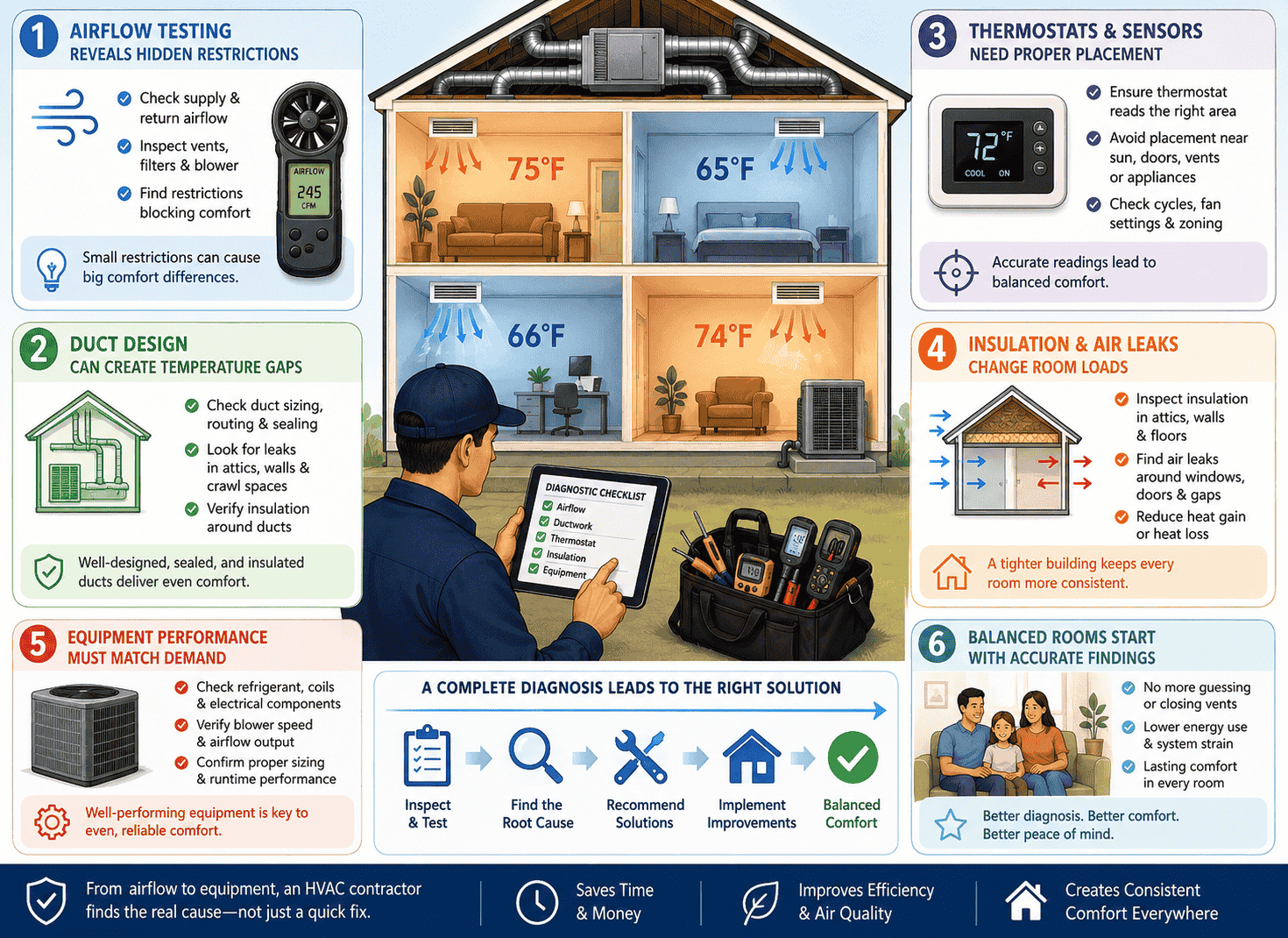
Uneven room temperatures are not just a comfort annoyance; they are often a sign that the HVAC system is reacting to hidden pressure, airflow, or building-envelope problems. One room may stay warm while another feels cold, even when the thermostat shows the right setting. For homeowners, property managers, or small building owners, guessing at the cause usually leads to wasted money and repeated adjustments. An HVAC contractor brings testing tools, system knowledge, and a practical process to find where the imbalance begins, whether it comes from equipment performance, duct design, air leaks, insulation gaps, or control issues.
What the Diagnosis Should Cover
1. Airflow Testing Reveals Hidden Restrictions
A contractor usually begins by checking how air moves through the system, because uneven temperatures often stem from poor airflow rather than a failed unit. Supply vents may not be delivering enough conditioned air; return vents may be undersized; closed doors may cut off certain rooms; blocked grilles, dirty filters, or weak blower performance. The contractor can measure airflow, inspect registers, review duct runs, and compare room conditions to what the system should produce. This matters because a room that feels too hot or too cold may not need more equipment; it may need better air delivery. In many cases, simple restrictions create significant differences in comfort. A clogged filter, crushed flexible duct, loose connection, or poorly placed return can force air toward easier paths while leaving distant rooms underserved.
2. Duct Design Can Create Temperature Gaps
Ductwork has a major influence on room-by-room comfort, especially in houses or buildings that have been remodeled, expanded, or altered over time. A contractor can inspect whether duct branches are properly sized, sealed, insulated, and routed for the spaces they serve. If one room has a long duct run with several bends while another is close to the air handler, the closer room may get stronger airflow, while the distant room struggles. In older homes around Sacramento, seasonal temperature swings can make these duct weaknesses more noticeable when cooling demand rises. Contractors may also look for leakage in attics, crawl spaces, basements, or wall cavities, where conditioned air can escape before reaching the intended room. Sealing ducts, adjusting dampers, adding returns, or correcting insulation around ductwork can often reduce temperature differences without replacing the entire HVAC system.
3. Thermostats And Sensors Need Proper Placement
Uneven temperatures can also come from controls that read the wrong part of the home or building. A thermostat placed near a sunny window, exterior door, kitchen, hallway, supply vent, or heat-producing appliance may shut the system off before distant rooms are comfortable. An HVAC contractor can test whether the thermostat reading matches actual room temperatures and whether the system cycles too quickly or runs too long. In buildings with multiple rooms, sensors may need recalibration, relocation, or zoning support. Zoning allows separate areas to receive different levels of heating or cooling based on actual demand, not one central reading. Contractors can also check whether fan settings, programmable schedules, and smart thermostat features are helping or hurting balance. Sometimes the system is mechanically sound, but poor control logic results in inconsistent comfort across rooms.
4. Insulation And Air Leaks Change Room Loads
A room can feel different from the rest of the property because it gains or loses heat faster. Contractors often look beyond the HVAC unit to examine insulation levels, window condition, attic access, exterior walls, weatherstripping, and gaps around doors or penetrations. A bedroom over a garage, a corner office with several windows, or a room under a poorly insulated attic may have a different heating or cooling load than interior rooms. If outside air leaks in or conditioned air escapes, the HVAC system must work harder, while that room still lags. A contractor can identify whether the temperature issue is mechanical, structural, or both. When air sealing, insulation improvements, or window upgrades are paired with HVAC adjustments, the result is usually more stable comfort and less unnecessary runtime.
5. Equipment Performance Must Match Demand
After airflow, ductwork, controls, and building conditions are reviewed, the contractor can evaluate whether the HVAC equipment itself is performing correctly. Weak cooling, low refrigerant, dirty coils, aging motors, improper blower speed, short cycling, or incorrect system sizing can all contribute to uneven temperatures. A system that is too small may never satisfy rooms with higher demand, while an oversized system may shut off too quickly before air mixes evenly. Contractors can check temperature split, refrigerant pressures, electrical components, coil condition, and runtime patterns to confirm whether the equipment is producing and distributing conditioned air as intended. This prevents unnecessary replacement decisions. The right diagnosis separates a true equipment problem from issues caused by ducts, insulation, controls, or room layout.
Balanced Rooms Start With Accurate Findings
Uneven room temperatures should not be solved by constantly changing the thermostat or closing random vents. Those shortcuts can increase strain, raise energy use, and create new comfort problems. An HVAC contractor helps by testing the full system, from airflow and ductwork to thermostat placement, insulation, leakage, and equipment performance. That complete review gives property owners a clearer path toward lasting correction. Sometimes the answer is a small repair; other times it involves duct sealing, zoning, added returns, or building improvements. Accurate diagnosis turns uneven comfort from a recurring frustration into a manageable system issue.