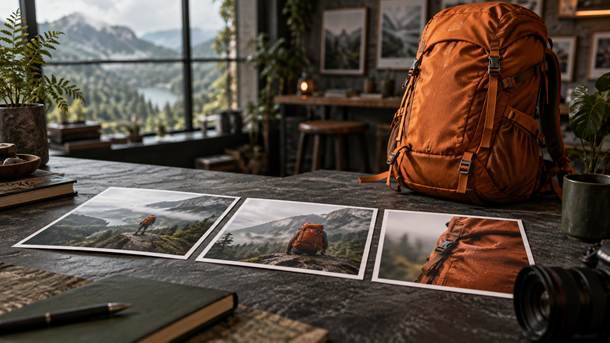
A beautiful opening shot can still be a weak opening. Mist rolls across a mountain, the camera glides forward, and sunlight spills over the ridge—but the viewer has no idea what matters. Is this a travel story, an outdoor product launch, or a meditation clip?
The first shot needs a job. It should introduce something worth noticing and give the audience a small reason to keep watching. For an AI-generated video, deciding that job before writing the prompt makes the rest of the creative process easier to manage.
Start with a question the picture can answer
An opening does not need a dramatic twist. A simple unresolved action is often enough: a backpack waiting beside an open door, a paper lantern beginning to glow, or a ceramic cup trembling as a train approaches.
Each image suggests a question. Who is leaving? What is about to happen? Where are we going? That question gives movement a purpose.
Write the intended viewer response in ordinary language before describing the image. For a hiking story, it might be: “I want to know where this person is headed.” For a workshop introduction: “I want to see what this material becomes.” If the response is only “That looks cinematic,” the opening may need a clearer subject or action.
Choose the input that protects the important detail
Some ideas begin with a visual that already exists. Others begin with a scene that has never been photographed. The Seedance AI video generator offers text-based and image-based creation, so the starting point can follow the material available.
If an exact backpack, handmade object, or illustrated character is central to the story, use a clear reference image. If the environment and mood matter more than a specific object, a written scene description may be a useful starting point.
Before generating, identify one detail that should survive every revision. It could be the backpack’s orange color, the cup’s unusual handle, or the character’s silhouette. Treat that detail as the visual thread that keeps the opening recognizable.
Give the shot one main movement
Camera movement and subject movement compete for attention. A rotating camera, walking character, changing background, and sudden light transition can make a short opening difficult to read.
Choose one dominant action and let the other elements support it. If a hand lifts a backpack from a bench, keep the camera relatively quiet. If the camera moves toward a mysterious doorway, the doorway does not also need to transform.
Here is an original scene brief to adapt:
An orange hiking backpack rests on a wooden bench beside an open cabin door. A hand enters from the right and lifts the backpack by its top handle. The camera stays at bench height with a gentle forward movement. Cool morning light enters through the doorway. Keep the backpack’s shape and color stable, and finish on the empty bench with the forest visible beyond it.
The final image leaves room for a next shot. The action has changed the scene without trying to tell the entire story at once.
Compare openings with a specific review question
Generate variations to answer a decision, rather than collecting unrelated possibilities. One version might begin closer to the backpack; another might show more of the doorway. Keep the subject and action the same so the comparison remains useful.
Watch each version once without sound. Can you identify the subject immediately? Does the action make sense? Is there a clear reason for the final composition?
Then watch at normal speed with sound. A visually strong opening can feel confused if an impact arrives before contact or music suggests a different mood. Review the whole moment, including its rhythm.
Let the second shot fulfill the promise
An opening creates an expectation. If the backpack leaves the cabin, the next image should develop that departure: boots on a trail, a forest path, or a wider view of the journey. Cutting to an unrelated spectacle spends the attention the opening has just earned.
When you are ready to turn a still image into a video, begin with a frame that already contains a useful story question. Add a single readable action, review what the viewer can understand, and build the next shot around the result. The strongest opening is the one that makes the following moment feel necessary.