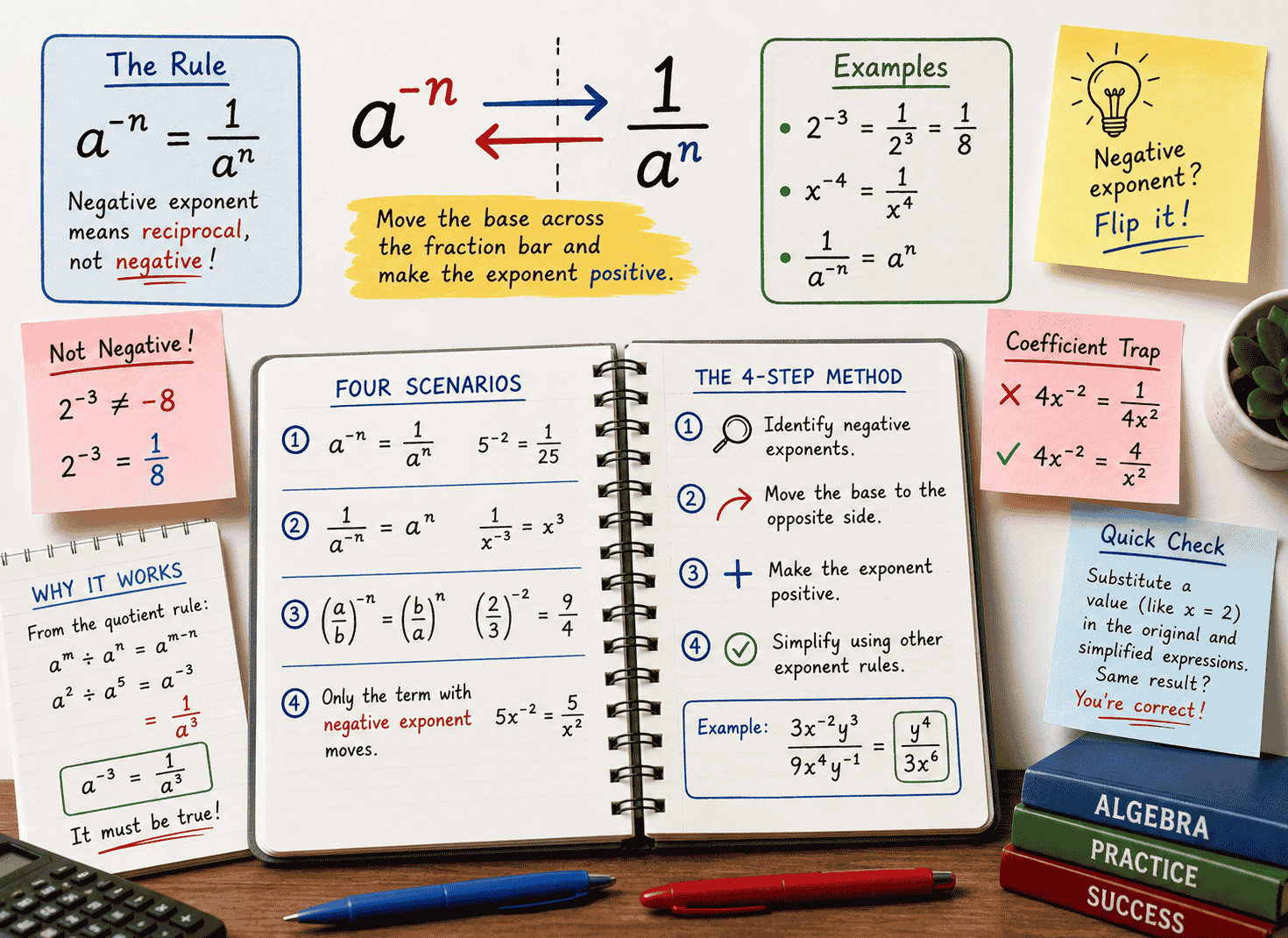
The negative exponent rule states that any non-zero base raised to a negative exponent equals the reciprocal of that base raised to the equivalent positive exponent: a⁻ⁿ = 1/aⁿ. In plain terms, a negative exponent does not make the result negative — it moves the base to the opposite side of the fraction bar and flips the sign of the exponent to positive.
For example, 2⁻³ = 1/2³ = 1/8, and x⁻⁴ = 1/x⁴. When a negative exponent appears in the denominator, the base moves up to the numerator: 1/a⁻ⁿ = aⁿ. For a fraction raised to a negative exponent, the entire fraction flips: (a/b)⁻ⁿ = (b/a)ⁿ. The rule applies to numbers, variables, and algebraic expressions — and it exists because the laws of exponents demand it: dividing a smaller power by a larger one (such as a²÷a⁵) naturally produces a negative exponent result (a⁻³), which must equal 1/a³ to keep the quotient rule consistent.
You simplified the expression, You moved the term with the negative exponent, You checked your work. Then your teacher circled it in red anyway.
Sound familiar? You’re not making a careless error. You’re making a specific mistake that almost every algebra student makes — and nobody ever explains it clearly enough to stop it from happening again.
This article does exactly that. By the end, you’ll know not just what the negative exponent rule says, but precisely where the confusion hides — and a step-by-step method that works on every expression you’ll ever face.
What the Negative Exponent Rule Actually Says
The rule itself is clean and simple:
a⁻ⁿ = 1/aⁿ
In plain English: a negative exponent means take the reciprocal of the base, then apply the positive version of the exponent.
So 2⁻³ doesn’t mean negative eight. It means 1/2³, which equals 1/8.
And x⁻⁴ doesn’t mean −x⁴. It means 1/x⁴.
Here’s the mental model that makes this stick: a negative exponent moves the base across the fraction bar — from the top to the bottom, or from the bottom to the top — and turns the exponent positive in the process.
That’s it. That’s the whole idea.
But here’s where almost everyone goes wrong.
The Mistake Nobody Talks About: The Coefficient Trap
Let’s say you’re asked to simplify this expression:
4x⁻²
Most students look at that negative exponent and immediately flip everything. Their working looks like this:
4x⁻² = 1/(4x²) ✗
That answer is wrong — and it’s the most common negative exponent mistake in Algebra 1.
Here’s the correct answer:
4x⁻² = 4/x² ✓
The difference? Only the x⁻² part moves. The 4 stays exactly where it is.
This is called the coefficient trap, and it catches students out because the rule says to move the base with the negative exponent — not everything attached to it. The 4 is a separate factor. It doesn’t carry a negative exponent, so it has no reason to move anywhere.
Let’s look at a few more examples to make this absolutely clear.
| Expression | Wrong | Right | Why |
|---|---|---|---|
| 4x⁻² | 1/(4x²) | 4/x² | Only x⁻² moves |
| 3y⁻⁵ | 1/(3y⁵) | 3/y⁵ | Only y⁻⁵ moves |
| −2a⁻³ | −1/(2a³) | −2/a³ | Only a⁻³ moves |
| 5x²y⁻¹ | 1/(5x²y) | 5x²/y | Only y⁻¹ moves |
The pattern is consistent every time: the coefficient and any terms with positive exponents stay put. Only the term carrying the negative exponent crosses the fraction bar.
Why Does a Negative Exponent Mean “Flip”? The Proof That Makes It Stick
Most articles just ask you to memorize the rule. But understanding why it’s true is the thing that makes you never forget it.
Start with the quotient rule of exponents: when you divide two powers with the same base, you subtract the exponents.
aᵐ ÷ aⁿ = aᵐ⁻ⁿ
Now try dividing a smaller power by a larger one. Say, a² ÷ a⁵.
Using the quotient rule: a²⁻⁵ = a⁻³
Writing it out by hand: (a·a)/(a·a·a·a·a) = 1/a³
Both answers describe the same division. So they must be equal:
a⁻³ = 1/a³
That’s not a rule someone invented. It’s a logical consequence of the quotient rule. Negative exponents have to mean reciprocals — otherwise the quotient rule breaks down the moment the top exponent is smaller than the bottom one.
Once you see this, the rule stops feeling arbitrary and starts feeling inevitable.
The Complete Rule: Four Scenarios You Need to Know
The negative exponent rule shows up in four different forms in algebra. Here’s each one, clearly laid out.
Scenario 1 — Simple Base
a⁻ⁿ = 1/aⁿ
The base moves to the denominator. The exponent becomes positive.
- 5⁻² = 1/5² = 1/25
- x⁻⁶ = 1/x⁶
- 10⁻³ = 1/1000 = 0.001
Scenario 2 — Negative Exponent in the Denominator
1/a⁻ⁿ = aⁿ
When the negative exponent is already in the denominator, the base moves up to the numerator. Think of it as moving in reverse.
- 1/x⁻³ = x³
- 1/2⁻⁴ = 2⁴ = 16
Here’s a quick way to remember this: a negative exponent in the denominator is like a double negative. It “un-flips” — the base goes up and the exponent becomes positive.
Scenario 3 — Fraction Raised to a Negative Exponent
(a/b)⁻ⁿ = (b/a)ⁿ
When a fraction is raised to a negative exponent, flip the entire fraction first — then apply the positive exponent.
- (2/3)⁻² = (3/2)² = 9/4
- (x/y)⁻³ = (y/x)³ = y³/x³
Think of it this way: flipping a fraction is just taking its reciprocal. A negative exponent tells you to take the reciprocal — so for a fraction, you literally just flip it, then raise to the positive power.
Scenario 4 — Expression with Coefficients (The Coefficient Trap)
This is the one that trips people up. The rule is this: only the part of the expression that carries the negative exponent moves.
- 6x⁻³ = 6/x³ (the 6 stays)
- 3a²b⁻⁴ = 3a²/b⁴ (only b⁻⁴ moves)
- −7m⁻¹n² = −7n²/m (only m⁻¹ moves)
A useful test: ask yourself, “which exact term has the negative exponent?” Only that term crosses the fraction bar. Everything else stays exactly where it is.
The 4-Step Method That Works Every Time
When you face any expression with negative exponents, run through these four steps in order. This approach works whether you’re dealing with one term or a complex multi-variable fraction.
1 — Identify every term that carries a negative exponent. Circle them if it helps.
2 — Move each identified term to the opposite side of the fraction bar.
3 — Flip the sign of each exponent from negative to positive.
4 — Simplify the remaining expression using other exponent rules as needed.
Let’s apply all four steps to a real example.
Simplify: (3x⁻²y³) / (9x⁴y⁻¹)
1 — Identify negative exponents: x⁻² in the numerator, y⁻¹ in the denominator.
2 — Move them: x⁻² moves down to the denominator. y⁻¹ moves up to the numerator.
3 — Flip signs: x⁻² becomes x², y⁻¹ becomes y¹.
After steps 2 and 3, the expression looks like:
(3y³ · y¹) / (9 · x⁴ · x²)
Step 4 — Simplify using the product rule and coefficient simplification:
(3y⁴) / (9x⁶) = y⁴ / (3x⁶)
That’s the final answer — all exponents positive, fully simplified.
Negative Base vs Negative Exponent: A Crucial Distinction
Before moving on, let’s clear up a confusion that costs students marks on every algebra test.
These two expressions look almost identical but mean completely different things:
−2³ vs 2⁻³
−2³ means the exponent applies only to 2, then the negative sign is applied after: −2³ = −(2³) = −(8) = −8
2⁻³ means the negative is in the exponent position — so take the reciprocal: 2⁻³ = 1/2³ = 1/8
One produces a negative integer. The other produces a positive fraction. They share no similarity beyond their appearance.
The parentheses test helps every time:
| Expression | Meaning | Answer |
|---|---|---|
| −3² | −(3²) | −9 |
| (−3)² | (−3) × (−3) | +9 |
| 3⁻² | 1/3² | 1/9 |
| (−3)⁻² | 1/(−3)² | 1/9 |
| −3⁻² | −(1/3²) | −1/9 |
Take a moment to study that last row. −3⁻² is not the same as either of the others. The negative sign belongs to the coefficient, not the exponent — so it stays out front while the reciprocal rule applies only to the 3.
Negative Fractional Exponents: When Two Rules Meet
Once you’re confident with negative exponents, you’ll encounter expressions like:
x⁻²/³ or 8⁻²/³
These combine the negative exponent rule with fractional (rational) exponents. The approach is straightforward: apply both rules in sequence.
The fractional exponent rule: aᵐ/ⁿ = ⁿ√(aᵐ) The negative exponent rule: a⁻ⁿ = 1/aⁿ
Combining them:
a⁻ᵐ/ⁿ = 1 / aᵐ/ⁿ = 1 / ⁿ√(aᵐ)
Example: Simplify 8⁻²/³
1 — Apply the negative exponent: 8⁻²/³ = 1 / 8²/³
2 — Apply the fractional exponent: 8²/³ = (³√8)² = (2)² = 4
3 — Combine: 1/4
8⁻²/³ = 1/4
Example: Simplify 27⁻¹/³
27⁻¹/³ = 1 / 27^(1/3) = 1 / ³√27 = 1/3
27⁻¹/³ = 1/3
The order doesn’t matter — you can apply the root before the power, or the power before the root. Either way, you always get the same answer. What matters is applying the negative exponent rule first so you’re not working with negative exponents inside a root.
Where Negative Exponents Show Up in Real Life
Negative exponents aren’t just an algebra exercise. They appear constantly in science, technology, and engineering — in ways you probably encounter every day without realising it.
Scientific notation for very small numbers
Scientists deal with quantities so tiny that writing them in full is impractical. Instead, they use negative powers of 10.
- The diameter of a human hair: 7 × 10⁻⁵ metres
- The mass of a proton: 1.67 × 10⁻²⁷ kilograms
- The wavelength of visible light: ~5 × 10⁻⁷ metres
The negative exponent tells you how many places to move the decimal point to the left. 10⁻⁵ means start at 1 and divide by 10 five times: 0.00001.
Physics: inverse-square laws
The force of gravity between two objects follows this formula:
F = Gm₁m₂r⁻²
The r⁻² is a negative exponent in action. It means gravitational force is proportional to 1/r² — so double the distance, and the force drops to one quarter. This same pattern appears in light intensity, electrical force, and sound level.
Computing: binary fractions
Your computer stores decimal numbers using negative powers of 2.
- 0.5 = 2⁻¹
- 0.25 = 2⁻²
- 0.125 = 2⁻³
This is why computers occasionally produce tiny rounding errors — not every decimal fraction can be expressed exactly as a sum of negative powers of 2. That “0.30000000000000004” you’ve seen in programming? Negative exponents are at the root of it.
The Exponent Pattern Table: The Visual That Makes It Click
If you’re someone who learns better through patterns than formulas, this table is for you.
Notice what happens as the exponent decreases by 1 each time:
| Expression | Value | What’s happening |
|---|---|---|
| 2⁴ | 16 | Multiplying by 2 |
| 2³ | 8 | Multiplying by 2 |
| 2² | 4 | Multiplying by 2 |
| 2¹ | 2 | Multiplying by 2 |
| 2⁰ | 1 | Pattern continues |
| 2⁻¹ | 1/2 | Dividing by 2 |
| 2⁻² | 1/4 | Dividing by 2 |
| 2⁻³ | 1/8 | Dividing by 2 |
| 2⁻⁴ | 1/16 | Dividing by 2 |
Each step down the exponent column divides the result by 2. Positive exponents represent repeated multiplication. Negative exponents represent repeated division. They’re two halves of the same continuous pattern — separated only by the zero exponent in the middle.
Once you see this pattern, negative exponents stop feeling like a separate rule and start feeling like the natural extension of something you already understood.
Common Mistakes: Quick Reference
Here are the six most frequent negative exponent errors — each with a clear fix.
Mistake 1: Thinking the answer will be negative
Wrong: 3⁻² = −9 ✗ Right: 3⁻² = 1/9 ✓
Fix: Negative exponent = reciprocal, not negative number. The result is always positive (for a positive base).
Mistake 2: Moving the coefficient along with the base
Wrong: 5x⁻³ = 1/(5x³) ✗ Right: 5x⁻³ = 5/x³ ✓
Fix: Ask which exact term holds the negative exponent. Only that term moves.
Mistake 3: Flipping the fraction before handling the negative
Wrong: (3/4)⁻² — flip first to (4/3), then apply ² incorrectly as 8/6 ✗ Right: (3/4)⁻² = (4/3)² = 16/9 ✓
Fix: Flip the fraction first, then apply the positive exponent cleanly.
Mistake 4: Forgetting that a negative exponent in the denominator goes up
Wrong: 1/x⁻³ = 1/x³ ✗ Right: 1/x⁻³ = x³ ✓
Fix: A negative exponent in the denominator is a double negative — the base moves to the numerator and the exponent becomes positive.
Mistake 5: Confusing negative base with negative exponent
Wrong: 2⁻³ = −8 ✗ (treating it as (−2)³) Right: 2⁻³ = 1/8 ✓
Fix: Negative exponent → reciprocal. Negative base → the minus sign applies to the multiplication. These are completely different operations.
Mistake 6: Adding negative exponents when multiplying with different bases
Wrong: x⁻² × y⁻³ = (xy)⁻⁵ ✗ Right: x⁻² × y⁻³ = 1/x² · 1/y³ = 1/(x²y³) ✓
Fix: The product rule (add exponents) only applies when the bases are identical. x and y are different bases — nothing combines.
Putting It All Together: A Multi-Step Practice Problem
Real exam questions combine multiple rules. Here’s one that requires negative exponents, the power rule, the quotient rule, and simplification — all in one go.
Simplify: (2a⁻³b²)² ÷ (4a²b⁻¹)
1 — Apply the power rule to the bracket: (2a⁻³b²)² = 2² · a⁻⁶ · b⁴ = 4a⁻⁶b⁴
2 — Write out the full division: (4a⁻⁶b⁴) ÷ (4a²b⁻¹)
3 — Simplify the coefficient: 4/4 = 1
4 — Apply the quotient rule to each variable: a: a⁻⁶ ÷ a² = a⁻⁶⁻² = a⁻⁸ b: b⁴ ÷ b⁻¹ = b⁴⁻⁽⁻¹⁾ = b⁵
5 — Convert the remaining negative exponent: a⁻⁸ = 1/a⁸
Final answer: b⁵/a⁸
Every step is a rule you already know. The multi-step problem isn’t harder than the single-step ones — it just requires you to apply the same ideas in the right order.
Quick-Reference Summary
| Situation | Rule | Example |
|---|---|---|
| Positive base, negative exponent | a⁻ⁿ = 1/aⁿ | x⁻³ = 1/x³ |
| Negative exponent in denominator | 1/a⁻ⁿ = aⁿ | 1/x⁻³ = x³ |
| Fraction with negative exponent | (a/b)⁻ⁿ = (b/a)ⁿ | (2/3)⁻² = 9/4 |
| Coefficient + negative exponent | Only the base moves | 5x⁻² = 5/x² |
| Negative fractional exponent | a⁻ᵐ/ⁿ = 1/ⁿ√(aᵐ) | 8⁻²/³ = 1/4 |
| Negative exponent in numerator + denominator | Move each separately | 2x⁻²/y⁻³ = 2y³/x² |
Frequently Asked Questions
Does a negative exponent always produce a fraction?
For a whole number or variable base — yes. The result of applying the negative exponent rule is always a fraction (or a decimal equivalent). It never produces a negative number on its own.
Can the base be negative and the exponent also be negative?
Yes. (−2)⁻³ = 1/(−2)³ = 1/(−8) = −1/8. The negative exponent rule still applies normally — you still take the reciprocal. The result is negative only because the base itself is negative raised to an odd power.
What does it mean when both numerator and denominator have negative exponents?
Move each one independently. x⁻²/y⁻³ means x⁻² moves down and y⁻³ moves up: result is y³/x². Think of it as each term finding its correct home across the fraction bar.
Is it ever acceptable to leave a negative exponent in your final answer?
In most algebra courses — no. Leaving a negative exponent unsimplified is considered incomplete. Always convert to a positive exponent in the final step unless a specific question asks otherwise.
How does the negative exponent rule connect to scientific notation?
Scientific notation uses powers of 10 for very large and very small numbers. Numbers smaller than 1 use negative powers of 10 (like 3.2 × 10⁻⁶), which means the decimal point moved 6 places to the left. The negative exponent rule is what makes that decimal conversion work.
What’s the fastest way to check your answer?
Substitute a number. Replace your variable with a simple value like x = 2 and evaluate both the original expression and your simplified version. If they give the same decimal result, your simplification is correct.
Final Word
The negative exponent rule is simpler than most students are initially taught to believe. It has one core idea — negative exponent means reciprocal — and one critical nuance: only the term carrying the negative exponent moves across the fraction bar.
That nuance is the coefficient trap. It’s the source of more lost marks on this topic than anything else.
Now you know it by name. You know where it hides. And you have a four-step method that handles every version of the problem you’ll encounter — from a simple 2⁻³ to a multi-variable algebraic fraction on a final exam.
Go back through the mistake table one more time, run a few practice problems on your own, and watch how quickly it all starts to feel obvious.
Preparing for an algebra exam? Pair this article with our guide on all 7 exponent rules for the complete picture.