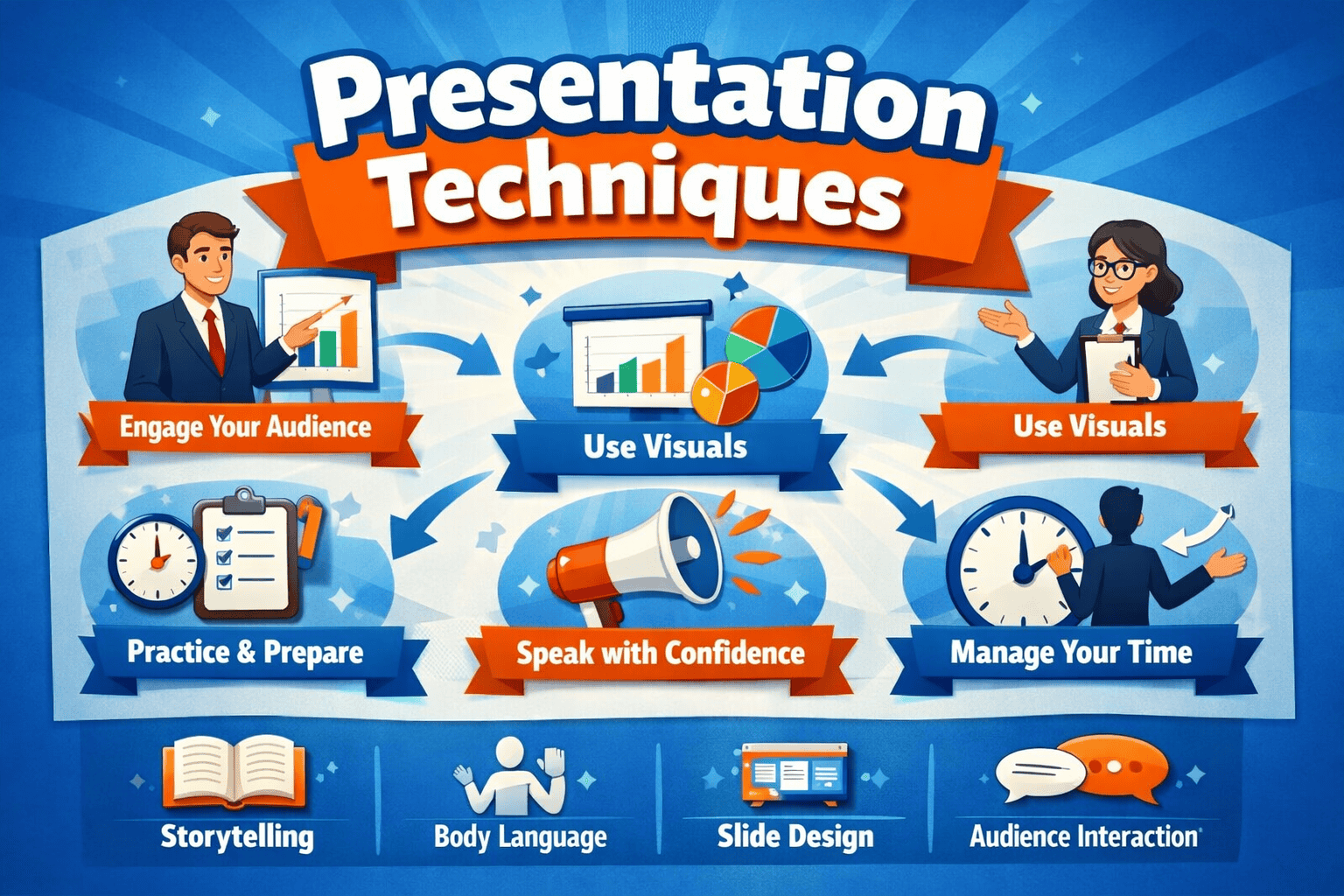
Many people believe that great presenters are simply born with natural speaking skills. In reality, most successful speakers rely on powerful presentation techniques that help them deliver clear, engaging, and memorable messages.
Effective presentations are not just about slides or information. They involve storytelling, audience engagement, structure, and confidence. When these elements come together, presentations become powerful tools for persuasion and communication.
In this guide, you will learn 10 proven presentation techniques used by successful speakers to captivate audiences, explain ideas clearly, and deliver impactful presentations. These techniques are widely used by professional speakers, business leaders, educators, and trainers around the world.
1. Start With a Powerful Opening
One of the most important presentation techniques used by successful speakers is starting with a strong opening. The first few minutes of your presentation determine whether your audience will stay interested or lose focus.
Instead of beginning with a generic introduction, skilled presenters capture attention immediately.
Effective opening strategies include:
- Asking a thought-provoking question
- Sharing a surprising statistic
- Telling a short story
- Presenting a relatable problem
For example, instead of saying “Today I will talk about communication skills,” you might begin with a question such as:
“Have you ever attended a presentation that was so boring you stopped listening after five minutes?”
This approach instantly engages the audience and makes them curious about what comes next.
2. Structure Your Presentation Clearly
A clear structure is essential for an effective presentation. Successful speakers organize their ideas in a logical sequence so the audience can easily follow along.
A simple and effective structure usually includes:
Introduction
- Introduce the topic
- Explain why it matters
- Outline what the audience will learn
Main Content
- Present key ideas
- Provide examples or evidence
- Use visuals or stories
Conclusion
- Summarize the main points
- Reinforce the key message
- End with a memorable closing thought
When your presentation has a clear structure, your audience can absorb the information more easily and remember it longer.
3. Use Storytelling to Make Ideas Memorable
Storytelling is one of the most powerful presentation techniques used by successful speakers. Stories help transform abstract concepts into relatable experiences.
Human brains naturally respond to stories. When speakers use storytelling, audiences become emotionally connected to the message.
For example, instead of explaining a theory or statistic, you could describe a real-life situation that demonstrates your point.
Effective presentation stories often include:
- A challenge or problem
- A turning point
- A lesson or solution
Stories make presentations more engaging and help audiences remember key ideas long after the presentation ends.
4. Focus on Your Audience
Great presenters understand that presentations are not about the speaker—they are about the audience.
Before preparing your presentation, ask yourself questions such as:
- Who is my audience?
- What do they already know?
- What problems are they facing?
- What value will they gain from this presentation?
By understanding your audience’s needs and interests, you can tailor your message to make it more relevant and useful.
For example, a presentation for business executives should focus on strategic insights and results, while a presentation for students may require simpler explanations and examples.
5. Use Visual Aids Effectively
Visual aids such as slides, charts, and images can greatly improve presentation clarity when used correctly. However, poorly designed slides can distract or overwhelm the audience.
Successful speakers use visuals to support their message rather than replace it.
Best practices for visual presentations include:
- Keep slides simple and uncluttered
- Use short phrases instead of long paragraphs
- Include relevant charts or images
- Use readable fonts and clear layouts
Remember that slides should enhance your message, not become the presentation itself. The audience should focus on your explanation, not on reading text-heavy slides.
6. Maintain Strong Body Language
Body language plays a major role in communication. Research shows that nonverbal cues often communicate more than words.
Confident speakers use body language to reinforce their message.
Important body language techniques include:
- Standing upright with confident posture
- Making natural hand gestures
- Moving purposefully rather than pacing nervously
- Maintaining eye contact with the audience
Eye contact is especially important because it helps build trust and connection with listeners.
Avoid common mistakes such as crossing your arms, looking down constantly, or turning your back to the audience.
7. Speak Clearly and With Confidence
Clear delivery is essential for a successful presentation. Even well-prepared content can lose impact if the speaker speaks too quickly, too softly, or without enthusiasm.
Successful speakers focus on three important aspects of vocal delivery:
Pace
Speak at a comfortable speed so the audience can understand your ideas.
Tone
Use variation in tone to emphasize important points and keep the presentation engaging.
Volume
Ensure that everyone in the room can hear you clearly.
Pausing at the right moments is also a powerful technique. A short pause after an important statement allows the audience to reflect on the message.
8. Engage the Audience Actively
Audience engagement is another hallmark of successful presentations. Passive listeners often lose focus quickly, so skilled speakers involve the audience whenever possible.
Ways to increase audience engagement include:
- Asking questions
- Encouraging short discussions
- Requesting audience opinions
- Using quick polls or show-of-hands
When the audience participates, they become more attentive and invested in the presentation.
Interactive presentations are often more memorable than lectures where the speaker talks continuously without involving listeners.
9. Use Examples and Real-World Applications
Successful speakers know that abstract ideas can be difficult to understand. That is why they frequently use examples and real-world applications.
Examples help audiences see how a concept works in practice.
For instance, if you are discussing leadership skills, you could mention real business situations where strong leadership made a difference.
Using examples can help:
- Clarify complex concepts
- Strengthen credibility
- Make information more relatable
Practical examples make presentations feel useful rather than theoretical.
10. End With a Memorable Conclusion
The conclusion of a presentation is just as important as the introduction. Successful speakers finish their presentations with a clear and memorable closing message.
An effective conclusion usually includes:
- A summary of key points
- A final insight or takeaway
- A call to action
For example, you might encourage your audience to apply the techniques they have learned or reflect on the main idea of the presentation.
A powerful closing statement leaves a lasting impression and ensures that your audience remembers your message.
Common Presentation Mistakes to Avoid
Even experienced speakers sometimes make mistakes that weaken their presentations. Being aware of these mistakes can help you improve your delivery.
Some common presentation mistakes include:
- Reading directly from slides
- Overloading slides with text
- Speaking too quickly
- Failing to engage the audience
- Lack of preparation or practice
Avoiding these errors can significantly improve the effectiveness of your presentation.
Tips to Practice and Improve Your Presentation Skills
Presentation skills improve with practice and preparation. Successful speakers rarely deliver great presentations without rehearsal.
Here are some helpful ways to practice:
Rehearse Your Presentation
Practice your presentation several times to become familiar with the content and timing.
Record Yourself
Recording your practice sessions allows you to evaluate your delivery, body language, and speaking style.
Ask for Feedback
Constructive feedback from colleagues or friends can help identify areas for improvement.
Focus on Continuous Improvement
Each presentation provides an opportunity to refine your skills and learn new techniques.
The Impact of Strong Presentation Techniques
Strong presentation techniques can transform how others perceive your ideas and expertise. When you present information confidently and clearly, people are more likely to trust and remember your message.
Professionals with strong presentation skills often experience benefits such as:
- Greater career opportunities
- Improved leadership influence
- Stronger communication abilities
- Higher confidence in public speaking
Because presentations are common in many careers, developing these skills can significantly enhance professional growth.
Conclusion
Great presentations are not the result of luck or natural talent alone. They are built on effective strategies and proven presentation techniques that help speakers communicate ideas clearly and engage their audiences.
The 10 proven presentation techniques used by successful speakers include starting with a strong opening, organizing content clearly, using storytelling, focusing on the audience, incorporating visuals effectively, maintaining confident body language, speaking clearly, encouraging audience participation, using real-world examples, and ending with a memorable conclusion.
By applying these techniques, anyone can improve their presentation skills and deliver more impactful messages. With preparation, practice, and the right strategies, your presentations can become powerful tools for communication, persuasion, and success.
Frequently Asked Questions (FAQs)
Presentation techniques are methods and strategies used by speakers to communicate ideas clearly, engage audiences, and deliver information effectively during presentations.
They help speakers organize their ideas, maintain audience interest, improve clarity, and ensure the message is memorable.
You can improve your presentation skills by practicing regularly, using clear structures, engaging your audience, and focusing on confident delivery.
One of the most important techniques is understanding and focusing on your audience. When the presentation is relevant to their needs and interests, it becomes more effective.
Yes. Most professional speakers use proven techniques such as storytelling, clear structure, and audience engagement to make their presentations more impactful.