A roofing company may serve 30 cities. A mobile notary may travel throughout several counties. A consulting firm may provide multiple services across an entire state.
Each business has many potential search opportunities, but creating every service and location page manually can require a significant amount of time.
Programmatic SEO provides another option. It uses structured information, reusable page frameworks, and a planned publishing system to create relevant pages at a larger scale.
The objective is not to publish thousands of nearly identical pages. It is to help businesses organize useful service and location information in a way that allows customers to find the specific answers they need.
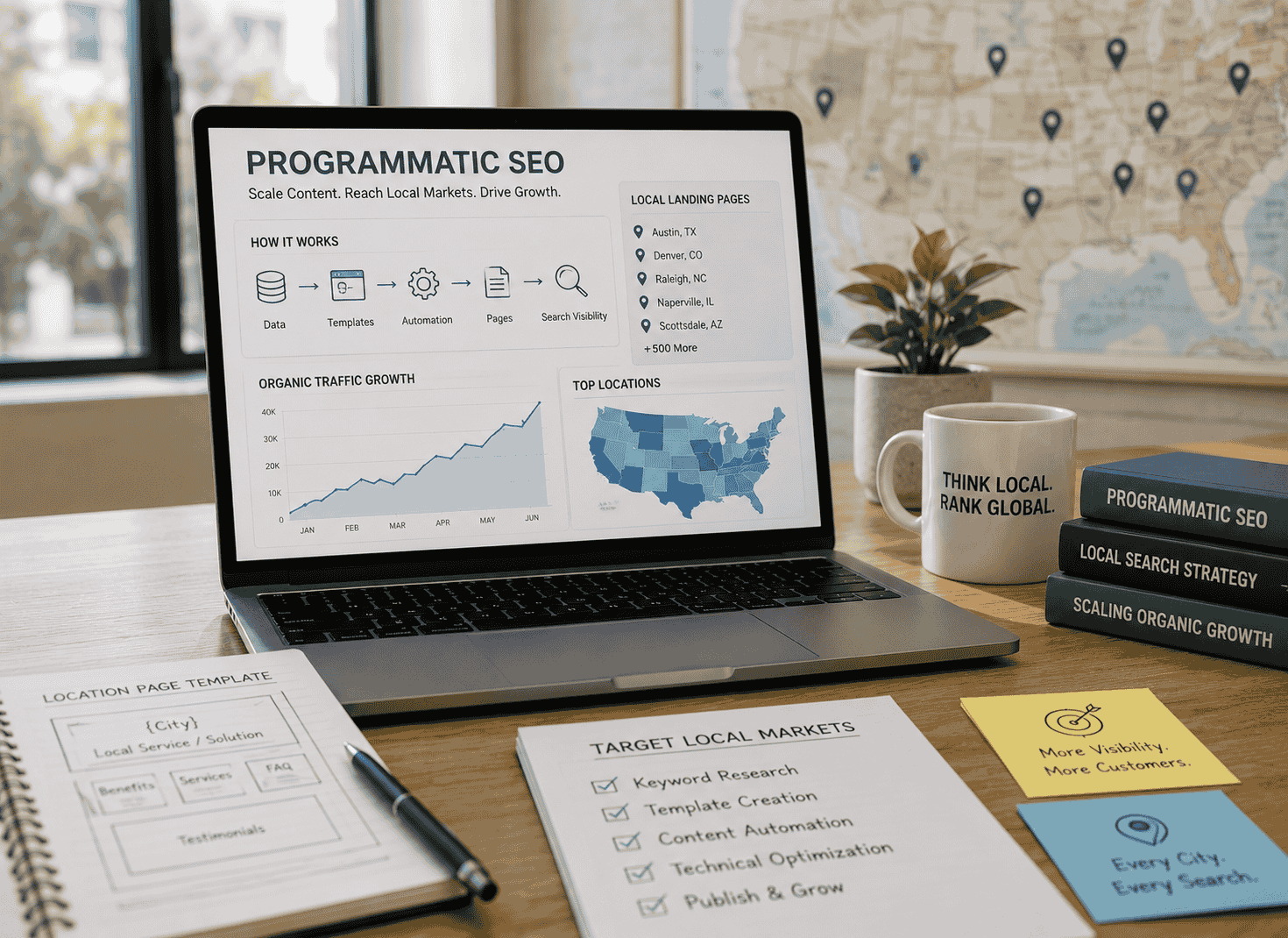
How Programmatic SEO Works
A traditional SEO process usually involves researching, writing, designing, and publishing each page individually. Programmatic SEO uses a repeatable structure that can be populated with carefully prepared information.
A programmatic SEO system may combine:
- A defined list of services.
- A list of relevant cities, counties, or regions.
- Unique information about each market.
- Service-specific questions and answers.
- Business qualifications and capabilities.
- Internal links connecting related pages.
- Structured calls to action.
- Consistent design and navigation.
The system then creates pages for relevant combinations of services and locations.
For example, a business offering four services in 25 cities could have 100 legitimate service and location combinations. Programmatic SEO makes it possible to build those pages through an organized process rather than starting from a blank page every time.
Manual SEO Compared With Programmatic SEO
| Area | Manual Page Creation | Programmatic SEO |
|---|---|---|
| Page production | Each page is created individually | Pages follow a structured publishing framework |
| Best use | Important core pages and detailed resources | Larger groups of services, locations, products, or categories |
| Consistency | May vary between writers or projects | Uses consistent design, structure, and required information |
| Publishing speed | Slower for large page groups | More efficient once the system is prepared |
| Main risk | Limited coverage because of time or cost | Repetitive or low-value pages if quality controls are missing |
| Quality requirement | Original and useful information | Original and useful information at every meaningful page variation |
Programmatic SEO does not eliminate the need for strategy, writing, design, or review. It changes how those elements are organized and applied.
Why Local Markets Create an Opportunity
Customers often search for services using a location.
They may search for:
- A specific service in their city.
- A provider serving their county.
- Emergency help near their location.
- A specialist familiar with a particular region.
- A company that travels to their area.
- Pricing or availability within a local market.
A general services page may not clearly answer whether the company serves that customer’s location. A properly developed local page can provide that answer while explaining the service in greater detail.
“Many businesses serve far more areas than their websites communicate,” said Elias Curtis, founder of Transformed Design Inc. “Programmatic SEO can help them build organized coverage for those markets, but every page still needs a legitimate purpose. Scaling content should never mean scaling empty pages.”
What Makes a Location Page Useful?
A strong local page should do more than replace one city name with another.
Useful location content may include:
- The specific service available in that area.
- The types of customers commonly served.
- Service boundaries or travel availability.
- Local scheduling or response information.
- Relevant regulations or regional considerations.
- Examples of work completed in the broader area.
- Frequently asked questions from local customers.
- Clear contact and appointment options.
Not every page needs to include every item. The information should reflect what is relevant and accurate for the business.
If two pages provide exactly the same information except for the city name, they may offer little value to visitors. The page should help someone understand why it exists and how it relates to the person’s specific need.
Programmatic Does Not Mean Automatic
The word “programmatic” can make the process sound completely automated. In practice, the strongest strategies require careful preparation before pages are generated.
A responsible process includes:
- Identifying real search opportunities.
- Selecting services and locations the business actually supports.
- Building a content structure around customer needs.
- Preparing accurate business and market information.
- Creating quality standards for every page.
- Reviewing pages before large-scale publication.
- Monitoring indexing, engagement, and conversions.
- improving or removing pages that do not provide sufficient value.
Automation can help assemble and publish content, but human review remains important. Business facts, service descriptions, location details, and calls to action must remain accurate.
The Difference Between Scale and Spam
Programmatic SEO can become harmful when businesses publish large numbers of pages solely to manipulate search rankings.
Google defines scaled content abuse as generating many pages primarily to manipulate rankings rather than help users. Its guidance applies whether the content is created by people, automation, artificial intelligence, or a combination of methods. Google Search Central
This distinction is important.
| Responsible Scale | Low-Value Scale |
|---|---|
| Pages address real customer needs | Pages exist only to target keyword variations |
| Locations reflect actual service areas | Locations are included even when the business does not serve them |
| Information is accurate and reviewed | Content is published without meaningful review |
| Pages provide useful distinctions | Pages repeat the same language with minor substitutions |
| Visitors have a clear next step | Pages are designed only to attract search traffic |
| Performance is monitored over time | Page quantity is treated as the primary goal |
The number of pages is not the only issue. Their purpose, quality, accuracy, and usefulness are what matter.
Measuring More Than Rankings
A programmatic SEO campaign should not be evaluated only by how many pages are published.
Businesses should also monitor:
- Whether search engines can crawl and index the pages.
- Which service and location combinations receive impressions.
- Whether visitors remain on the pages.
- Which pages generate calls, forms, or appointments.
- Whether information remains accurate over time.
- Whether similar pages should be combined or improved.
- Which markets show meaningful customer demand.
This information can help the company strengthen useful pages and avoid maintaining content that does not support customers or business goals.
A Scalable Path to Local Visibility
Programmatic SEO gives growing businesses a structured way to communicate their services across multiple markets. It can expand search coverage, improve local relevance, and make large content projects more manageable.
However, the strategy should begin with real customer needs, accurate business information, and clear quality standards. Technology can increase the number of pages a company publishes, but it cannot replace usefulness.
Transformed Design Inc., founded by Elias Curtis in 2009, helps businesses develop programmatic SEO strategies that connect service and location content with website design, search visibility, lead generation, CRM technology, and customer follow-up.