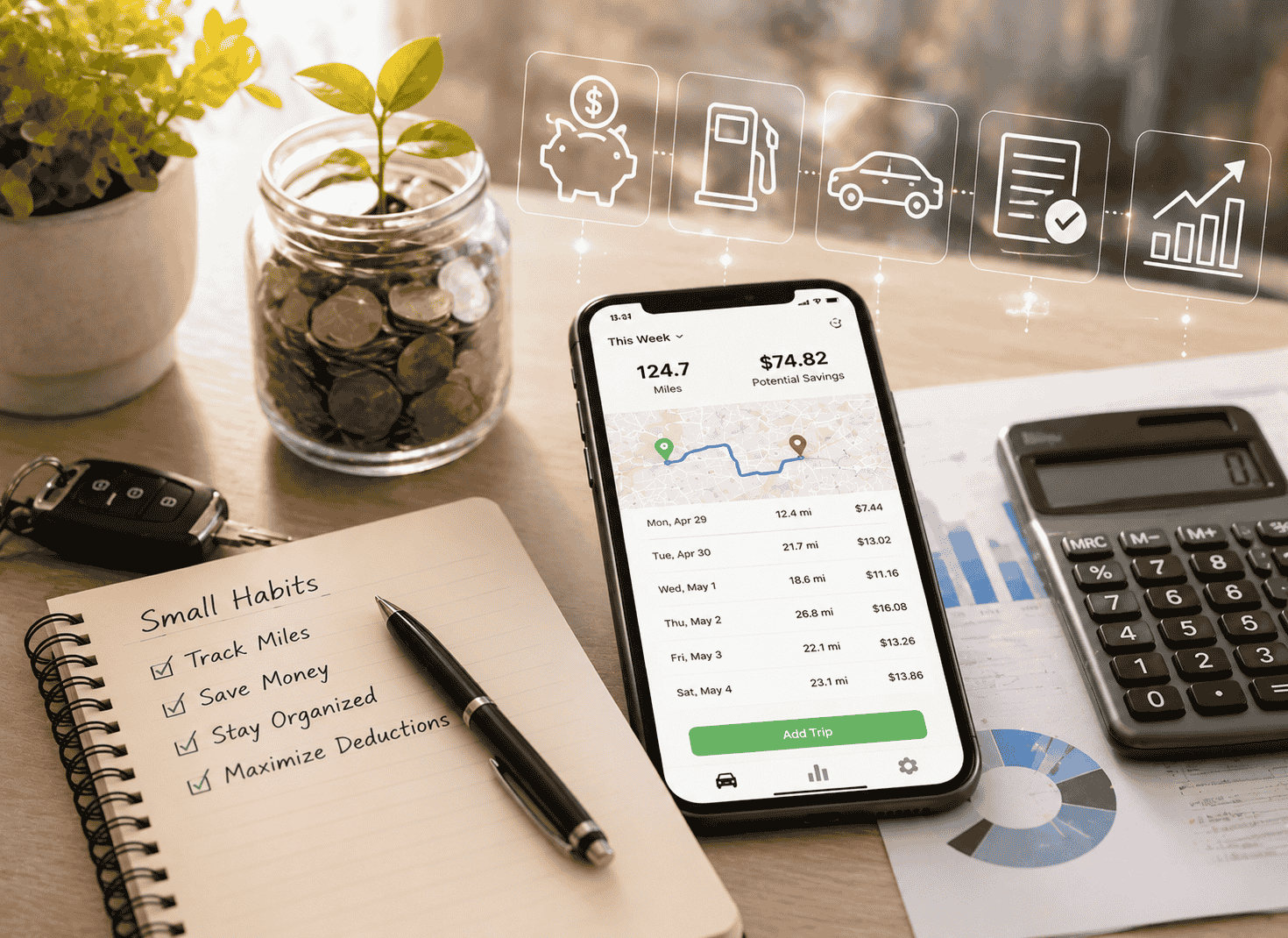
The biggest wins in personal finance rarely come from dramatic moves. They come from small, consistent habits that quietly compound over time. Most people chase the flashy decisions, the investment tip or the budgeting overhaul, while ignoring the steady leaks draining their money in the background. One of the most common and most fixable of these leaks is unclaimed business mileage. If you drive for work in any capacity, adopting a mileage tracker is exactly the kind of tiny habit that returns far more than the effort it costs. It is a small discipline with an outsized payoff.
The principle: small habits, large results
Smart money management is less about willpower and more about systems. The people who build wealth tend to automate good behavior so it happens without constant effort. Mileage tracking fits this philosophy perfectly. It is:
- Low effort, taking seconds a day once set up
- Automatic, running in the background without your attention
- Compounding, adding up to a large sum across a full year
- Repeatable, delivering the same benefit every tax season
This is the opposite of a financial crash diet. It is a habit you set once and benefit from indefinitely.
The leak most people never notice
Unclaimed mileage is the perfect example of a silent financial drain. The money is yours to keep, the rules clearly allow it, and yet most people who drive for work let a chunk of it slip away every year. Why? Because the deduction only exists if you can prove it, and proving it requires a record most people never keep.
The leak happens through small, forgettable trips:
- A quick drive to meet a client
- A run to pick up supplies or equipment
- A trip between job sites
- An errand for the business that felt too minor to record
Individually, these feel trivial. Collectively, they add up to thousands of miles a year, and at the current rate, thousands of dollars in lost deductions.
What the habit is worth
To understand why this small habit matters, look at what those reclaimed miles are actually worth. For 2026, the IRS business mileage rate is 72.5 cents per mile. Here is the payoff at different levels of driving:
| Annual business miles | Deduction at 72.5 cents |
|---|---|
| 3,000 | $2,175 |
| 6,000 | $4,350 |
| 9,000 | $6,525 |
| 12,000 | $8,700 |
That deduction reduces the income you are taxed on. Depending on your situation, every few thousand dollars in deductions can keep hundreds of real dollars in your pocket. For a habit that costs you seconds a day, that is an extraordinary return.
Why good intentions are not enough
Plenty of people know they should track their miles. Far fewer actually do it, and the reason is always the same: manual tracking depends on memory and discipline, and both fail under the weight of a busy life. The classic failure pattern:
- You decide to track your miles this year.
- You start strong with a notebook or a note on your phone.
- You forget after a few hectic days.
- You give up, and reconstruct a guess at tax time.
The problem is not your character. It is that you built the habit on the wrong foundation. Relying on memory is a design flaw. Automating the tracking removes the flaw entirely.
How automation makes the habit stick
A mileage tracker works because it does the hard part for you. The only thing left for you to do is a single, easy action that is realistic to sustain:
- The app detects and records your drives automatically.
- You classify each trip as business or personal with one swipe.
- The app stores the date, route, and distance with no further effort.
- At tax time, you export a complete report ready to use.
Because the only manual step is a one-second swipe right after you park, the habit survives even the busiest weeks. That is the secret to making any financial habit work: shrink the required effort until skipping it is harder than doing it.
Building it into a broader money routine
Mileage tracking works best as part of a small set of automatic money habits that compound together. Consider pairing it with:
- Automatic savings transfers the moment you get paid
- A dedicated tax account if you are self-employed
- Quarterly reviews of your income, expenses, and deductions
- Expense tracking so no legitimate write-off is missed
None of these require heroic effort. Each is a small system that quietly improves your finances, and together they add up to real money over time.
The record-keeping rule that protects you
There is one important reason automation matters beyond convenience: the records have to hold up. Tax authorities expect a log kept at or near the time of each trip, capturing the date, destination, purpose, and miles. Estimates assembled later can be rejected. A reconstructed guess is not just less accurate; it may not survive scrutiny at all.
An automatic tracker produces exactly the kind of detailed, time-stamped record that protects your deduction. That is the difference between a habit that merely feels productive and one that actually defends your money.
Getting started today
The beauty of this habit is how quickly you can adopt it. There is no learning curve and no ongoing burden:
- Install a tracker and enable automatic trip detection.
- Grant location access so it works in the background.
- Classify trips daily, right after you park.
- Keep business and personal separate for a clean record.
- Export your log each quarter if you pay estimated taxes.
The bottom line
The most effective financial habits are the small ones you can sustain forever, and reclaiming your business mileage is among the best of them. It requires almost no effort once automated, it produces records that protect you, and it returns thousands of dollars a year that most people simply let slip away. You are already doing the driving. Capturing it with a mileage tracker is the kind of small, smart habit that quietly builds real financial strength, one trip at a time.