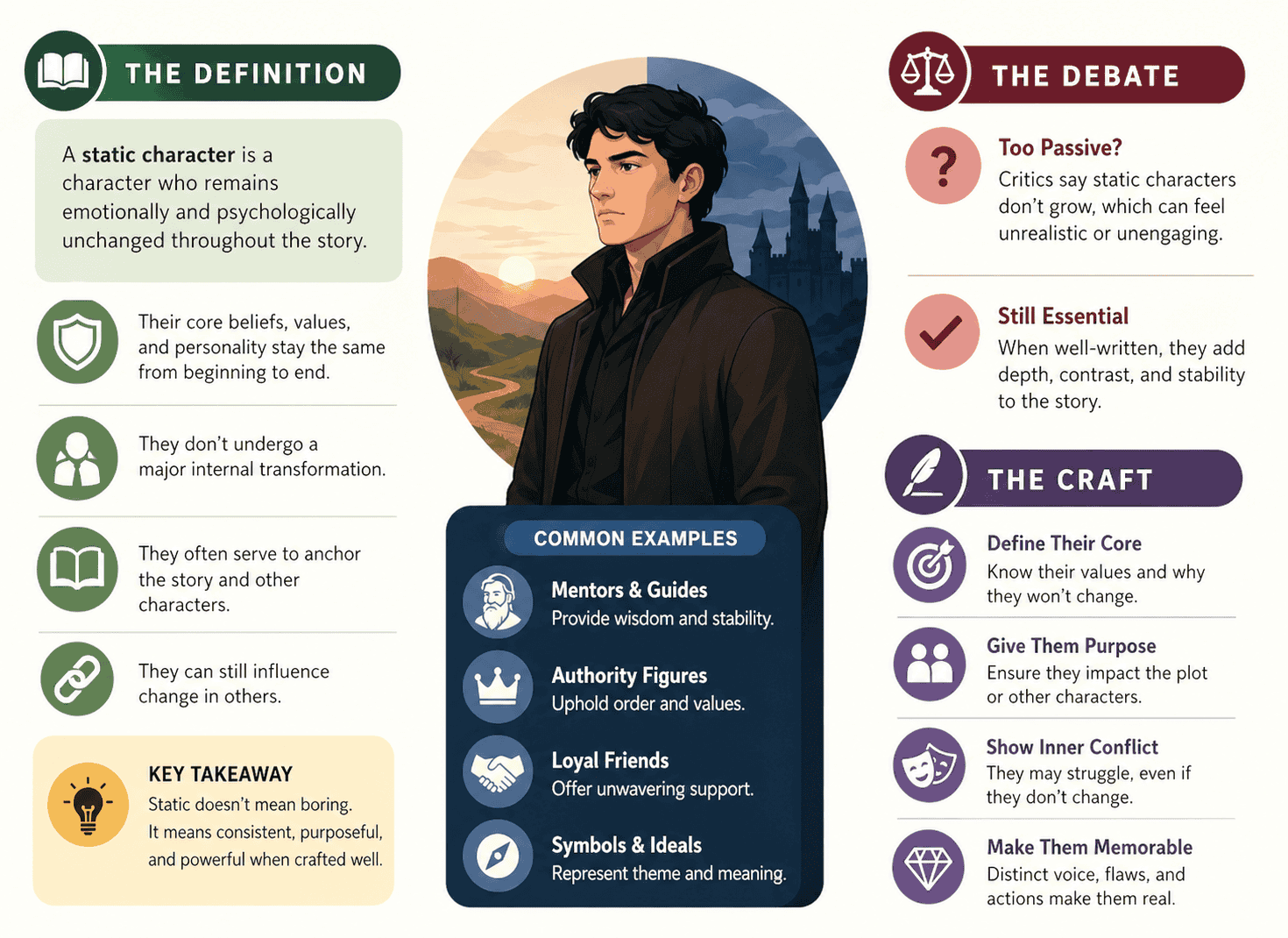
A static character is a character whose core personality, beliefs, values, and worldview do not fundamentally change from the beginning of a story to the end.
You’ll find that definition (or something close to it) on every major literature site. What they don’t tell you is that one word in that sentence does almost all the work: fundamentally.
A static character can experience external events. They can react emotionally, suffer loss, achieve victory, learn new information, or even appear to grow. What they cannot do is become a different person because of those experiences.
The test isn’t “did anything happen to this character?” It’s “are they the same person — same core values, same driving beliefs, same essential self — at the end as they were at the beginning?”
If the answer is yes, you have a static character. If something at the center of them has shifted irreversibly, they’re dynamic.
That distinction sounds simple. In practice, it produces some of the most heated debates in literary analysis — and some of the most common mistakes in how the concept gets taught.
The Four-Character Matrix (What Almost Nobody Teaches)
Here is the single most important thing missing from every guide about static characters: static/dynamic and flat/round are two completely separate axes. They measure different things, and confusing them — which most introductory materials do — produces exactly the kind of muddled thinking that makes “static character” feel like a slippery concept.
These are the two axes:
- Static ↔ Dynamic measures change over time. Does the character’s core self transform?
- Flat ↔ Round measures complexity of personality. How many dimensions does the character have?
Because these axes are independent, four combinations are possible:
| FLAT (simple, one-dimensional) | ROUND (complex, multi-layered) | |
|---|---|---|
| STATIC (doesn’t change) | Simple personality, stays the same. e.g., Crabbe and Goyle, most henchmen | Complex personality, doesn’t change. e.g., Atticus Finch, Sherlock Holmes |
| DYNAMIC (does change) | Simple personality, somehow changes. (rare; often signals incomplete writing) | Complex personality, undergoes real transformation. e.g., Elizabeth Bennet, Walter White |
The most misunderstood quadrant is static + round. Most people assume that if a character is static, they must be simple. Atticus Finch demolishes that assumption. He is one of the most fully realized characters in American fiction — morally complex, emotionally textured, with a rich inner life — and he changes almost not at all across the entire novel. His consistency is not a limitation. It is, as we’ll see, precisely the point.
Understanding which quadrant a character belongs in — and choosing that quadrant deliberately — is the foundation of intentional character writing.
Static vs. Dynamic: The Full Picture
The contrast between static and dynamic characters is where most guides spend most of their time. Usually it’s a paragraph saying “dynamic characters change, static ones don’t.” Here’s what a fuller understanding looks like.
Dynamic characters
undergo fundamental internal transformation. Something about who they are — their core beliefs, their self-understanding, their moral framework, their deepest commitments — is different at the end of the story from what it was at the beginning. This transformation is usually caused by the story’s central conflict pressing hard enough on the character that their old self can no longer hold.
Static characters
resist this transformation, either because of narrative design (the author needs them to remain constant) or because the story’s events simply don’t press hard enough on their particular core to produce change. Importantly, “resisting transformation” doesn’t mean passivity. Static characters can be enormously active forces in a story. They drive plot, create conflict, embody themes, and shape the lives of every character around them.
There is a common misconception — one that most guides perpetuate by listing examples and then contradicting themselves — that static characters are “rarely protagonists.” The truth is more interesting:
Static protagonists work brilliantly in specific storytelling contexts:
- Genre fiction — Sherlock Holmes, James Bond, and most classic detective or thriller protagonists are static by design. The genre contract depends on knowing who the protagonist is and watching them apply their unchanging self to a new problem.
- Tragedy — In many great tragedies, the protagonist’s inability to change is the tragedy itself. Ahab cannot stop chasing the whale. Macbeth cannot retreat from ambition. Their staticism is what makes destruction inevitable.
- Serial/franchise storytelling — When a character appears across dozens of books, films, or episodes spanning decades, their core must remain stable. The audience’s relationship with the character depends on it.
- Moral exemplars — A protagonist who stands as a fixed moral center — unchanging in their principles while the world around them shifts — serves a different purpose than one who arcs, but no less powerful a one.
The claim that static protagonists are rare isn’t wrong exactly — they’re less common than dynamic ones in literary fiction. But the better lesson for writers is not “avoid static protagonists” but “understand what you’re choosing when you make one.”
Static vs. Flat: The Confusion That Won’t Die
Nearly every guide on this topic says something like: “Static and flat characters are often confused, but they’re different.” Then they give it one or two sentences and move on. The distinction deserves more.
Here is the clearest way to understand it:
Flat describes the interior architecture of a character — how complex or simple their personality is. A flat character is defined by essentially one trait: the bully, the comic sidekick, the wise elder, the naive innocent. There is not much behind the surface.
Static describes whether that interior architecture changes — regardless of how complex it is. A static character keeps the same essential self from beginning to end.
The confusion arises because most flat characters are also static — a one-note villain who starts bad and stays bad is both flat and static — and because in casual conversation, both terms are used as mild insults meaning “underdeveloped.”
But the distinctions matter:
A flat character can technically be dynamic. If a two-dimensional character somehow changes (even shallowly), they are no longer static. This is unusual and often feels unearned in fiction, but it is possible.
A static character is not necessarily flat. This is the more important direction. Atticus Finch, Sherlock Holmes, and Hannibal Lecter are extraordinarily complex. They have rich inner lives, contradictions, depth, history, and nuance. They are also static. Their complexity is not in question — their transformation is.
A useful mental model: think of flat/round as describing the width of a character’s inner world, and static/dynamic as describing whether that world shifts. Wide and unchanging is different from narrow and unchanging, even if both end up in the same column of the matrix.
The Underrated Power of Static Characters
Static characters have a reputation problem. In an era when “character development” has become synonymous with quality storytelling, “no development” reads as “bad writing.” This is a mistake that misunderstands what static characters actually do.
They Carry the Story’s Moral Argument
The most powerful use of a static character — and the one most rarely discussed — is as a thematic anchor. Atticus Finch does not need to change because he is the argument of the novel. In a story about a community’s moral failure, its racism, its cowardice, and its corruption, Atticus represents what human beings are capable of being. His immovability is the thesis.
The story doesn’t need him to learn anything. It needs him to demonstrate something — to show, through sustained example under sustained pressure, that moral courage is possible and what it looks like. If he changed, wavered, or grew disillusioned, the novel would become a tragedy of a different kind. His constancy is the point.
They Make Dynamic Characters Visible
This function is mentioned in most guides but rarely analyzed. You cannot show transformation without a reference point. A dynamic character’s arc is measured against what they were before — and nothing establishes “before” more clearly than a static character standing still while everyone else moves.
Joe Gargery in Great Expectations is the perfect example. Joe is kind, humble, generous, and unsophisticated from the first page to the last. His qualities never waver no matter how Pip treats him. Because Joe is fixed, Pip’s moral descent — his embarrassment, his coldness, his social climbing — is visible and measurable. And when Pip finally returns, changed and chastened, Joe’s unchanged loyalty makes the reconciliation devastating in the best way.
They Create Sustained Dread
A villain who could change but will not is more frightening than one who might. Anton Chigurh in No Country for Old Men operates from a fixed philosophical system. No appeal to mercy, self-interest, logic, or emotion alters his behavior in any meaningful way. There is no argument that reaches him because he has already resolved every question about what he is and what he does. His static nature is not a characterization limitation — it is the source of his horror.
They Serve Genre Contracts
Different genres use static characters differently, and this is almost never discussed:
Tragedy: In tragedy, the static character’s refusal to change is often the mechanism of catastrophe. The tragic flaw is static by definition — if the protagonist could recognize it and correct it, the tragedy wouldn’t happen. Ahab, Macbeth, Othello — their destruction is encoded in their unchanging nature.
Comedy: The unchanging fool is the engine of comedy. Basil Fawlty makes the same catastrophic social errors in every episode. The humor depends entirely on his inability to learn. A version of Basil who grew and improved would cease to be funny; he would cease to be Basil. Static characters in comedy are frequently protagonists, which complicates the claim that static protagonists are rare.
Thriller and Horror: The implacable antagonist — relentless, unwavering, immune to persuasion — is a genre staple precisely because their static nature converts into sustained dread. What makes the slasher, the terrorist, the unstoppable villain frightening is the same thing that makes Anton Chigurh frightening: the certainty that nothing will stop them.
Serial Fiction: When a character spans multiple installments across years or decades, their core must be stable. James Bond across 26+ films and multiple actors remains essentially the same: charming, lethal, British, unflappable. The audience’s affection for the character is partly an affection for the certainty of who he is. Franchise characters who change too dramatically often face audience resistance — not because change is bad, but because the serial contract depends on continuity of character.
Coming-of-Age: In coming-of-age stories, the adults surrounding the young protagonist are typically static, and this is deliberate. Scout Finch changes enormously across To Kill a Mockingbird. Atticus does not. The contrast between Scout’s evolving understanding and Atticus’s stable moral center is what makes her growth visible and meaningful.
The “Reader Perception Shift”: A Technique Almost No One Teaches
Here is a sophisticated storytelling device that the top results for “static character” almost never discuss, and when they touch it, they don’t develop it.
A character can be fully, genuinely static — their core self never changes — and yet the reader’s understanding of them can transform dramatically over the course of the story. When this works well, it creates all the emotional power of a character arc without the character technically having one.
The mechanism: the author withholds information. As the story progresses, revelations about the character’s past, their hidden motivations, their secret history, or their unseen inner life recontextualize everything the reader thought they knew. The character hasn’t changed. The frame has.
Severus Snape
is the definitive example. Across seven books, Snape appears to be one thing, then another, then something else entirely. But Snape himself never changes. His love for Lily Potter is fixed and absolute from the moment it was formed. His grief, his guilt, his grudging protection of Harry — all of it is constant. What changes, book by book, revelation by revelation, is the reader’s understanding of what that constancy means. The final revelation in The Deathly Hallows lands with extraordinary force precisely because Snape himself is unchanged — it is we who have been transformed.
Boo Radley
works similarly. Boo is the same shy, traumatized, gentle man throughout To Kill a Mockingbird. He does not grow or change. But Scout’s perception of him — and the reader’s — travels from monster to mystery to guardian to tragic figure. The same character, seen through an evolving lens, becomes richer and more moving as the story progresses.
Why this technique matters
It allows writers to give minor or background characters enormous emotional resonance without constructing a full arc for them and rewards attentive readers. It creates genuine surprise without the cheat of retroactive characterization. And it demonstrates that the question “is this character static?” is separate from the question “is this character interesting?” — a distinction that too many guides fail to make.
Why Real People Stay Static (And Why This Matters for Your Fiction)
This is the question no guide about static characters asks, and it’s arguably the most important one for writers.
Fiction feels false when characters change without sufficient pressure. It also feels false — in a different, subtler way — when characters refuse to change without believable reasons. When writing a static character with complexity, understanding why they won’t change gives them psychological weight and makes their constancy feel earned rather than observed.
Real people stay static for a range of psychologically coherent reasons:
Genuine conviction
Some people are not static because they can’t change; they are static because they have examined the question and believe they are right. Atticus Finch is not an accident of temperament — he is a man who has thought carefully about justice and knows where he stands. His constancy under pressure is a form of courage, not a failure of imagination.
Trauma response
Psychologically, significant trauma can freeze a person at the moment of their worst experience. They are not choosing to stay static; the work of change has become inaccessible. This produces tragic static characters — those who cannot move on from a formative wound. Miss Havisham in Great Expectations is the most extreme literary example: she has literally stopped time at the moment of her abandonment.
Ideological rigidity
Characters who have organized their entire identity around a belief system — religious, political, moral, philosophical — may be genuinely incapable of updating that system in response to new evidence, because the cost of doing so is the destruction of their self. Such characters are not stupid. They are defended. The certainty that reads as strength from the inside can read as blindness from the outside.
Narcissism or structural incapacity for empathy
Some characters cannot change because they cannot genuinely perceive other people’s inner lives as real. If you do not really believe that other people have interiority comparable to your own, other people’s suffering cannot teach you what the author intends it to. This is chilling when used well, because it renders certain characters immune to the moral lessons the plot is trying to impart.
It’s working
The simplest and most overlooked reason. A character who consistently gets what they want, using who they are, has no incentive to become someone else. Bond does not need to be more emotionally available because his emotional unavailability is not costing him anything he values. Understanding what a static character is getting from their constancy — what it protects, enables, or provides — makes them feel real.
The comic archetype
Certain character types derive their entire narrative function from their consistency. The bumbling sidekick who never learns. The pompous authority figure who never doubts himself. The relentlessly cheerful optimist who cannot be taught cynicism. These are not failed dynamic characters. They are comic archetypes, and their humor depends absolutely on their stasis.
When you build a static character — especially a complex, round one — knowing their reason for not changing is essential, even if that reason never appears explicitly on the page. Readers feel the presence or absence of that inner logic.
Intentional vs. Accidental Static Characters
This is the most practically important distinction in the entire concept, and it appears in exactly zero of the top-ranking articles on static characters.
An intentional static character is one whose constancy serves a deliberate narrative, thematic, or structural purpose. The writer made a conscious choice: this character should not arc. Their consistency does something specific — anchors a theme, provides contrast, embodies a moral argument, fulfills a genre requirement, creates dread. The decision feels like craft.
An accidental static character is one who doesn’t change not because the writer decided so, but because the writer didn’t develop them. No arc exists not by design but by neglect. The character was introduced, used for plot purposes, and never revisited at a deeper level. Their constancy is not meaningful — it is simply the absence of attention.
Readers feel this difference immediately, even when they can’t articulate it.
The test is simple: can you state clearly, in one or two sentences, why this character should remain static? What narrative, thematic, or structural purpose does their constancy serve? If you can answer that question specifically, you have an intentional static character. If the honest answer is “I didn’t really think about it,” the character may deserve more work — or more honest acknowledgment of their function.
This doesn’t mean every minor character needs to be intentionally designed to be static. Most of them are static simply because they’re minor — a brief appearance doesn’t provide enough space for transformation to occur or matter. But for any character who occupies significant page space and remains unchanged, the question is worth asking.
The Examples Everyone Uses — And What’s Actually True About Them
Sherlock Holmes — Genuinely Static, Deliberately So
Holmes is one of the cleanest examples in the canon. Across dozens of Doyle stories, countless adaptations, and well over a century of cultural presence, Holmes remains fundamentally the same: brilliant, arrogant, emotionally guarded, empirically voracious, socially indifferent. He does not learn to value human connection, does not become humble. He does not develop.
This is not a failure of characterization. It is the characterization. The pleasure of a Holmes story is watching an exceptional and fixed mind applied to a new problem. If Holmes changed — if he grew emotionally, softened, became more ordinary — the stories would lose their particular appeal. His readers have a relationship with him that depends on knowing exactly who he is before the story begins.
Holmes is static and round: an enormously complex character who does not arc.
Atticus Finch — Static as Thematic Architecture
Atticus is the clearest example of a static character serving as the thematic argument of a novel. He does not change, because change in him would undermine everything the book is trying to say. His moral courage under social pressure, his patient dignity, his refusal to be made cynical — these are not personality traits waiting to develop. They are the novel’s thesis rendered as a human being.
What makes Atticus interesting as a literary study is that his constancy is also the novel’s limitation, depending on how you read it. Later critical rereadings of To Kill a Mockingbird have pointed out that Atticus’s unwillingness to confront systemic racism more directly — his patience and proceduralism in a system designed to fail Black citizens — is itself a form of stasis with real costs. Whether this makes him a more complex character or a more flawed one is a legitimate debate. But it underscores that static characters are not exempt from moral analysis; their constancy can be examined, critiqued, and found wanting.
Anton Chigurh — Static as the Purest Expression of Dread
Chigurh arrives in No Country for Old Men fully formed. His philosophy, his methods, his self-certainty, and his absolute indifference to mercy are established in his first scene and never altered by anything that happens subsequently. Every encounter that might humanize or destabilize him — near-death, failure, confrontation — fails to change him. He walks away from each one identically himself.
McCarthy uses Chigurh’s static nature to make an argument about a certain kind of evil: that it is not reachable, not persuadable, and not reducible to a wound or a motive that could be addressed. The novel frames this as something new in the world, or at least new in that landscape. Chigurh’s constancy is not characterization by omission. It is characterization by design, and it produces one of the most unsettling antagonists in modern American fiction.
Romeo — The Example Everyone Miscategorizes
Romeo is listed as a static character by a significant number of major literary resources. The reasoning given: his impulsivity is constant from beginning to end, and this never changes.
This classification deserves to be challenged.
Yes, Romeo’s mechanism — impulsivity, emotional excess, acting before thinking — is consistent throughout. But consider what actually happens to Romeo across the play: he moves from theatrical infatuation with a girl he has never spoken to, to one of the most celebrated depictions of genuine love in Western literature. He experiences murder, exile, grief, and despair of a depth that produces suicidal action. His emotional life is not the same at the end as it was at the beginning; it has been transformed by genuine love, real loss, and the destruction of everything he cared about.
The impulsivity that drives these transformations is static. The interior experience that impulsivity operates on is not. A more accurate framing might be: Romeo is a character whose method of engaging with the world never changes, but whose inner world genuinely transforms. Whether that makes him static or dynamic depends on how tightly you define “core self” — and that ambiguity is worth preserving and discussing, not resolving by rote.
Mr. Darcy — Not Static, Regardless of What Some Sites Say
Several literary resources list Mr. Darcy as a static character on the grounds that his “underlying decency never changes.”
This is incorrect by any rigorous definition of the term.
Darcy begins Pride and Prejudice in the grip of class snobbery so pronounced that it renders him incapable of seeing Elizabeth as a social equal. His first proposal is a masterwork of condescension — he essentially tells her he is proposing despite himself, despite her family, despite all reason. By the novel’s end, he has genuinely reckoned with his arrogance, changed his behavior, supported the Bennet family at significant personal cost with no expectation of credit, and proposed again in terms of honest humility.
This is not a revelation of pre-existing qualities. This is change. The shift from Darcy in Chapter 1 to Darcy in Chapter 60 is one of the most analyzed and celebrated character transformations in the English literary canon. He is dynamic, and listing him as static is an error.
Atticus Finch, Boo Radley, and Miss Maudie — Static Supporting Cast, Dynamic Protagonist
The adult world of To Kill a Mockingbird is largely static, and deliberately so. Atticus holds his position throughout. Miss Maudie holds hers. Boo Radley remains the same frightened, gentle, hidden man he has always been. The static adult world creates the backdrop against which Scout’s changing perception — the real arc of the novel — is made visible and meaningful.
This is a structural choice, not a writing limitation. Harper Lee built her novel’s scaffolding out of static characters precisely so that her dynamic one would move.
How to Write a Compelling Static Character
Most guides warn that static characters can feel thin. Almost none of them explain how to prevent this. Here is practical craft guidance:
Know Their Reason for Not Changing
Before you write a static character, answer this: why won’t they change? Not “because the plot doesn’t require it” — that’s the author’s reason, not the character’s. What in their psychology, history, belief system, or situation makes transformation unavailable to them? The answer doesn’t need to appear in the text, but it needs to exist in your understanding. Readers feel the difference between a character whose constancy is grounded and one whose constancy is just inertia.
Make Their Consistency Active, Not Passive
A static character who simply refuses to do things is inert. A static character whose unchanging nature drives action is compelling. Their consistency should generate events — create conflicts, force confrontations, make impossible demands on the people around them, or provide the kind of reliable, unwavering support that other characters organize their lives around. The static quality should be doing narrative work.
Let New Situations Reveal Hidden Facets
You don’t need an arc to create depth. Put the same character in progressively more extreme or unusual situations and let aspects of their personality emerge that were always there but not yet visible. This is how Sherlock Holmes works across dozens of stories: each new case doesn’t develop him, it illuminates him. A new facet is revealed, not created. The reader’s understanding of the character grows even though the character doesn’t change. This is, in miniature, the “reader perception shift” technique.
Use Them as a Measuring Stick
Static characters become more powerful when placed next to dynamic ones. Their constancy is most meaningful when contrasted with change. If you have a static character in your story, ask: who is changing nearby? What does the static character’s consistency reveal about the other character’s transformation? The static character and the dynamic one should illuminate each other.
Give Their Constancy a Cost
The most interesting static characters are not unchanged because it’s easy. They remain who they are despite enormous pressure to become otherwise. Atticus holds his moral position in a community that reviles him for it. Chigurh maintains his philosophy in a world that keeps trying to introduce exceptions. The cost of constancy — what it takes, what it sacrifices — is what makes static characters feel like they’re making choices rather than simply being drawn that way.
Distinguish Between Core and Surface
Not every consistent trait makes a character static. A dynamic character can have consistent surface behaviors — a nervous laugh, a preference for solitude, a talent for deflection — while undergoing fundamental internal change. The static quality applies to the core: beliefs, values, self-understanding, moral framework. Make sure you’re clear on which of your character’s qualities are surface (allowed to vary, probably variable) and which are core (the things that, if they changed, would signal a different person).
Quick Reference
The Essential Definitions
| Term | What It Measures | Definition |
|---|---|---|
| Static | Change | Does not fundamentally change from beginning to end |
| Dynamic | Change | Undergoes fundamental internal transformation |
| Flat | Complexity | Simple, one-dimensional personality |
| Round | Complexity | Complex, multi-dimensional personality |
The Four Combinations
| Type | Description | Classic Example |
|---|---|---|
| Static + Flat | Simple and unchanging | Crabbe & Goyle, most henchmen |
| Static + Round | Complex and unchanging | Atticus Finch, Sherlock Holmes |
| Dynamic + Flat | Simple but somehow changes | Rare; often signals incomplete writing |
| Dynamic + Round | Complex and transforming | Elizabeth Bennet, Walter White |
The Functions Static Characters Serve
- Thematic anchor — embodies the story’s central argument
- Moral contrast — highlights the dynamic character’s transformation
- Narrative engine — drives plot through their unchanging nature (especially in tragedy)
- Genre anchor — provides stability in serial or genre fiction
- Sustained antagonist — creates dread through implacable consistency
- Measuring stick — makes the dynamic protagonist’s change visible
The Questions to Ask
Before using a static character, ask yourself:
- Why won’t this character change? (The psychological/narrative reason)
- What is their constancy doing for the story? (The functional purpose)
- Is this a deliberate choice or an oversight? (Intentional vs. accidental)
- Who are they standing next to? (How does their constancy contrast with others?)
- What is the cost of their constancy? (What do they sacrifice by remaining who they are?)
The Deeper Truth About Static Characters
Here is what most discussions of static characters finally miss.
The dynamic character is the story of someone becoming. The static character is the story of someone being. Both are legitimate stories. Both are true to human experience. In real life, we know people who change profoundly in response to what happens to them, and we know people who do not — who emerge from the same pressures that would reshape others, still recognizably themselves. Both kinds of people are real, complex, and worth writing about.
The mistake is assuming that “becoming” is more interesting than “being.” For the reader who needs to see growth, the dynamic arc is more satisfying. For the reader who needs to see constancy — who needs to believe that certain qualities of character can survive pressure intact — the static character can be more moving, and more necessary.
Atticus Finch does not change. And that, for many readers, is exactly why they have loved him for sixty years.