Most people at networking events feel exactly the way you do. They just hide it better. And the good news? Networking is a skill, not a personality trait. You don’t have to be naturally outgoing, effortlessly charming, or “built for small talk” to walk away from an event with real, valuable connections.
Walking into a room full of strangers is uncomfortable. For most people, it’s genuinely hard.
Your heart rate picks up. You scan the room and everyone already seems to know someone, You grab a drink just to have something to do with your hands, You hover near the edges, waiting for the “right moment” that never quite arrives.
Sound familiar? You’re in very good company.
This guide gives you 25 practical, honest tips that work — especially if networking makes you uncomfortable, anxious, or just deeply bored.
Why Most Networking Advice Fails Introverts
Most networking tips are written for extroverts by extroverts.
“Just introduce yourself!” “Work the room!” “Talk to as many people as possible!”
That advice ignores how draining large social events feel for introverts — and how forced, surface-level connections benefit almost no one.
The better approach: Fewer, deeper conversations. Intentional preparation. Selective follow-through. Quality over volume.
That’s what this guide is built around. Not how to become a social butterfly — but how to show up, connect genuinely, and leave with something real.
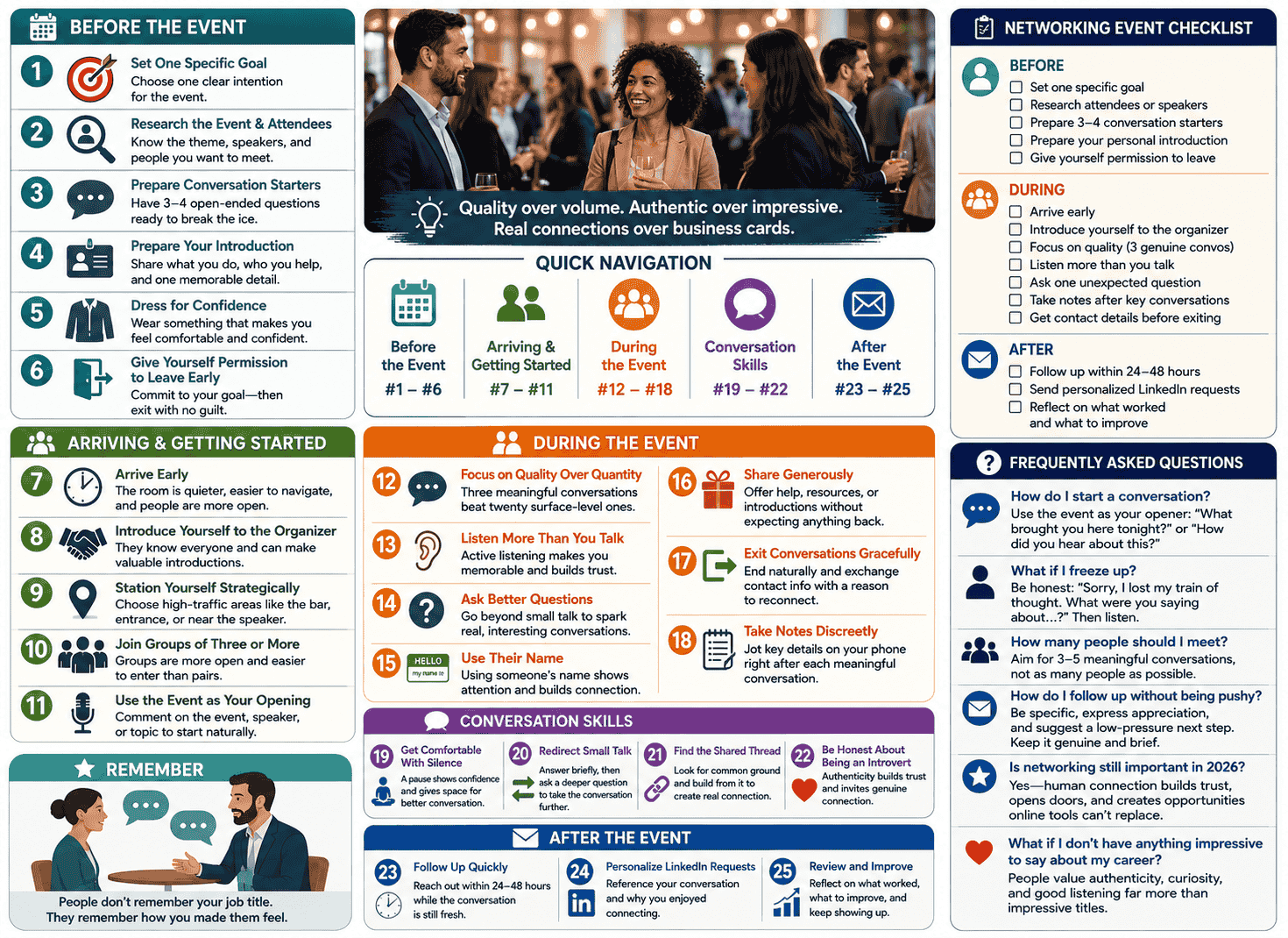
Quick Navigation
| Category | Tips |
|---|---|
| Before the Event | #1 – #6 |
| Arriving & Getting Started | #7 – #11 |
| During the Event | #12 – #18 |
| Conversation Skills | #19 – #22 |
| After the Event | #23 – #25 |
Part 1: Before the Event
1. Set One Specific, Realistic Goal Before You Go
Walking into a networking event with no clear goal is the fastest route to overwhelm and wasted time.
Before you leave the house, decide on one specific intention. Not “meet as many people as possible” — that’s vague, exhausting, and frankly meaningless.
Better goals:
- “I want to have three genuine conversations tonight”
- “I want to meet one person working in [specific field]”
- “I want to find one potential mentor or collaborator”
- “I want to learn about one company I didn’t know before”
One concrete goal gives you direction. It also gives you a clear finish line — once you hit it, you’ve succeeded. Anything beyond that is a bonus.
2. Research the Event and Attendees in Advance
Preparation is an introvert’s greatest superpower at networking events.
Do this before every event:
- Read the event description carefully — understand the theme, format, and purpose
- Check if there’s an attendee list, guest speaker lineup, or company sponsor list
- Look up two or three specific people you’d genuinely like to meet on LinkedIn
- Read about any speakers presenting — having a thoughtful question ready makes starting a conversation effortless
Walking in knowing who you want to talk to and why eliminates the paralysis of not knowing where to start.
3. Prepare Three or Four Conversation Starters in Advance
Blank-mind moments — where you open your mouth and nothing comes out — happen to almost everyone in high-pressure social situations.
Prepare your conversation starters the night before and they’ll be there when you need them.
Starters that work well at networking events:
- “What brought you to this event tonight?”
- “How did you hear about this — are you connected to the organizers?”
- “Are you local or did you travel in for this?”
- “What are you working on right now that you’re most excited about?”
- “Have you been to one of these events before? What did you think?”
These questions are open-ended, easy to answer, and naturally lead to real conversation. Practice saying them out loud so they feel natural, not rehearsed.
4. Prepare Your Introduction — But Keep It Human
You need a clear, concise answer to “So, what do you do?” — but the best version isn’t a job title recitation. It’s a short, human statement that sparks curiosity or connection.
Formula: What you do + who you help or what you create + one specific detail that makes it memorable.
Examples:
- Instead of: “I’m a marketing manager at a tech company.”
- Try: “I run marketing for a fintech startup — we help small businesses manage cash flow without needing an accountant.”
- Instead of: “I’m a freelance designer.”
- Try: “I’m a freelance brand designer — I mostly work with early-stage founders who need to look established before they actually are.”
The goal isn’t to impress — it’s to give the other person something interesting to respond to.
5. Dress in a Way That Makes You Feel Confident
This sounds superficial. It isn’t.
When you feel comfortable and confident in what you’re wearing, you carry yourself differently. You stand taller, You make more eye contact, You worry less about how you appear and focus more on the conversation.
You don’t need to overdress or underdress — just dress in a way that feels like your best, most authentic self for the context. When in doubt, research the event’s typical dress code in advance.
6. Give Yourself Permission to Leave Early
This one is specifically for introverts and people with social anxiety.
Before you go, give yourself explicit permission to leave once you’ve met your goal — even if the event is still going strong.
Knowing you have an exit plan dramatically reduces pre-event anxiety. You’re not trapped for three hours. You’re going in, doing what you came to do, and leaving when it feels right.
Often you’ll find the event more enjoyable than anticipated and stay longer. But having the mental permission to leave removes the dread before you even arrive.
Part 2: Arriving and Getting Started
7. Arrive Early — It’s Counterintuitive but It Works
Most introverts want to arrive late and slip in unnoticed. This is actually the harder approach.
Walking into a full, buzzing room mid-event is significantly more overwhelming than arriving early when the crowd is small and conversations haven’t locked in yet.
Why early arrival works:
- The room is quieter and easier to navigate
- People haven’t formed settled groups yet — everyone is still looking for conversation
- It’s easier to meet the organizers and get introductions through them
- You can choose your positioning before feeling the pressure of a crowded room
Aim to arrive in the first 15 minutes. You’ll find it far more manageable than you expect.
8. Introduce Yourself to the Organizer First
When you arrive, find and introduce yourself to the event organizer or host.
This is a high-value move for two reasons:
First, organizers want to meet attendees — it validates their effort and investment. You’re doing them a favor.
Second, organizers know everyone. A good organizer will often say, “Oh, you should meet [Name] — they work in the same space.” Suddenly you have a warm introduction without doing the cold-approach work yourself.
Opening line: “Hi, I’m [Name] — thank you for putting this together. It’s a great turnout. Do you mind if I ask who else came from [industry/field]?”
9. Station Yourself at High-Traffic Areas
Strategic positioning reduces the pressure of cold approaches.
The best spots in any networking venue:
- The refreshments or bar area — everyone passes through; it’s natural to strike up conversation while waiting
- Near the entrance — you can greet people as they arrive, which is socially much easier than interrupting formed groups
- Near the speaker or presentation area — shared content gives you instant conversation material
- At small tables — sitting down signals you’re open to others joining you
Avoid standing alone in corners or against walls — it signals disengagement and makes approach harder for others too.
10. Join Groups of Three or More — Not Pairs
When scanning the room for conversation opportunities, target groups of three or more people, not pairs.
Two people in conversation are often in a closed loop — joining them can feel intrusive and is socially awkward for everyone. Three or more people in conversation have naturally open body language and usually welcome a new face.
Look for groups where people are turned slightly outward, making eye contact with the broader room — these are open conversations actively welcoming new participants.
11. Use the Event Itself as Your Opening
You always have one thing in common with every single person in the room: you’re both at this event.
That shared context is your easiest, most natural conversation opener.
- “Have you been to one of these before?”
- “What made you decide to come tonight?”
- “Did you catch the speaker earlier? What did you think?”
- “How are you connected to this group?”
No clever line needed. The event itself hands you the opener.
Part 3: During the Event
12. Focus on Quality Over Quantity
One of the most liberating reframes in networking: you don’t need to talk to everyone.
Three meaningful conversations will do more for your career and relationships than fifteen forgettable exchanges. Introverts are often naturally wired for depth over breadth — in networking, this is an advantage, not a limitation.
Give yourself permission to have one long, genuine conversation with one interesting person rather than sprinting around the room collecting business cards from strangers.
13. Listen More Than You Talk
The most memorable people at any networking event are rarely the loudest ones. They’re the ones who make you feel genuinely heard.
Active listening is a rare skill — and it makes an outsized impression.
How to listen actively:
- Make consistent eye contact (not staring — natural, engaged contact)
- Nod and respond with small acknowledgments that show you’re following
- Ask follow-up questions based specifically on what they said — not just the next question on your mental list
- Resist the urge to fill every silence immediately
When someone finishes talking with you and thinks “that person really listened to me” — you’ve already succeeded.
14. Ask Better Questions Than Everyone Else
Most people at networking events ask the same three questions: What do you do? Where are you based? How long have you been in the industry?
Stand out by asking questions that invite real, interesting answers.
Questions that create memorable conversations:
- “What’s the most interesting problem you’re working on right now?”
- “What’s something about your industry that outsiders almost always get wrong?”
- “What made you choose this field originally?”
- “What are you most excited about in the next year?”
- “What’s the best advice you’ve been given in your career?”
These questions take courage to ask because they’re different. But they consistently lead to the kind of conversations people remember long after an event ends.
15. Use the Name of the Person You Just Met
After someone introduces themselves, use their name once — naturally, in the conversation.
“That’s a really interesting approach, [Name] — how did you land on that strategy?”
Using someone’s name signals genuine attention and makes the interaction feel personal rather than transactional. It also helps you remember their name — which is useful when you follow up later.
16. Share Generously Without Expecting Anything Back
The most magnetic people at networking events are givers, not takers.
Before you think about what you can get from a conversation, think about what you can offer.
- A referral to someone in your network
- A relevant article or resource
- An introduction to someone else at the event
- Honest feedback on something they mentioned
- A perspective from your field they might find useful
When you approach networking as a place to add value rather than extract it, the entire experience shifts — and so does how people respond to you.
17. Exit Conversations Gracefully
Knowing how to exit a conversation is just as important as knowing how to start one. Staying too long when a conversation has naturally concluded makes both parties uncomfortable.
Clean, professional exits:
- “It’s been really great talking with you. I want to make sure I connect with a couple of other people before the evening ends — can I grab your card or connect on LinkedIn?”
- “I don’t want to monopolize your time — let’s definitely stay in touch.”
- “I need to go catch [the speaker / the organizer / a colleague] before they leave — but I’d love to continue this conversation. Are you on LinkedIn?”
These exits are natural, warm, and always end with a door open for future connection.
18. Take Discreet Notes on Your Phone After Key Conversations
Memory fades quickly after a busy event. The specific details that make a follow-up feel personal — the project someone mentioned, the challenge they’re facing, the book they recommended — disappear within hours.
After each meaningful conversation, take 30 seconds to type a brief note on your phone:
“Sarah Chen — product lead at Horizons — launching new B2B tool in Q3, mentioned struggling with early adopter feedback loops. Referenced [book title].”
These notes make your follow-up feel remarkably personal — because it is.
Part 4: Conversation Skills
19. Get Comfortable With Silence
Most people panic at a pause in conversation and rush to fill it with anything — usually something forgettable or tangential.
Silence is not failure. It’s thinking space.
A two-second pause after someone finishes speaking before you respond signals that you actually processed what they said rather than just waiting for your turn to talk. It makes your response more considered and the conversation more substantive.
Practice sitting with silence for just a beat longer than feels comfortable. It makes you a noticeably better conversationalist.
20. Redirect Small Talk Into Real Conversation
Small talk isn’t the enemy — it’s just the on-ramp. The goal is to move through it quickly into something with actual substance.
The technique: Answer the surface question, then redirect with a deeper one.
- Them: “So, how’s business going?”
- You: “Really well, actually — we just wrapped a big project that pushed us in a new direction. What about you — are you in a growth phase right now or more of a consolidation moment?”
You answered briefly, then invited something more interesting. Most people respond enthusiastically to being asked something more thoughtful than “good, you?”
21. Find the Shared Thread
Every person you talk to has something in common with you — a shared challenge, a similar career stage, a mutual interest, an overlapping perspective. Your job is to find it.
The fastest way to deepen a conversation is to locate that shared thread and pull on it.
When you find it — “Oh, we dealt with exactly the same thing when we were scaling our team” — the dynamic shifts from networking to genuine conversation. That’s where real professional relationships are born.
22. Be Honest About Being an Introvert (When It Feels Right)
This will feel risky. It almost always pays off.
When you’re honest — “I’ll be upfront, these events aren’t exactly my natural habitat — but I find the people who come to them tend to be worth meeting” — you do something powerful. You signal authenticity. You give the other person permission to drop their own professional mask. And you immediately stand out from the 40 people they’ve already had scripted exchanges with tonight.
Vulnerability, used appropriately, is one of the fastest routes to genuine human connection.
Part 5: After the Event
23. Follow Up Within 24 to 48 Hours — Always
This is where most networking falls apart. People have great conversations, collect contacts, and then never follow up. The connection evaporates.
Following up within 24 to 48 hours — while the conversation is still fresh for both of you — is what converts a brief meeting into an actual professional relationship.
What a great follow-up message includes:
- A specific reference to something you discussed (this is where your notes pay off)
- A genuine, brief expression of why you enjoyed the conversation
- A clear, low-pressure next step (a coffee chat, a resource you mentioned, an introduction you offered)
Keep it short. Make it specific. Send it sooner than feels necessary.
24. Connect on LinkedIn With a Personalized Note
Don’t send a generic LinkedIn connection request to people you met. Take 15 seconds to personalize it.
Template:
“Hi [Name] — great meeting you at [Event] last night. Really enjoyed our conversation about [specific topic]. Would love to stay connected and continue the conversation.”
That one sentence of personalization separates your request from the dozens of generic ones they receive each month. It also dramatically increases acceptance rates and makes a stronger first impression on their profile.
25. Review What Worked — And Go Again
After every networking event, spend 10 minutes reflecting:
- Which conversations felt most natural and why?
- What conversation starters worked well?
- Who do you want to stay in touch with?
- What would you do differently next time?
Networking is a skill that compounds over time. Each event teaches you something — if you pay attention. The people who become genuinely great at building professional relationships aren’t the naturally extroverted ones. They’re the ones who showed up consistently, reflected honestly, and improved with every experience.
One event won’t transform your network. Ten events, over a year, absolutely will.
For Introverts: A Special Note
If you’ve made it this far, here’s something worth sitting with.
Introverts don’t need to become extroverts to network effectively. The traits that make you introverted — your capacity for deep listening, your preference for meaningful conversation over surface-level chatter, your tendency to think before you speak — are genuine networking strengths.
The world is full of extroverts who collect hundreds of contacts and maintain zero real relationships. Some of the most powerfully connected professionals are deeply introverted people who built their networks one genuine conversation at a time.
You don’t need to work every room. You just need to work your room — thoughtfully, authentically, and on your own terms.
Networking Event Checklist
Print this or save it to your phone before your next event:
Before:
- [ ] Set one specific goal for the evening
- [ ] Research attendees or speakers in advance
- [ ] Prepare 3–4 conversation starters
- [ ] Prepare your personal introduction
- [ ] Give yourself permission to leave once your goal is met
During:
- [ ] Arrive early
- [ ] Introduce yourself to the organizer
- [ ] Focus on quality — aim for 3 genuine conversations
- [ ] Listen more than you talk
- [ ] Ask one unexpected, interesting question per conversation
- [ ] Take notes on your phone after key conversations
- [ ] Get contact details before exiting each conversation
After:
- [ ] Follow up within 24–48 hours with a personal message
- [ ] Send personalized LinkedIn connection requests
- [ ] Reflect on what worked and what to improve
Frequently Asked Questions
How do I start a conversation with a complete stranger at a networking event?
Use the event itself as your opener. “What brought you here tonight?” or “How did you hear about this event?” gives you an easy, natural starting point. Everyone has an answer — and it naturally leads into deeper conversation.
What should I do if I freeze up or go blank mid-conversation?
It happens to everyone. The easiest recovery is honesty: “Sorry — I completely lost my train of thought. What were you saying about [repeat the last thing they said]?” This redirects to them, buys you a moment, and actually shows you were paying attention.
How many people should I aim to meet at a networking event?
Quality beats quantity every time. Three to five meaningful conversations with genuine follow-through will serve your career far better than twenty forgettable exchanges. Give yourself permission to stop counting and start connecting.
How do I follow up after a networking event without seeming pushy?
The key is specificity and low pressure. Reference something specific from your conversation, express genuine appreciation for the exchange, and suggest a loose next step — a coffee chat, a resource, an introduction. Keep the tone warm and casual, not transactional.
Is networking still important in 2026 with so many online tools available?
More than ever. Online tools make it easier to find people — but nothing replaces the trust built through in-person connection. In-person networks tend to generate warmer referrals, more candid advice, and stronger professional relationships than purely digital ones.
What if I don’t have anything impressive to say about my career?
This mindset is more common than you think — and it misses the point. Networking isn’t a performance of success. People connect with authenticity, curiosity, and genuine interest far more than with impressive credentials. Show up curious, ask good questions, and listen well. That’s genuinely impressive.
Final Thoughts
Networking events don’t have to feel like an endurance test. They don’t require you to pretend to be someone you’re not, collect a hundred business cards, or drain yourself performing extroversion for three hours.
They require one goal, a little preparation, a genuine willingness to connect with another human being — and the follow-through that most people skip.
Do those things consistently and your network will grow in ways that actually matter: real people who know you, trust you, and want to see you succeed.
The next event on your calendar? You’re more ready than you think. Go.
Last updated: 2026 | Estimated reading time: 14 minutes