Every organization that handles sensitive files faces the same fundamental question: how should those documents be encrypted? Choosing between symmetric and asymmetric encryption for securing documents isn’t just an academic exercise – it determines how fast your systems run, how safely keys get shared, and whether your security holds up under real-world pressure. The right answer depends on your use case, your user base, and how far ahead you’re willing to plan.
Foundations of Document Encryption Technology
Encryption is the backbone of modern data privacy. Without it, every PDF, contract, and financial report you send across a network is essentially a postcard: readable by anyone who intercepts it. Cryptography transforms readable information into something unintelligible to unauthorized parties, and it has evolved from simple substitution ciphers into mathematically complex systems that underpin everything from email to cloud storage.
The Role of Cryptography in Data Privacy
Cryptographic protocols ensure that even if a document is intercepted, its contents remain protected. Regulations like GDPR, HIPAA, and the updated NIST frameworks in 2026 all mandate encryption for sensitive data at rest and in transit. But compliance alone doesn’t equal security – the type of encryption you choose and how you manage keys matters just as much as whether encryption exists at all.
Core Components: Plaintext, Ciphertext, and Keys
Every encryption system works with three elements. Plaintext is your original document. Ciphertext is the scrambled output after encryption. Keys are the mathematical values that lock and unlock the data. The critical difference between symmetric and asymmetric systems comes down to how many keys are involved and who holds them.
Symmetric Encryption: Speed and Efficiency
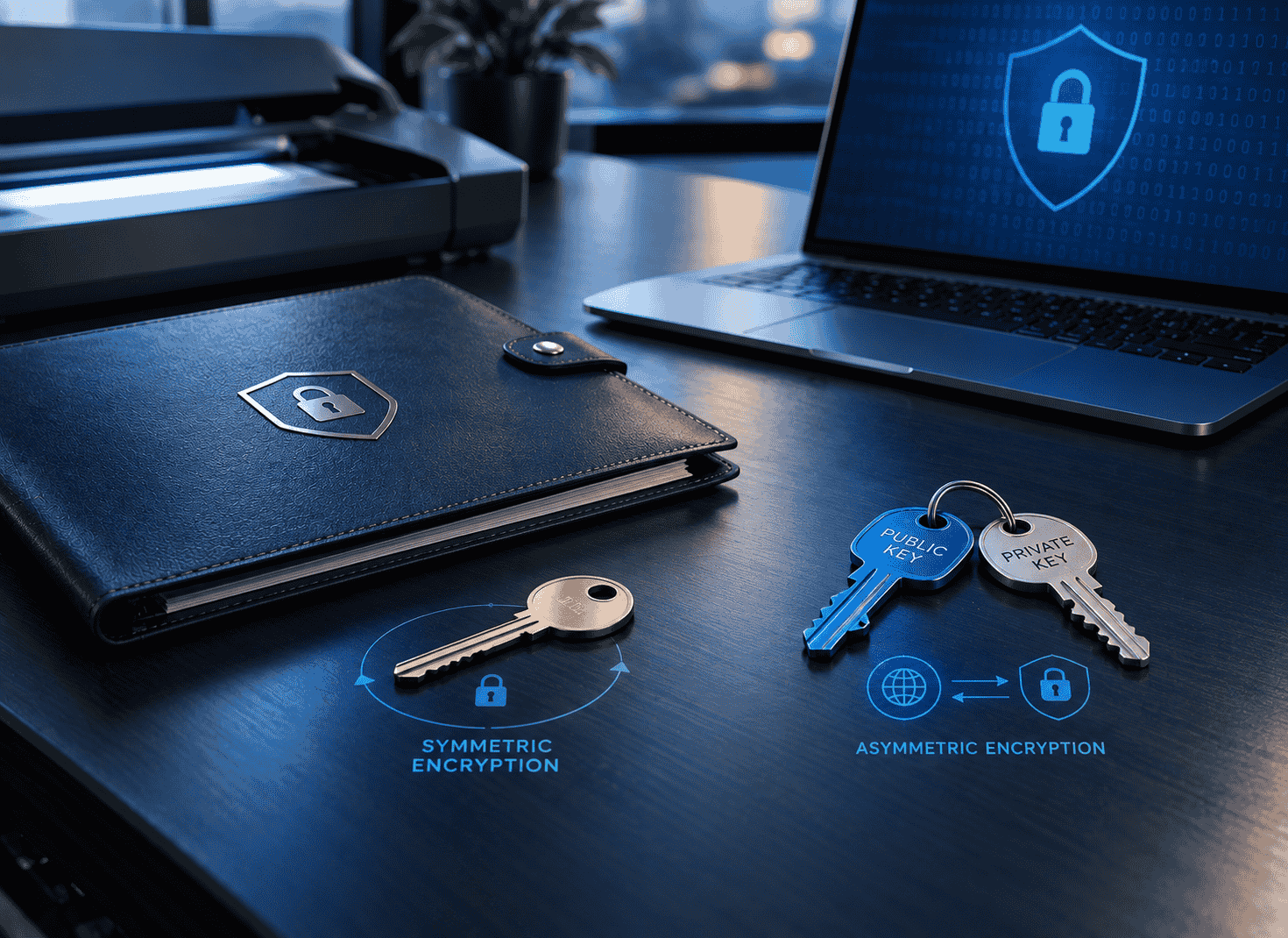
Symmetric encryption uses a single key for both encrypting and decrypting a document. Think of it like a physical lockbox where the sender and recipient share an identical key. This simplicity makes symmetric encryption extremely fast, which is why it remains the default choice for encrypting large files and bulk data.
Common Algorithms: AES and DES
AES (Advanced Encryption Standard) with 256-bit keys is the gold standard in 2026. It’s used by governments, financial institutions, and virtually every major cloud provider. DES (Data Encryption Standard) is its predecessor, but with a 56-bit key length, it was cracked decades ago and is now considered obsolete. Triple DES extended its life briefly, but AES has fully replaced it for any serious document protection.
The Challenge of Secure Key Distribution
Here’s the catch: if both parties need the same key, how do you get that key to the recipient without someone else grabbing it? This is the key distribution problem, and it’s been the Achilles’ heel of symmetric encryption since its inception. Emailing a key alongside an encrypted file is like locking your front door and taping the key to the doorframe. Solving this problem is exactly where asymmetric encryption enters the picture.
Asymmetric Encryption: The Public Key Infrastructure
Asymmetric encryption uses two mathematically linked keys: one public, one private. You can share your public key with anyone. Only your private key can decrypt what the public key encrypts. This eliminates the key distribution problem entirely, but it comes with a significant performance cost.
The Relationship Between Public and Private Keys
The two keys are generated together using complex mathematical functions – typically based on the difficulty of factoring large prime numbers or solving discrete logarithm problems. The public key encrypts; the private key decrypts. Crucially, knowing the public key doesn’t help you derive the private key, at least not with current computing power.
RSA and Elliptic Curve Cryptography (ECC)
RSA has been the workhorse of asymmetric encryption for decades, but it requires increasingly large key sizes (2048-bit minimum, 4096-bit recommended) to stay secure. ECC achieves equivalent security with much smaller keys – a 256-bit ECC key offers roughly the same protection as a 3072-bit RSA key. That efficiency gap makes ECC the preferred choice for mobile devices and resource-constrained environments.
Comparative Analysis for Document Security
When comparing symmetric and asymmetric approaches for document protection, the tradeoffs are stark. Neither approach is universally superior – context determines which one fits.
Performance Benchmarks and Processing Overhead
AES-256 can encrypt a 100 MB document in milliseconds on modern hardware. RSA encryption of that same file could take orders of magnitude longer. For individual documents shared between two people, this difference might not matter. For an enterprise processing thousands of files daily, it’s a dealbreaker. Symmetric encryption wins on raw speed every time.
Scalability in Multi-User Environments
Symmetric encryption scales poorly. If 50 people need access to encrypted documents, you need to manage key pairs between every combination of users – that’s 1,225 unique keys. Asymmetric encryption scales elegantly: each user has one key pair, and anyone can encrypt a file using someone’s public key. For organizations with large teams or external collaborators, asymmetric systems are far more manageable.
Hybrid Systems: Combining Both Worlds
In practice, almost no modern system uses purely symmetric or purely asymmetric encryption. Hybrid approaches take the best of both: asymmetric encryption’s key management with symmetric encryption’s speed.
Using Asymmetric Keys to Encrypt Symmetric Session Keys
The standard approach generates a random symmetric key for each document or session, encrypts the document with that fast symmetric key, then encrypts the symmetric key itself using the recipient’s public key. The recipient uses their private key to unlock the symmetric key, then uses that to decrypt the document. TLS, PGP, and most DRM platforms all work this way.
Digital Envelopes in Modern File Formats
This hybrid model is often called a “digital envelope.” The encrypted symmetric key and the encrypted document travel together as a package. Modern PDF encryption, S/MIME email attachments, and enterprise document management systems all rely on digital envelopes. It’s an elegant solution that sidesteps the weaknesses of either approach used alone.
Selecting the Right Framework for Your Organization
Picking an encryption strategy isn’t just a technical decision – it’s a business one that touches compliance, usability, and long-term risk.
Compliance and Regulatory Requirements
Different industries mandate different standards. HIPAA requires encryption but doesn’t specify the algorithm. PCI DSS mandates “strong cryptography,” which in 2026 means AES-128 at minimum. NIST’s post-quantum migration guidelines are pushing organizations to begin transitioning away from RSA toward quantum-resistant algorithms. Simply checking a compliance box doesn’t mean your documents are actually safe from exfiltration – a defense-in-depth strategy that layers encryption with access controls, DRM, and audit logging is far more effective.
Future-Proofing Against Quantum Computing Threats
Quantum computers threaten to break RSA and ECC by efficiently solving the mathematical problems they rely on. NIST finalized its first post-quantum cryptographic standards in 2024, and organizations handling long-lived sensitive documents should already be evaluating these algorithms. The risk isn’t theoretical: adversaries are harvesting encrypted data now, planning to decrypt it once quantum capability matures. If your documents need to stay confidential for a decade or more, your encryption choices today need to account for threats that don’t fully exist yet.
Protecting What Matters Most
The choice between symmetric and asymmetric encryption for securing documents isn’t binary – hybrid systems dominate real-world implementations for good reason. Symmetric encryption delivers the speed needed for large files, while asymmetric encryption solves the key distribution challenge that has plagued cryptography for decades. The right framework depends on your organization’s size, compliance obligations, and how seriously you take the coming quantum threat.