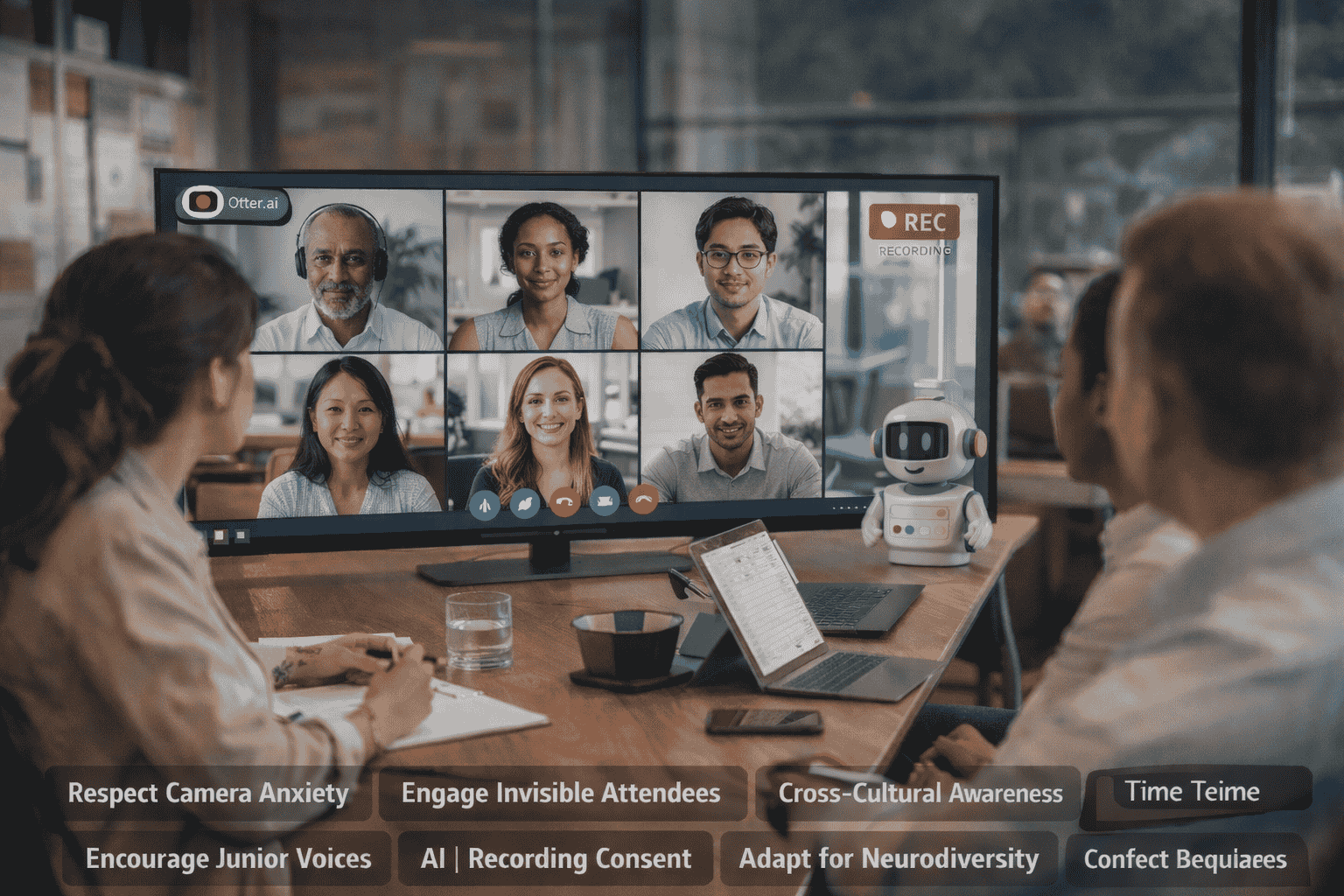
Every article on virtual meeting etiquette tells you the same things. Mute your microphone. Dress professionally. Test your tech. Find good lighting.
You already know this. Yet your virtual meetings still feel awkward, exhausting, or unproductive — and you can’t quite figure out why.
That’s because the real problems in online meetings have almost nothing to do with mute buttons or camera angles. They run deeper: unspoken power dynamics, cultural blind spots, the unaddressed anxiety millions of professionals feel on camera, and the etiquette vacuum created by AI tools, chat boxes, and global time zones.
This guide covers the dimensions of virtual meeting etiquette that most articles ignore entirely — the human, psychological, cultural, and organizational layers that determine whether your meetings actually work.
Why Most Virtual Meeting Etiquette Advice Falls Short
The top-ranking content on this topic was largely written between 2020 and 2022, when the world was scrambling to adapt to remote work. That advice was practical and necessary at the time. But the virtual meeting landscape of 2026 is fundamentally different.
Today, the challenges aren’t technical. Most people have figured out how to mute themselves. The remaining friction in virtual meetings comes from:
- Unresolved psychological barriers (camera anxiety, meeting fatigue as a cultural issue)
- Cross-cultural communication gaps that nobody names explicitly
- The rise of AI note-takers and recording tools — and the ethical vacuum around them
- A generation of “invisible attendees” who join calls but effectively disappear
- Chat box behavior that quietly derails conversations
- Time zone inequity embedded in how meetings are scheduled
- Junior professionals who have never been taught how to speak up in virtual spaces
- Neurodivergent participants whose needs are almost never discussed
Let’s address each of these properly.
1. Camera Anxiety Is Real — and Ignoring It Is Bad Etiquette
Every guide says “turn your camera on.” Virtually none of them acknowledge that for a significant number of professionals, being on camera triggers genuine anxiety — sometimes severe enough to affect performance.
Research in communication psychology consistently shows that video calls place people in a state of heightened self-monitoring. Unlike in-person meetings, you can see yourself at all times. This activates a form of continuous self-surveillance that doesn’t happen in physical rooms. For people with social anxiety, body image concerns, or even ordinary self-consciousness, this is genuinely distressing — not a preference.
What good etiquette actually looks like here:
Hosts should establish a default camera norm before the meeting, not during it, and state it without pressure. Phrases like “cameras on is preferred but please do what lets you engage best” reduce anxiety and actually increase overall participation quality.
Attendees who feel camera anxiety should communicate this proactively with a simple, professional message to the host beforehand: “I’ll be joining audio-only today — I’ll be fully present and contributing.” This is not an excuse. It’s professional communication.
The etiquette principle is simple: camera presence should serve the meeting’s purpose, not serve as a performance of compliance.
2. The Invisible Attendee Problem — and the Host’s Responsibility
There is a specific category of meeting participant that almost no etiquette guide addresses: the person who joins, stays on mute, turns off their camera, and exits 45 minutes later having contributed nothing. They were technically “present.”
This happens for several reasons. Sometimes the person wasn’t sure whether they were expected to contribute. Some-times they felt intimidated by the format. Sometimes they were double-booked and joined out of obligation. In every case, it represents a failure of meeting design — not just personal etiquette.
What hosts must do:
Good virtual meeting etiquette for hosts includes proactive inclusion. This means calling on specific people by name (not in a cold-call way, but in a “I’d love to hear your perspective, Alex” way), creating structured turns for input, and using polls or reaction tools to get signals from quieter participants.
If you consistently host meetings where half the attendees are functionally invisible, that is an etiquette failure — yours, as the host.
What attendees must do:
If you’re attending a meeting, you owe it to the group to signal your engagement. This doesn’t mean performing enthusiasm. It means using reaction buttons, contributing one substantive point, or at minimum sending a follow-up message with your perspective afterward. Silent attendance should be an exception, not a habit.
3. Cross-Cultural Virtual Meeting Etiquette: The Gap Nobody Talks About
In global teams spanning multiple countries and cultures, virtual meeting etiquette carries enormous cultural variance — and the silence on this topic in most guides is a significant gap.
Here are patterns that create real friction:
Silence means different things in different cultures. In many East Asian professional cultures, silence after a question signals respect and thoughtful processing. In many Western meeting cultures, silence signals confusion, disagreement, or disengagement. Hosts who rush to fill silence — or interpret it negatively — are projecting their cultural norms onto the entire room.
Directness varies dramatically. What reads as confident participation in a U.S. or German meeting context may feel aggressive or disrespectful in a Japanese, Indonesian, or Arab context. What reads as thorough and consultative in a Japanese context may feel evasive or slow in an American context. Neither is wrong; both are legitimate.
Hierarchical structures affect participation. In cultures with high power distance (where seniority commands significant deference), junior team members may literally not feel it is appropriate to speak before a senior person has signaled their view. Hosts who don’t understand this will repeatedly misread silence from junior international colleagues as disengagement.
What to do about this:
If your team is multinational, establish explicit meeting norms that name these differences rather than pretending a universal standard exists. Something as simple as: “In our meetings, everyone’s input is equally invited regardless of seniority, and we welcome a few seconds of silence before responses — it means people are thinking.” This sentence alone can transform participation dynamics.
4. Zoom Fatigue Is an Etiquette Issue, Not Just a Wellness Issue
Most content treats Zoom fatigue as a personal wellness problem — something you manage with breaks and shorter meetings. But meeting fatigue is significantly created by other people’s etiquette failures, and naming this shifts the conversation in a useful way.
These specific behaviors accelerate meeting fatigue in others:
Unnecessary camera movement. Constant fidgeting, leaning in and out, or repositioning while someone else is speaking creates cognitive noise for every other attendee. The brain is wired to track movement, and involuntary attention to a moving face is tiring.
Over-talking without pausing. Virtual audio has micro-latency even on good connections. Speakers who talk for extended periods without deliberate pauses make it nearly impossible for others to enter the conversation naturally. The polite pace for virtual speech is slightly slower and more pauseful than in-person conversation.
Unnecessary meetings. The most fatiguing meeting etiquette failure is holding a meeting at all when an async message would have served the purpose. Before sending a calendar invite, ask honestly: does this require real-time interaction, or am I scheduling a meeting because it feels more efficient for me?
The fix: Build a team norm around “async first.” Synchronous meetings should be reserved for decision-making, relationship-building, and complex collaborative work. Status updates, announcements, and one-way information sharing belong in written communication.
5. The Chat Box: A Parallel Conversation Nobody Has Rules For
The meeting chat is one of the most misunderstood dimensions of virtual etiquette — and it’s almost entirely absent from top-ranking content on this subject.
In most virtual meetings, the chat box runs as a second, parallel conversation that hosts can’t fully monitor, speakers can’t respond to in real time, and attendees use with wildly inconsistent norms.
Here’s what good chat etiquette actually looks like:
Don’t use the chat to undermine the speaker. Side comments, jokes at the presenter’s expense, or running commentary that contradicts what’s being said creates a fractured experience. If attendees can see the chat while someone is presenting, they are now managing two streams of information simultaneously — which degrades comprehension for everyone.
Use the chat to support, not replace, verbal participation. “Great point, I’d add that…” in the chat is not the same as saying it. If you have a substantive contribution, raise it verbally (or use the raise hand feature). Chat should supplement, not substitute.
Reactions and emoji have their place. Applause, thumbs up, and heart reactions are legitimate engagement signals. They reduce the pressure to speak while still communicating presence. But they should reflect genuine engagement — reflexively reacting to everything is just noise.
Direct messages during meetings require care. Sending a private message to another attendee during a meeting is the virtual equivalent of passing notes in class. It’s not always wrong — sometimes it’s necessary coordination — but using it to gossip about the meeting, the presenter, or other attendees is a meaningful etiquette violation even if the speaker never knows.
6. AI Note-Takers and Recording Consent: The Etiquette Frontier
This is perhaps the fastest-growing etiquette gap in virtual meetings today, and almost no mainstream content addresses it seriously.
AI transcription bots now join meetings automatically in many organizations. Tools like Otter.ai, Fireflies, and Read.ai can join your call, transcribe every word, summarize decisions, and attribute specific statements to named individuals — all without explicit consent from every attendee.
This is an etiquette problem before it is a legal one.
The core principle: Every person in a meeting has a reasonable expectation to know whether the conversation is being recorded or transcribed before it begins — not buried in calendar invite fine print, and not disclosed as an afterthought once the meeting has started.
Good etiquette requires:
Hosts must state at the start of every recorded or AI-transcribed meeting, clearly and explicitly: “This meeting is being recorded and/or transcribed using [tool]. If anyone has concerns about this, please let me know.” This is not a legal disclaimer. It is a courtesy that respects the autonomy of everyone present.
Attendees who deploy personal AI tools (like a personal Otter account) without disclosing it to hosts or other participants are violating a basic trust norm, regardless of their jurisdiction’s consent laws.
Organizations should establish a clear, written policy on recording and transcription, communicated to all employees — and hosts should be trained to disclose this at the start of every relevant meeting.
A note on AI summaries: When AI meeting summaries are auto-distributed to stakeholders who weren’t present, they carry the authority of minutes without the accuracy of human review. Before distributing any AI-generated summary, a human must review it. Misattributed statements, missed nuance, and incorrectly captured decisions can cause real professional harm.
7. Time Zone Equity: Scheduling as an Etiquette Practice
For global teams, who gets inconvenient meeting times is an etiquette question, not just a logistics question — and it’s one with real equity implications.
The most common pattern in international companies is that meeting times are set to accommodate headquarters, which typically means teams in Asia-Pacific, the Middle East, or South America regularly join calls at 7 AM, or 9 PM, or worse. Over time, this sends an unmistakable message about whose time and comfort matter.
What ethical scheduling looks like:
Rotate inconvenient times deliberately and transparently. If a recurring meeting requires someone to join at an off-hour, rotate that burden systematically so no single team always absorbs it.
Use scheduling tools that visualize working hours across time zones before picking a time. Tools like World Time Buddy, Calendly, and Google Calendar’s time zone feature make this simple.
When a meeting time genuinely doesn’t work for some participants, proactively ask what information format works best for them — a recording, a summary, a brief async video — rather than expecting them to simply attend outside working hours or miss out.
8. Speaking Up as a Junior Professional: Etiquette Nobody Teaches
A large portion of people struggling with virtual meeting etiquette are early-career professionals who have never been explicitly taught how virtual meeting hierarchies work.
Most etiquette guides are written from the perspective of hosts or experienced professionals. But if you’re three months into your first remote job and you’re in a meeting with your manager’s manager and six people you’ve never spoken to, the question “when is it appropriate for me to speak and how?” is not trivial — and nobody is answering it.
Here are the things that nobody publishes:
It is almost always appropriate to speak during a meeting you were invited to. If you were invited, your presence was considered necessary. You are not there to observe.
The most effective way to enter a conversation in a virtual meeting is to use the raise hand feature, or to say the speaker’s name. “Sarah — I want to add something to that point” is a professional, effective way to enter a conversation without talking over someone.
Speaking briefly and crisply is always better than speaking at length to prove you’ve thought about something. One focused, useful point lands better than three minutes of setup.
If you miss your moment to speak, the chat is a legitimate secondary channel. “I had a thought on this — happy to share in the next gap” is a perfectly professional chat message that signals engagement.
After the meeting, following up by email with a point you didn’t get to voice is entirely acceptable. It shows initiative, not weakness.
9. Neurodiversity and Virtual Meetings: The Etiquette Nobody Is Having
Neurodivergent professionals — including people with ADHD, autism, dyslexia, or anxiety disorders — are a significant portion of the workforce, and virtual meeting etiquette almost never accounts for the specific challenges they navigate.
This is a gap with real consequences. Here is what it looks like from both sides:
For attendees with ADHD: The low-stimulation environment of a video call — talking heads, no movement, no ambient energy — is genuinely harder to sustain attention in than a physical room. Behaviors that look like disengagement (looking away briefly, fidgeting slightly off-camera, typing notes) may be active attention management strategies.
Hosts who understand this structure meetings with more interactivity, shorter segments, and deliberate engagement checkpoints — not because they’re being accommodating in a performative sense, but because those meeting design choices improve outcomes for everyone.
For attendees with autism: Neurotypical virtual communication is heavily laden with indirect signals — implied turn-taking, read-between-the-lines questions, ambiguous facial cues filtered through video compression. For autistic professionals, this can be genuinely confusing in ways that don’t map neatly onto “bad etiquette.” Explicit communication norms, clear agendas, and written follow-up summaries are not just nice-to-haves for this population — they are meaningful inclusions.
For all participants: Being explicitly clear about meeting norms — when to speak, how to signal you want to contribute, what is expected of attendees — benefits everyone but is essential for neurodivergent participants.
10. When Someone Else Violates Etiquette — and How to Handle It
This is another gap almost entirely absent from mainstream virtual meeting etiquette content: what do you actually do when someone else is behaving badly?
Most guides tell you how to behave. None of them tell you how to respond when a colleague repeatedly talks over everyone, when someone’s audio is clearly distracting the entire call, or when the host is running so far over time that people are genuinely stuck.
For hosts addressing participant issues in real time:
Direct, brief, and neutral is always the right register. “Let’s give Sarah a chance to finish her point” works. “Can whoever has background noise check their mute?” works. These don’t require the other person to feel embarrassed or called out.
For attendees addressing host issues:
If a meeting is running significantly over time and multiple people are affected, one clear intervention is appropriate: “I want to flag that we’re at the scheduled end time — should we schedule a continuation or capture what’s outstanding for async?” This is not rude. It is a service to everyone in the room.
For persistent patterns:
If a specific person’s behavior is consistently disruptive — they talk over others constantly, they arrive significantly late every week, or they publicly use the chat to mock other participants — this is a manager conversation, not a meeting-moment intervention. Document the specific behavior, its impact, and raise it outside the meeting context.
11. The Etiquette of Ending Meetings Well
Almost no content on virtual meeting etiquette addresses how meetings should end — yet meeting endings are where a significant amount of professional goodwill is lost or gained.
A meeting that ends abruptly (“OK, I think we’re done, thanks everyone”) without clear next steps, ownership of actions, or acknowledgment of what was accomplished leaves participants feeling vaguely unsatisfied even if the content was good.
Good meeting endings take under three minutes and include:
A brief verbal summary of the key decisions made. Not a reading of notes — a human, conversational recap that confirms shared understanding.
Explicit assignment of next steps with named owners and realistic deadlines. “Someone should follow up on X” is not a next step. “Marcus will send the revised proposal by Thursday” is.
A genuine, brief close. Thanking attendees for their time is not just politeness — it signals that the host recognized the cost of people’s attention and valued it.
For hosts of recurring meetings, a simple end-of-meeting ritual — even thirty seconds of “what worked today, what should we do differently” — builds enormous psychological safety and meeting quality over time.
A Final Note: Etiquette Is Culture, Not Compliance
The deepest mistake in how most organizations approach virtual meeting etiquette is treating it as a list of rules to be followed rather than a culture to be built.
Rules can be followed technically while being violated in spirit. You can dress professionally, mute your microphone, and look directly into the camera while still being psychologically absent, subtly dismissive of colleagues, or structurally excluding participants from the conversation.
Real virtual meeting etiquette is a set of values expressed in behavior: that other people’s time is worth respecting. That every person in the room has something worth hearing. That clarity and honesty serve everyone better than performance and ambiguity. That the technology is a medium for human connection, not a substitute for it.
When teams build meetings from those values rather than from a rules checklist, the surface-level behaviors tend to take care of themselves.