You’ve probably heard the phrase “quantum entanglement” thrown around in science news, sci-fi movies, and tech headlines. But most of what gets written about it is either wildly oversimplified or buried under equations that make your eyes glaze over.
Quantum entanglement communication is one of the most genuinely strange and consequential technologies being developed right now — and the facts behind it are more surprising than the myths. Whether you’re curious about the science, worried about cybersecurity, or just trying to figure out if any of this is actually real, these seven facts will change how you think about it.
Fact 1: Entanglement Is Real — And Einstein Spent Years Trying to Prove It Wasn’t
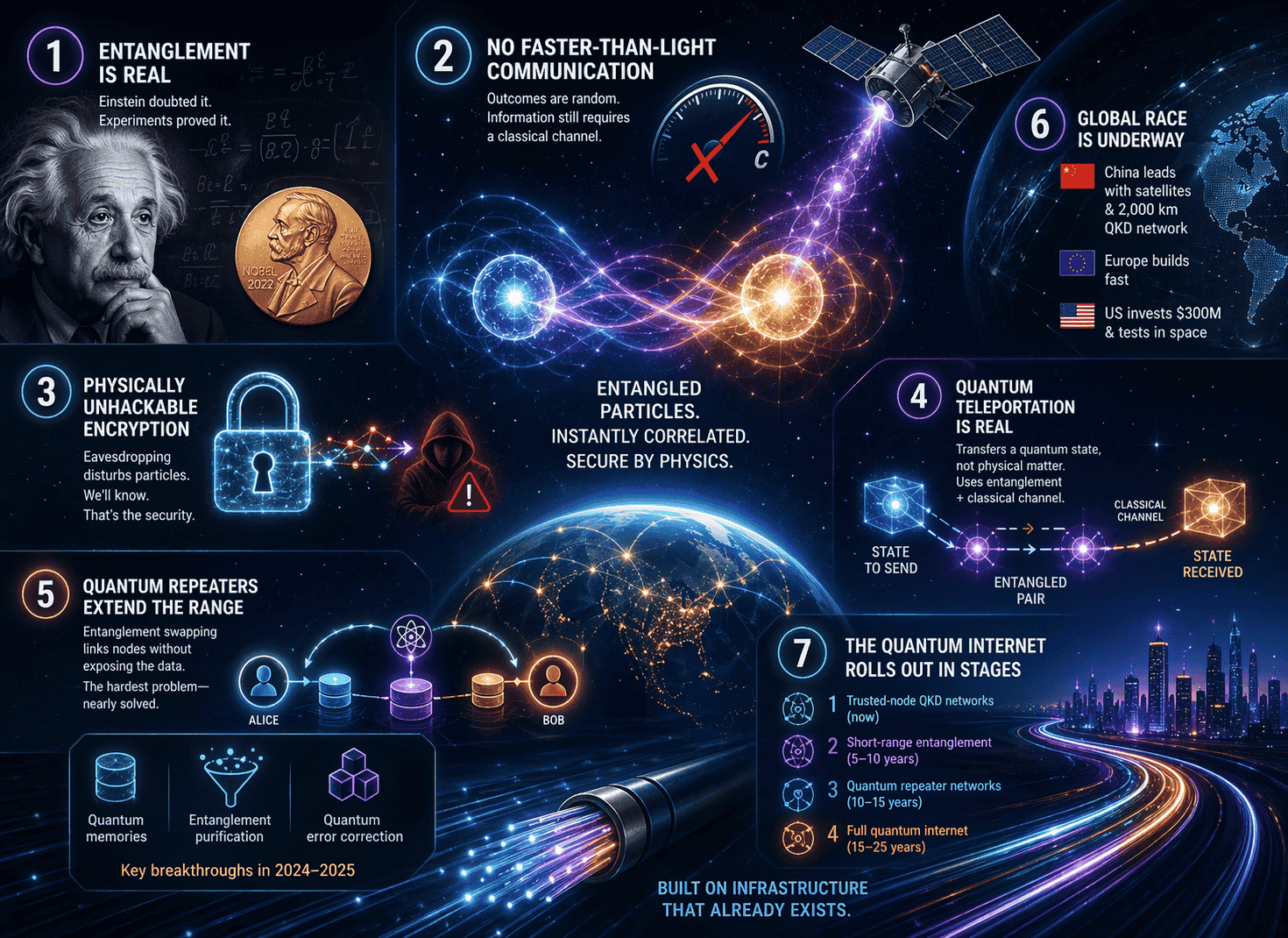
Let’s start with the foundation. Quantum entanglement is a phenomenon where two particles become so deeply linked that measuring one instantly tells you the state of the other — no matter how far apart they are. Einstein famously called this “spooky action at a distance,” and he hated it. He spent the last decades of his life arguing that entanglement was just a statistical illusion caused by hidden variables we couldn’t detect yet.
He was wrong.
In the 1960s, physicist John Bell developed a mathematical test — now called Bell’s theorem — that could determine whether entanglement was a real physical phenomenon or just a gap in our knowledge. Decades of increasingly precise experiments followed. The results were unambiguous: entanglement is real, and particles genuinely have no definite state until you measure them.
The scientific community’s verdict came in 2022, when Alain Aspect, John Clauser, and Anton Zeilinger won the Nobel Prize in Physics specifically for their experiments with entangled photons and their role in establishing the violation of Bell inequalities. The prize effectively closed the debate Einstein started. Spooky action at a distance is real physics, and it forms the bedrock of everything that comes next.
Why this matters for communication: entanglement gives us access to a physical resource that simply doesn’t exist in classical physics — a link between particles that persists across any distance. That resource is what quantum communication is built on.
Fact 2: Entanglement Cannot Send Information Faster Than Light (And That’s Actually Fine)
This is the fact that trips up almost every popular article on the subject — and getting it wrong leads to serious misunderstandings about what quantum communication can actually do.
Here’s the misconception: if two entangled particles respond to each other instantly across any distance, surely you can use that to send a message faster than light?
You can’t. And the reason is surprisingly elegant.
When you measure an entangled particle, its outcome is random. You have no control over whether it comes up spin-up or spin-down. Your partner on the other side also gets a random result. Neither of you can encode a deliberate message into randomness. The correlation between your results only becomes meaningful when you compare notes afterward — over a normal, light-speed-limited channel.
This is protected by the no-communication theorem, a rigorous result in quantum mechanics that proves entanglement alone cannot carry information. It’s not a technological limitation we might overcome someday. It’s a consequence of the fundamental structure of quantum mechanics.
Here’s the thing though: this doesn’t make entanglement useless for communication. It just means entanglement does something different from sending a message — something that turns out to be arguably more valuable. It creates a shared, physically guaranteed secret between two parties. And that secret can be used to encrypt communications with a level of security that no classical system can match.
The no-communication theorem isn’t a dead end. It’s a redirect — toward the genuinely revolutionary applications covered in the facts below.
Fact 3: Quantum Entanglement Makes Encryption That Is Physically Impossible to Hack
This is where things get practically important — especially if you work in security, finance, healthcare, or government.
Quantum Key Distribution (QKD) uses entanglement to create a shared encryption key between two parties in a way that makes eavesdropping physically detectable. Here’s how it works:
Alice and Bob each receive one photon from an entangled pair. They measure their photons using randomly chosen bases and record the results. Later, they compare a subset of those results over a classical channel. If an eavesdropper intercepted any photons during transmission, the act of measuring them would have disturbed their quantum states — and Alice and Bob would see statistical anomalies in their comparison. The eavesdropping reveals itself automatically.
In the most rigorous version of this protocol (the E91 protocol, based on Bell inequality violations), the security doesn’t depend on the hardware being trustworthy or the algorithm being unbroken. It depends on the laws of physics. A quantum computer, no matter how powerful, cannot break QKD — because the security isn’t based on a hard math problem. It’s based on the fact that measuring a quantum state disturbs it.
The real-world implications are serious. Security agencies worldwide are preparing for “Q-Day” — the point at which quantum computers become powerful enough to break the RSA and elliptic-curve encryption that currently protects most of the internet. QKD offers a route to communication security that remains intact even after that point.
Current limitation worth knowing: a single QKD fiber link works reliably up to roughly 100–400 km, with a practical sweet spot around 20–50 km. Beyond that, photon loss in the fiber becomes a serious problem. This is why quantum repeaters (Fact #5) are one of the most urgently funded research areas in the world right now.
Fact 4: Quantum Teleportation Is Real — But It Doesn’t Work the Way Movies Show It
The word “teleportation” earns a lot of eye-rolls, and fairly so given how Hollywood uses it. But quantum teleportation is a real, experimentally demonstrated phenomenon — and what it actually does is more interesting than the sci-fi version.
Quantum teleportation does not move physical objects. It moves quantum information — the exact quantum state of a particle — from one location to another, without that information physically traversing the space in between.
Here’s the mechanism: Alice has a qubit in an unknown quantum state that she wants to send to Bob. They share a pre-established entangled pair. Alice performs a joint measurement on her qubit and her half of the entangled pair, which produces a classical result. She sends that classical result to Bob through a normal channel. Bob applies a specific operation to his half of the entangled pair based on Alice’s result — and his particle ends up in exactly the state Alice’s qubit was in. The original state has been “teleported.”
Two things to notice: first, this requires a classical channel, so it’s still limited by the speed of light. Second, Alice’s original qubit loses its state in the process — this is consistent with the no-cloning theorem, which forbids copying an unknown quantum state. No information was duplicated; it was transferred.
In December 2024, researchers demonstrated quantum teleportation over active internet cables for the first time — sharing the same fiber infrastructure used by regular internet traffic. This is a landmark result because it shows quantum and classical networks can coexist in the same physical cables, which means you don’t need to build entirely separate infrastructure to deploy quantum communication.
Fact 5: The Biggest Engineering Problem Is the Quantum Repeater — It’s Almost Solved
Quantum networks face a challenge that classical networks solved decades ago: signal loss over distance. Classical fiber networks handle this with repeaters that read the signal and re-transmit it. Quantum states can’t be read and re-transmitted — the no-cloning theorem forbids copying an unknown quantum state. Trying to amplify a quantum signal destroys it.
Quantum repeaters solve this with a completely different approach called entanglement swapping:
A repeater node creates two short entangled links — one to Alice and one to Bob. It then performs a Bell state measurement on its two internal particles. This measurement “swaps” the entanglement so that Alice’s and Bob’s particles become entangled with each other, even though they never directly interacted. The repeater passes along classical measurement results, and neither Alice nor Bob ever sends their quantum state through the repeater. The repeater never has access to the information being protected.
Chain multiple repeater nodes together, and you can extend entanglement across thousands of kilometers hop by hop.
The engineering challenge is that quantum repeaters require three components that are all hard to build: quantum memories (to store entanglement while waiting for both links to succeed), entanglement purification (to filter out low-quality entanglement), and quantum error correction. All three exist in labs. None are deployed commercially at scale — yet.
In November 2025, the University of Chicago demonstrated a new quantum memory material that pushes quantum link distances 200 times farther than the previous state of the art with the same approach — a result that directly addresses the core bottleneck. In April 2025, Deutsche Telekom and Qunnect achieved 99% fidelity entanglement transmission across 30 km of live commercial fiber for 17 consecutive days — and routed entangled photons across 82 km of active fiber coexisting with classical internet traffic. These aren’t lab curiosities. They’re proofs of concept running on infrastructure that already exists.
Fact 6: China and Europe Are Already Running Quantum Communication Networks — the US Is Racing to Catch Up
Quantum communication isn’t a future technology. Operational networks already exist.
China:
China leads the world in deployed quantum infrastructure: The Micius satellite, launched in 2016, was the first to demonstrate satellite-based quantum key distribution — enabling a quantum-encrypted video call between Beijing and Vienna spanning 7,600 km. In 2025, the Jinan-1 microsatellite extended this to a 12,900 km quantum connection between China and South Africa which is the longest quantum communication link ever demonstrated. China also operates the world’s longest terrestrial QKD network connecting Beijing and Shanghai across 2,000 km.
Europe:
Europe is building fast. ESA has confirmed that entanglement stays intact across 144 km of free-space ground links — a precursor to satellite deployment. The April 2025 Deutsche Telekom experiment in Berlin ran across commercially deployed urban fiber. The EU’s Quantum Flagship program is funding quantum network infrastructure across member states.
United States:
The United States announced a major push in September 2025: a $300 million investment to turn Long Island’s existing telecom fiber into a quantum network testbed, anchored by a new Quantum Research and Innovation Hub at Stony Brook University. The facility will host the first data center designed specifically to manage entangled photons. Researchers there are already running entanglement experiments between Stony Brook and Brookhaven National Laboratory — currently the largest quantum network in the US.
And in November 2024, a quantum entanglement experiment was mounted on the outside of the International Space Station. Its first results, presented in April 2025, show strong Bell inequality violations — confirming that entanglement sources survive and operate in the radiation environment of low Earth orbit. This is a direct stepping stone to a global quantum satellite network.
The geopolitical dimension is real. Quantum-secured communication networks represent a form of infrastructure sovereignty — nations that build them can communicate in ways that are physically impossible for adversaries to intercept. That’s why every major power is treating this as a national security priority.
Fact 7: The Quantum Internet Will Roll Out in Stages — And the First Stage Is Already Here
The “quantum internet” sounds like a single switch-on moment. It isn’t. It’s a gradual expansion of capabilities that will unfold across roughly four stages — and the first stage is already operational in several cities.
Stage 1 — Trusted-node QKD networks (now): Fixed nodes connected by dedicated fiber distribute quantum encryption keys. The nodes themselves must be physically secure (they’re trusted), but the links between them are quantum-protected. Networks at this stage already operate in Beijing, Tokyo, Amsterdam, and other cities. This stage protects communication against any future computational attack, including by quantum computers.
Stage 2 — Entanglement distribution over short ranges (5–10 years): Limited entanglement distribution removes the requirement to trust the intermediate nodes. Device-independent QKD becomes possible — security that doesn’t even require trusting the quantum hardware itself. The Deutsche Telekom experiment operates at the boundary of this stage.
Stage 3 — Quantum repeater networks (10–15 years): Functional quantum repeaters extend entanglement to national and continental scales. Distributed quantum computing becomes possible — multiple quantum processors in different locations working together as a single, far more powerful system. Drug discovery, materials simulation, and financial optimization that exceed today’s supercomputer capabilities start to become available.
Stage 4 — Full quantum internet (15–25 years): Global entanglement distribution as a utility. Quantum-secured communication available to any connected device. Large-scale distributed quantum computing accessible over a network the way classical computing is today. Stanford’s December 2025 demonstration of a room-temperature quantum communication device — eliminating the need for expensive cryogenic cooling — is a key step toward making quantum hardware small and cheap enough for this stage to become practical.
The timeline is genuinely uncertain. Breakthroughs can compress it; engineering difficulties can extend it. But the direction is not uncertain. The foundations are being built right now with serious money, in real networks and on infrastructure that already exists.
Here’s the detailed article: if you want to discover the latest break throughs in quantum computing.
The Bottom Line
Quantum entanglement communication sits at the intersection of the strangest physics ever confirmed and some of the most consequential engineering problems of the next century. The myths around it — that it’s just FTL messaging hype, or that it’s purely theoretical, or that it’s decades away — are all out of date.
What actually true is: Quantum-secured communication is already deployed and entanglement is proven physics. Satellite quantum links spanning 12,900 km already exist. Quantum repeaters are advancing faster than most coverage reflects. And a room-temperature quantum communication device now exists that could one day fit in your pocket.
You don’t need to understand the math of Bell inequalities to appreciate what’s coming. You just need to know that the rules of communication are about to change — and the change has already started.
Frequently Asked Questions
What is quantum entanglement communication in simple terms? It’s a way of using the linked behavior of entangled particles to create communication channels that are provably secure against eavesdropping. Measuring one particle instantly reveals information about its partner — and any attempt to intercept the particles disturbs them in a detectable way.
Can quantum entanglement send information instantly? No. The no-communication theorem prevents this. Entanglement correlations are real, but they cannot carry a deliberate message without a classical channel. The quantum part of quantum communication is about security, not speed.
Is quantum communication available today? QKD networks are operational in several cities worldwide. Commercial QKD hardware is sold by companies including Toshiba, ID Quantique, and QuantumCTek. Satellite quantum communication has been demonstrated across 12,900 km. The technology is real and deployed, though not yet globally available as a consumer service.
How does quantum communication differ from quantum computing? Quantum computing focuses on performing calculations using quantum mechanical effects. Quantum communication uses those same effects — especially entanglement — to create secure channels and connect quantum devices over a network. They’re related but separate fields, and the quantum internet will connect quantum computers the way the classical internet connects classical ones.
What is Q-Day and why does it matter? Q-Day refers to the point at which quantum computers become powerful enough to break current RSA and elliptic-curve encryption. Estimates place this somewhere between 2030 and 2040. Organizations handling sensitive long-lived data — governments, hospitals, banks, defense contractors — need to begin transitioning to quantum-resistant security (either QKD or post-quantum cryptography algorithms) before that date.