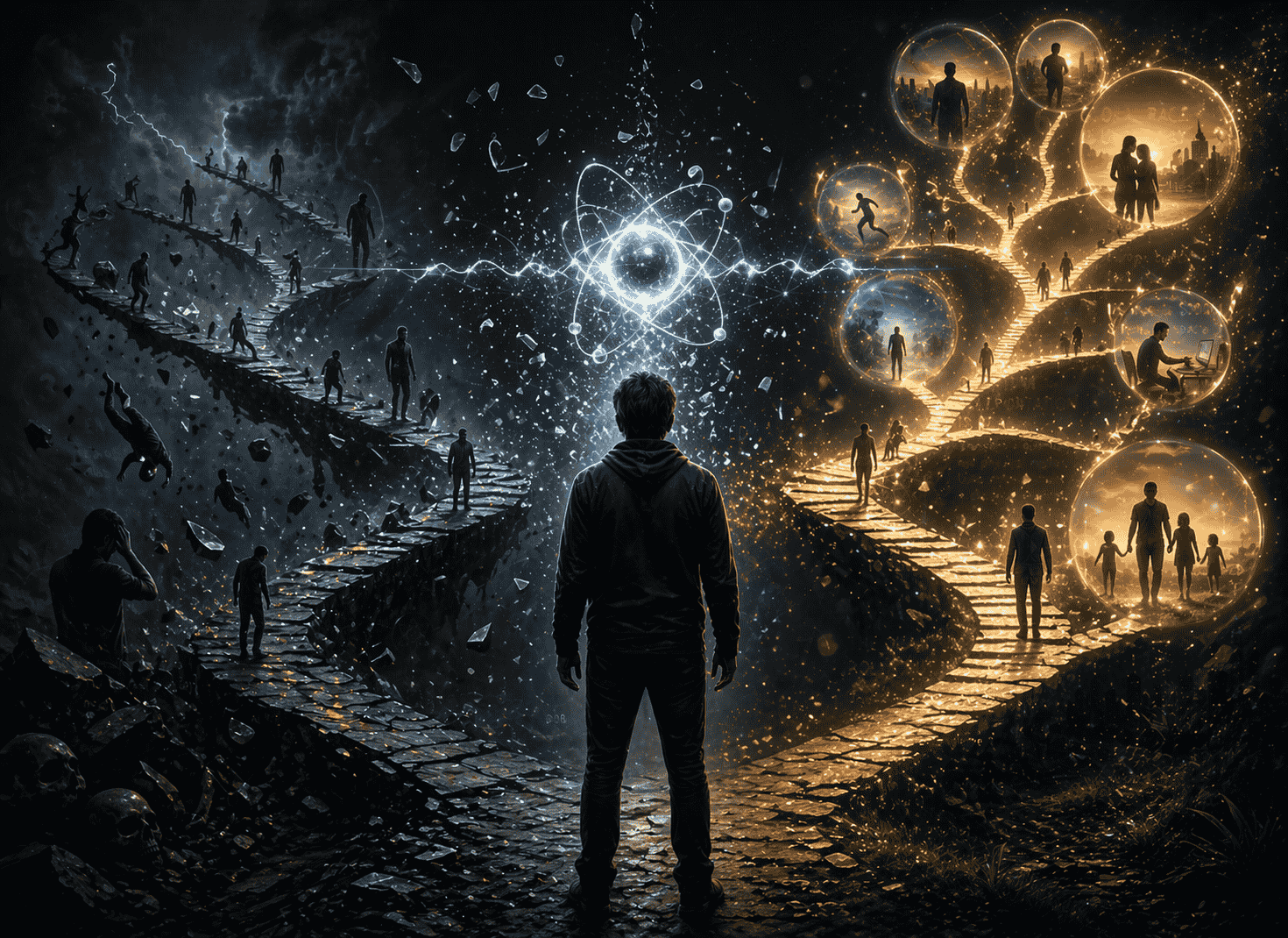
You’ve probably seen quantum immortality framed as a strange kind of cosmic safety net.
The idea sounds almost comforting at first: no matter what happens, your consciousness always continues in some branch of reality where you survive.
No death. No true ending. Just… continuation. But here’s the problem: that version is incomplete.
When you follow the logic all the way through — using actual physics, not internet mythology — quantum immortality stops being comforting and starts becoming deeply unsettling.
Because survival doesn’t mean living well.
And in this theory, it might mean something far worse.
First, What Quantum Immortality Actually Claims
Quantum immortality comes from the Many-Worlds Interpretation of quantum mechanics, proposed by Hugh Everett.
In simple terms:
- Every quantum event creates multiple outcomes
- Each outcome exists in its own branching universe
- Your consciousness continues in one of those branches
Now apply that to life-or-death situations:
If there’s any branch where you survive — even an extremely unlikely one — your subjective experience continues there.
From your perspective, you never experience death.
That’s the core idea.
And this is where things start to go wrong.
The First Problem: Survival Gets Increasingly Improbable
At first, survival might mean small things:
- You narrowly avoid a car accident
- A disease doesn’t progress
- A random event goes in your favor
But over time, probabilities compound.
Eventually, survival requires outcomes that are:
- Extremely unlikely
- Statistically absurd
- Physically borderline impossible
Yet in the Many-Worlds framework, those branches still exist.
So your consciousness doesn’t move into a normal life.
It drifts into increasingly improbable realities.
The Real Horror: You Don’t Stay Healthy — You Just Stay Alive
This is the part almost no article explains clearly.
Quantum immortality does not guarantee:
- Youth
- Health
- Comfort
- Awareness
It only guarantees continuation.
Which leads to a disturbing implication:
You could survive in states where:
- Your body is severely damaged
- Your brain function is degraded
- Your environment is barely sustainable
In other words, you don’t get an ideal version of life.
You get the minimum viable version of survival.
And that threshold gets worse over time.
The “Almost Unconscious Forever” Problem
Philosophers have taken this idea further — and it gets darker.
If survival continues through increasingly unlikely states, then the most probable long-term outcome isn’t a thriving life.
It’s a state where:
- Consciousness barely persists
- Awareness is fragmented or minimal
- You exist in a near-unconscious condition
Not dead.
But not fully alive either.
Just… continuing.
Indefinitely.
This is sometimes described as a kind of asymptotic existence — where your experience approaches zero quality but never fully ends.
Hugh Everett Believed This — And It Didn’t Save Him
Here’s the part that makes this theory feel uncomfortably real.
Hugh Everett, the physicist who introduced the Many-Worlds Interpretation, reportedly took the idea seriously.
Some accounts suggest he believed that:
- Consciousness would continue across branches
- Death might not be subjectively experienced
And yet, Everett died at age 51 from a heart attack.
No miraculous escape.
No observable continuation.
From the outside, reality behaved exactly as expected.
This highlights a critical tension:
Quantum immortality is unfalsifiable from the inside — but completely invisible from the outside.
The Physics Problem Nobody Talks About (The Born Rule)
Here’s where things break down scientifically.
Quantum mechanics doesn’t just say outcomes happen — it assigns probabilities to them.
This is governed by something called the Born rule.
In simple terms:
- High-probability events dominate what we observe
- Low-probability events are effectively negligible
Quantum immortality requires you to:
- Continuously “experience” extremely low-probability branches
- Ignore the statistical weight of more probable outcomes
That creates a contradiction.
Because if the Born rule is correct (and all experiments support it), then your subjective experience shouldn’t consistently track ultra-rare events.
This is one of the strongest arguments against quantum immortality — and most articles skip it entirely.
The Psychological Trap: Why the Idea Is So Attractive
Despite all this, people are drawn to quantum immortality.
Why?
Because it offers something powerful:
- Escape from death anxiety
- A sense of continuity
- The illusion of control over the unknown
But there’s a hidden risk.
If taken literally, the idea can lead to:
- Reckless thinking (“I’ll survive anyway”)
- Distorted risk perception
- Existential detachment from reality
Even if the theory were true, acting as if it guarantees safety would be dangerously misguided.
The Ethical Question Nobody Asks
Let’s assume, for a moment, the theory is correct.
That raises a disturbing question:
If you survive in one branch… what happens in all the others?
Because in Many-Worlds:
- Every possible outcome occurs
- That includes versions where you don’t survive
So quantum immortality doesn’t eliminate death.
It just means:
- You don’t experience it in your branch
- But it still happens in countless others
Which makes the concept less like immortality…
…and more like selective awareness.
So Is Quantum Immortality Real?
Here’s the honest answer:
- It’s a theoretical implication, not a proven phenomenon
- It depends entirely on the Many-Worlds Interpretation
- It cannot be tested or verified subjectively
Most physicists don’t treat it as a practical or meaningful prediction.
It’s a thought experiment — one that exposes strange consequences of quantum theory.
Not a roadmap for reality.
The Bottom Line
Quantum immortality sounds like a loophole in death.
But when you follow the logic all the way through, it becomes something else entirely.
Not eternal life.
But indefinite survival under increasingly worse conditions.
Not control over fate.
But entrapment within probability.
And not a comforting theory…
…but one of the most unsettling implications of modern physics.