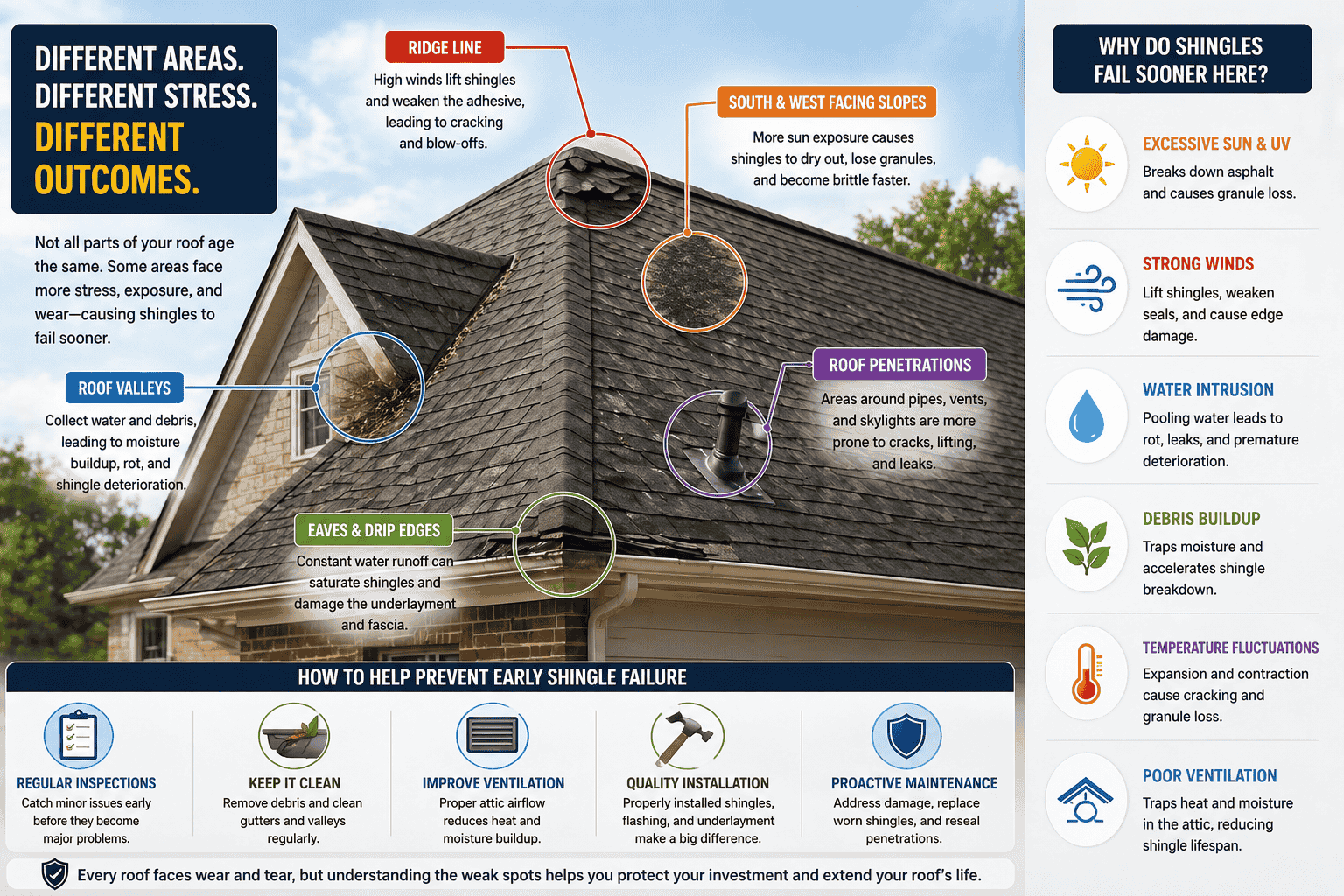
A roof rarely wears out evenly, even when the shingles came from the same bundle and were installed at the same time. That uneven aging is where many property owners get caught off guard. One section starts curling, losing granules, or staining long before the rest, and the damage is often mistaken for a simple material defect.
For property managers, facility managers, and building owners, early shingle failure on isolated roof sections is a warning sign that should be taken seriously. It usually points to conditions that are harsher in one area than another, not to random wear. Sun exposure, water flow, ventilation imbalance, roof geometry, and installation details all affect how different parts of a roof age. The shingles may be the visible problem, but the real cause usually lies in the conditions beneath and around them.
Looking At The Roof In Zones
Some Roof Areas Age Faster
Shingles do not experience the same environment across the entire roof surface. One slope may face stronger afternoon sun, while another stays damp longer after rain. One section may drain cleanly, while another may handle concentrated runoff from a valley or an upper roof plane. These differences matter because shingles fail where stress is repeated, not where the roof simply exists.
That is why early deterioration often appears in patterns. A property owner may notice granule loss near valleys, cracking on sun-heavy exposures, or curling around edges and penetrations. The shingles respond to local conditions, and those conditions are rarely identical from ridge to eave or from one side of the building to the other. A roofing contractor looks for these patterns first because the location of failure often explains more than the damage itself.
Where Wear Becomes Uneven
A roof should be evaluated as a series of working zones, not as one uniform surface. Contractors often inspect the field shingles, valleys, hips, ridges, eaves, and flashing transitions separately because each area experiences different stresses. A section that handles direct sun all afternoon will age differently from one shaded by trees or neighboring structures. A lower section catching runoff from above may show wear much earlier than a cleaner, drier slope.
That is especially relevant in climates and neighborhoods like Bellevue, where moisture, tree cover, seasonal debris, and changing weather patterns can affect one roof plane very differently from another. When shingles fail early, the question is not only what product was used. The more useful question is which part of the roof has been forced to handle repeated loads over time.
Sun Exposure Speeds Surface Breakdown
One of the most common reasons shingles fail early on certain parts of a roof is uneven sun exposure. South- and west-facing slopes often absorb more heat and ultraviolet radiation, which can accelerate drying, granule loss, and brittleness. Over time, those slopes may show curling, cracking, or color fading sooner than cooler sections of the same roof.
This kind of wear is not always dramatic at first. It may begin as a subtle difference in texture or flexibility before it becomes visible damage. But once the asphalt components lose resilience, the shingles become more vulnerable to wind, thermal movement, and routine weathering. In practical terms, the sun-exposed portions of the roof usually carry a heavier daily load and often show it earlier than the more protected areas.
Water Concentration Changes Durability
Water does not affect every shingle equally. Valleys, lower roof sections, and areas beneath upper slopes often carry more runoff than the rest of the roof. That repeated water flow can accelerate wear, especially if drainage is slowed by debris, poor slope transitions, or rough installation details. Shingles in these locations are exposed to more frequent moisture contact and often more forceful water movement during storms.
The problem becomes more serious when water is not shedding cleanly. Small installation irregularities, uneven decking, or clogged drainage paths can allow water to linger where it should not. Over time, that concentrated exposure can weaken the shingle surface and stress the underlayment below. When one part of the roof handles more runoff during rain, it should not be surprising that it shows signs of age before the rest.
Early Failure Usually Has A Cause
Shingles fail earlier on certain parts of a roof because the roof is not exposed to one set of conditions. Different areas handle different levels of sun, water, airflow, wind pressure, moisture retention, and structural detail. When wear shows up unevenly, it is usually revealing where the roof has been under the most stress, not simply where the shingles happened to age first.
For building owners and managers, that distinction is important. It shifts the conversation away from surface patching and toward real diagnosis. A targeted inspection can show whether the issue comes from runoff concentration, poor ventilation, shade, detailing, or installation-related stress. Once that cause is understood, repairs and future roof decisions become more accurate. That leads to longer service life, fewer repeat failures, and a clearer understanding of how the roof actually performs across its most vulnerable sections.