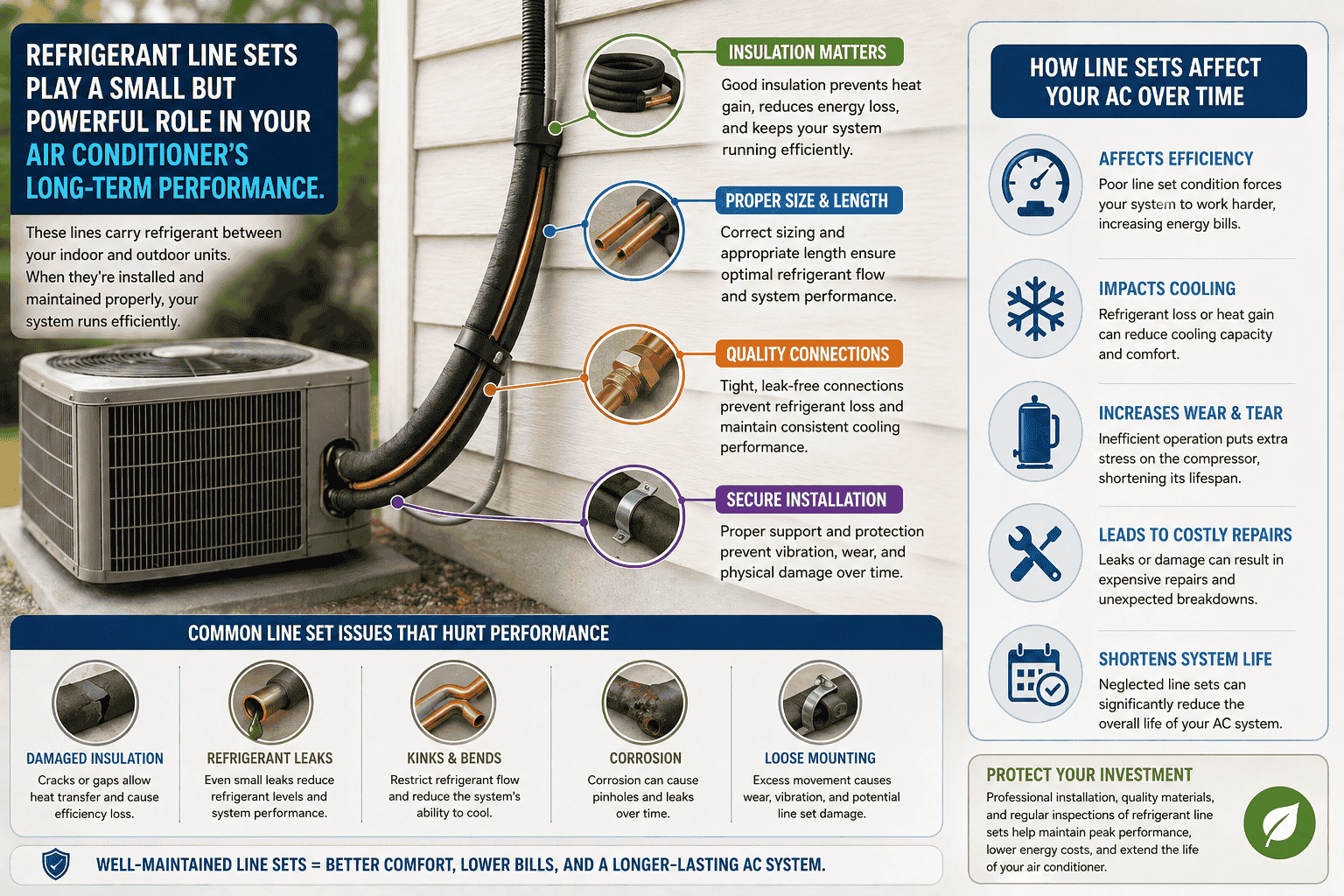
Air conditioners are often judged by the equipment everyone can see. The condenser gets the attention, the thermostat gets adjusted, and the indoor unit gets blamed when cooling starts slipping. But many long-term performance problems begin in a part of the system that is easy to overlook: the refrigerant lines that connect everything.
For property managers, facility managers, and building owners, this matters because air-conditioning performance depends on more than the main equipment itself. Refrigerant line sets influence pressure balance, heat transfer, efficiency, and system reliability year after year. When those lines are undersized, aging poorly, improperly routed, or no longer in good condition, the system can lose performance gradually without one obvious failure point. The air conditioner may still run, but it may no longer run as cleanly and effectively as it should.
Looking Beyond The Main Equipment
Line Sets Carry More Than Refrigerant
Refrigerant line sets do more than connect the outdoor and indoor sections of an air conditioning system. They help maintain the pressure and temperature conditions the equipment needs to move heat effectively. That means the condition of the lines directly affects how smoothly refrigerant circulates, how well the compressor is protected, and how accurately the system can maintain its expected operating range.
This becomes more important over time because line sets are exposed to vibration, weather, insulation wear, oil movement, and installation stresses, which can gradually affect performance. A system may seem mechanically sound at a glance, yet still suffer from reduced efficiency or reliability because the refrigerant path between components no longer supports proper operation as it did when the system was newer.
Why The Connection Path Matters
Contractors who work regularly with HVAC line sets understand that cooling performance is not only about the unit size or the thermostat setting. The refrigerant path must properly support that equipment over the years of operation. If the line set is mismatched to the system, poorly insulated, kinked, contaminated, or deteriorating at the connections, the equipment may never deliver the same performance it was designed to provide.
That is why careful HVAC evaluation does not stop at the condenser or air handler. It also looks at what is happening between them. A line set may seem passive because it has no moving parts, but it still plays an active role in how the system transfers heat and returns refrigerant under the right conditions. Over time, small problems along that path can lead to greater performance losses than many owners expect.
Sizing Affects Efficiency From The Start
One of the most important line-set issues is sizing. Refrigerant lines need to be matched correctly to the system’s capacity and design requirements. If the suction or liquid line is improperly sized, refrigerant velocity and pressure can drift from the equipment’s requirements. That can affect cooling output, compressor loading, oil return, and overall operating stability.
Even when the system starts out working acceptably, poor sizing can create long-term inefficiency. The air conditioner may have to work harder to move refrigerant under the right conditions, especially during peak summer demand. Property owners often notice this as longer runtimes, weaker cooling during hot weather, or a system that still functions but seems to struggle more as the years pass. The equipment has not necessarily failed. The refrigerant path may simply be working against it.
Insulation Breakdown Changes System Behavior
The insulation around the suction line matters much more than many people realize. Its job is to protect the refrigerant from unwanted heat gain as it travels back to the compressor. When that insulation becomes brittle, split, compressed, or missing in sections, the refrigerant can absorb heat where it should not. That changes operating conditions and can reduce cooling efficiency over time.
This usually develops gradually, which is why it is often overlooked. A cracked or deteriorated insulation jacket may not shut the system down, but it can contribute to higher energy use, warmer suction conditions, and more strain on key components. Over multiple seasons, what looks like a cosmetic issue on the refrigerant line can lead to reduced performance and less stable cooling within the system.
Long-Term Cooling Depends On The Whole Path
Refrigerant line sets affect air conditioner performance over time because they determine how efficiently and reliably the system moves refrigerant between its major components. Sizing, insulation condition, connection integrity, internal cleanliness, physical damage, and routing all influence how well the system maintains pressure, transfers heat, and protects its compressor across years of operation.
For property managers and building owners, line sets are more than background hardware. They are part of the system’s performance foundation. When they are overlooked, cooling problems can develop gradually and be blamed solely on the main equipment. When they are carefully inspected and matched, the air conditioner has a much better chance of delivering stable comfort, greater efficiency, and fewer avoidable problems as it ages.