Real-time analytics has evolved from a “nice-to-have” into core infrastructure for modern businesses. In 2026, companies rely on streaming data to power fraud detection, AI models, personalization engines, and operational dashboards—often within milliseconds.
According to recent industry insights, real-time data streaming is now strategic infrastructure, with demand driven by AI, zero-latency decision-making, and massive data growth .
This guide covers the best real-time analytics platforms in 2026, including open-source frameworks, cloud-native tools, and modern data platforms—along with real-world use cases and why they matter today.
What Makes a Great Real-Time Analytics Platform in 2026?
Before diving into tools, here are the key capabilities that define top platforms:
- Low latency (milliseconds-level processing)
- Scalability (handle millions of events/sec)
- Streaming + batch unification
- AI/ML integration
- Cloud-native or serverless architecture
- High reliability (zero data loss)
1. Apache Kafka – The Backbone of Real-Time Data
Why it’s essential in 2026
Kafka is the foundation of modern real-time systems. It handles high-throughput data ingestion and event streaming across distributed systems.
- Processes massive data streams with low latency
- Acts as a central “data pipeline” for analytics, AI, and microservices
- Widely used in fintech, e-commerce, and IoT
Example Use Case
- Real-time fraud detection in banking
- Streaming clickstream data for personalization
Proof of relevance
- Platforms like Confluent (Kafka-based) are being acquired to strengthen AI + streaming ecosystems
2. Apache Flink – Advanced Stream Processing
Why it stands out
Flink is one of the most powerful stream-processing engines for real-time analytics.
- True event-time processing
- High throughput + low latency
- Stateful computations for complex analytics
Example Use Case
- Real-time anomaly detection
- Continuous ETL pipelines
Real-world proof
- Used at massive scale (e.g., ByteDance production clusters) for mission-critical analytics
3. Databricks – Unified Lakehouse + AI
Why it’s a top platform in 2026
Databricks has become a leader in real-time analytics + AI integration.
- Combines data lake + warehouse (lakehouse architecture)
- Supports streaming, batch, and ML in one platform
- Strong AI ecosystem (LLMs, model serving)
Latest update (2026)
- Real-Time Mode in Spark can be up to 92% faster than Flink in some workloads
Example Use Case
- Real-time recommendation systems
- AI-driven analytics pipelines
4. Apache Spark (Streaming) – Mature & Scalable
Why it still dominates
Spark remains a go-to platform for large-scale analytics, now enhanced for real-time workloads.
- Unified batch + streaming engine
- Large ecosystem (MLlib, SQL, Python support)
- Enterprise adoption at scale
Best for
- Companies already using Spark ecosystem
- Hybrid workloads (batch + real-time)
5. ClickHouse – Ultra-Fast Analytics Database
Why it’s booming
ClickHouse is one of the fastest OLAP databases for real-time analytics.
- Extremely fast query performance
- Optimized for analytics workloads
- Handles petabyte-scale data
Proof of growth
- Valued at $15 billion in 2026, driven by AI demand
Example Use Case
- Product analytics dashboards
- Observability and monitoring
6. Apache Druid – Real-Time OLAP Engine
Key strengths
- Sub-second query latency
- Built for streaming ingestion
- High concurrency support
Best for
- Business intelligence dashboards
- Ad-tech analytics
7. Apache Pinot – Low-Latency Analytics at Scale
Why companies love it
- Designed for real-time user-facing analytics
- Millisecond query response times
- Used by companies like LinkedIn
Example Use Case
- User-facing dashboards
- Real-time metrics tracking
8. Amazon Kinesis – Fully Managed Streaming
Why it’s important
- Serverless real-time data streaming
- Tight integration with AWS ecosystem
- No infrastructure management
Example Use Case
- IoT data processing
- Log analytics in cloud-native apps
9. Google Cloud Dataflow – Serverless Stream Processing
Highlights
- Based on Apache Beam
- Auto-scaling pipelines
- Unified batch + streaming
Best for
- GCP-native architectures
- Data engineering teams needing flexibility
10. Snowflake – Real-Time Data Cloud
Why it’s trending
- Real-time ingestion + analytics
- Strong data sharing capabilities
- Increasing AI + streaming integration
Example Use Case
- Real-time business dashboards
- Cross-company data collaboration
11. Confluent Platform – Enterprise Streaming
Why it matters
- Enterprise-grade Kafka platform
- Fully managed streaming pipelines
- Strong governance and security
Comparison of Top Real-Time Analytics Platforms (2026)
| Platform | Type | Best For | Key Strength |
|---|---|---|---|
| Kafka | Streaming backbone | Data pipelines | High throughput |
| Flink | Stream processing | Complex analytics | Event-time accuracy |
| Databricks | Lakehouse | AI + analytics | Unified platform |
| Spark | Analytics engine | Hybrid workloads | Mature ecosystem |
| ClickHouse | Database | Fast queries | Ultra-low latency |
| Druid | OLAP DB | BI dashboards | Sub-second queries |
| Pinot | OLAP DB | User analytics | Real-time metrics |
| Kinesis | Cloud service | AWS apps | Serverless |
| Dataflow | Cloud service | GCP pipelines | Auto-scaling |
| Snowflake | Data cloud | Enterprise analytics | Data sharing |
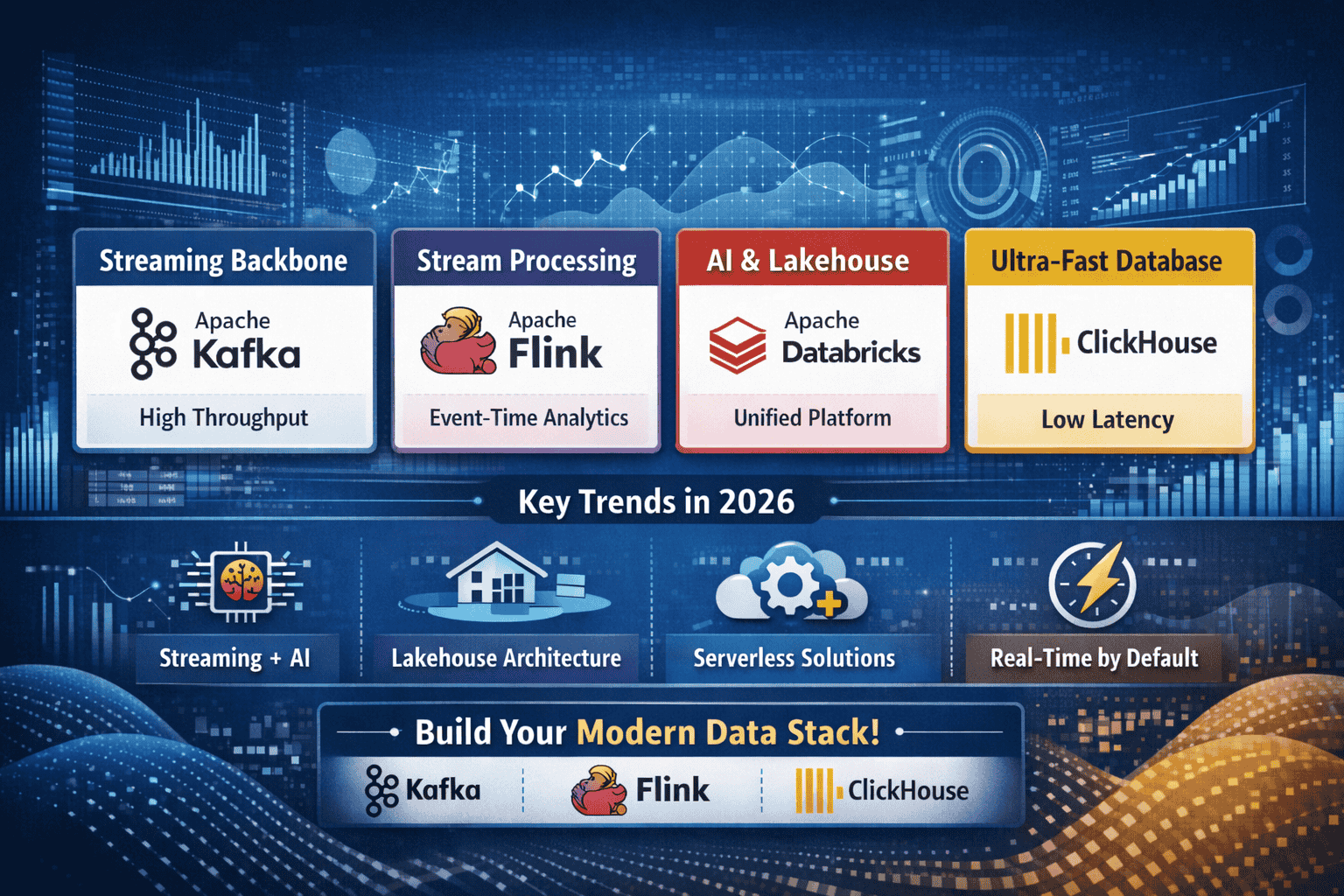
Key Trends in Real-Time Analytics (2026)
1. Streaming + AI Convergence
Real-time data is now powering AI systems and LLMs directly.
2. Lakehouse Architecture Dominance
Platforms like Databricks unify:
- Data engineering
- Analytics
- Machine learning
3. Shift to Serverless
Tools like Kinesis and Dataflow reduce infrastructure complexity.
4. Real-Time Becomes Default
Streaming is no longer optional—it’s expected in modern systems.
How to Choose the Right Platform
Choose based on your use case:
- For streaming pipelines: Kafka + Flink
- For AI + analytics: Databricks
- For dashboards: ClickHouse / Druid / Pinot
- For cloud-native apps: Kinesis / Dataflow
- For enterprise data cloud: Snowflake
Final Thoughts
In 2026, the best real-time analytics platforms are no longer just tools—they are core infrastructure for AI-driven, data-first businesses.
- If you want flexibility and power → Apache Flink + Kafka
- If you want all-in-one platform → Databricks
- If you want speed → ClickHouse
- If you want simplicity → Cloud-native tools
The winning strategy isn’t choosing one tool—it’s building a modern data stack that combines streaming, storage, and analytics seamlessly.