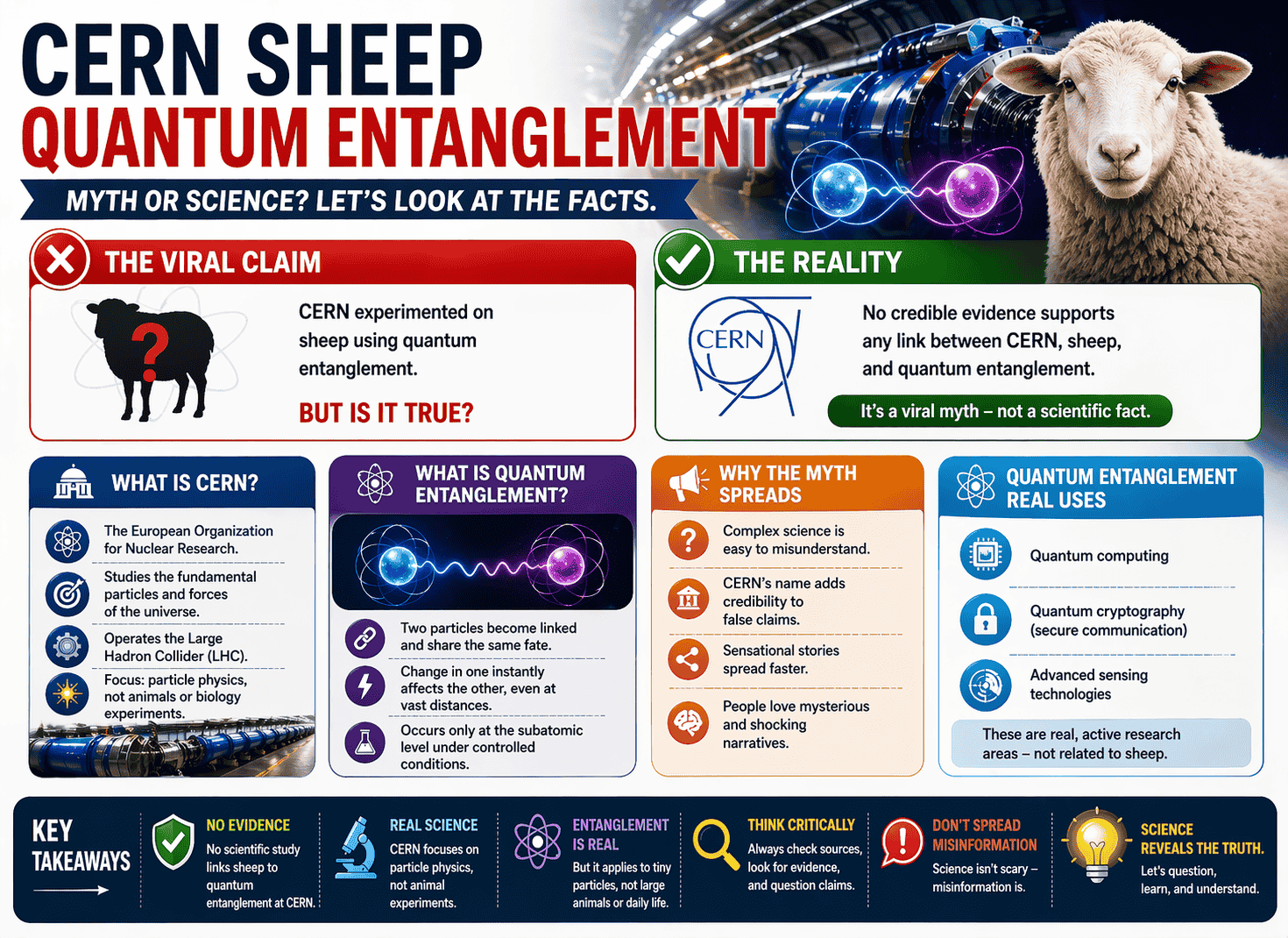
At first glance, the phrase “CERN sheep quantum entanglement” sounds like a bizarre mix of science and mystery.
Is it a real experiment?
A hidden breakthrough?
Or just another viral internet myth?
Let’s break it down clearly, factually, and without the hype.
“CERN sheep quantum entanglement” is not a real scientific concept. CERN studies particle physics using the Large Hadron Collider, while quantum entanglement is a subatomic phenomenon. There is no credible evidence linking entanglement experiments to animals like sheep.
What Is CERN?
CERN is one of the world’s leading scientific research centers, located near Geneva, Switzerland.
Its primary mission:
- Study the fundamental structure of the universe
- Understand particles, forces, and energy
- Conduct high-energy physics experiments
The Key Machine: LHC
The most famous tool at CERN is the Large Hadron Collider.
It:
- Accelerates particles close to the speed of light
- Collides them to observe fundamental interactions
- Helped confirm the existence of the Higgs boson
There are no documented or credible experiments involving sheep at CERN.
What Is Quantum Entanglement?
Quantum Entanglement is a real and well-tested phenomenon in quantum physics.
Simple Explanation
When two particles become entangled:
- Their states are linked
- Changing one instantly affects the other
- Even if they are far apart
This idea was famously discussed by Albert Einstein, who called it “spooky action at a distance.”
Where Did “CERN Sheep Quantum Entanglement” Come From?
This phrase is not a recognized scientific concept.
It likely emerged from:
- Viral social media posts
- Misinterpretations of complex physics
- Conspiracy-style content mixing unrelated ideas
Why It Spreads
- Complexity of quantum physics
→ Easy to misunderstand - Authority of CERN
→ Makes claims sound credible - Emotional curiosity + mystery
→ Encourages sharing
This combination creates a perfect viral myth.
Is There Any Link Between Sheep and Quantum Entanglement?
No credible scientific evidence supports this.
Quantum entanglement:
- Happens at the subatomic level
- Is extremely fragile
- Requires controlled lab conditions
Applying it directly to animals like sheep:
- Is not supported by physics
- Would require breakthroughs far beyond current science
Common Misconceptions About Quantum Entanglement
❌ “It Allows Mind Control”
No scientific evidence supports this.
❌ “It Works on Large Living Beings Easily”
Entanglement is extremely delicate and typically limited to particles or very small systems.
❌ “It Enables Instant Communication”
Entanglement does not transmit usable information faster than light.
Why People Believe These Claims
Understanding this helps you avoid misinformation.
1. Scientific Language Sounds Convincing
Terms like “quantum” and “entanglement” feel authoritative.
2. Lack of Context
Most viral posts remove the actual scientific limitations.
3. Cognitive Bias
People tend to:
- Trust complex explanations
- Prefer mysterious narratives
How to Verify Claims Like This
Use this simple framework:
1. Check the Source
Is it from:
- A scientific journal?
- A verified institution like CERN?
2. Look for Evidence
- Are there published studies?
- Are experts cited?
3. Cross-Check Information
Compare across multiple credible sources.
4. Watch for Red Flags
- Emotional language
- Lack of data
- Extraordinary claims without proof
Real Uses of Quantum Entanglement
While not related to sheep, entanglement has real applications:
- Quantum computing
- Quantum cryptography (secure communication)
- Advanced sensing technologies
These are active, legitimate research areas.
Final Verdict
The phrase “cern sheep quantum entanglement” is not based on real science.
It’s a mix of:
- A legitimate research institution
- A real quantum phenomenon
- And an unrelated, misleading element
What You Should Take Away
- CERN conducts advanced particle physics—not animal experiments like this
- Quantum entanglement is real but limited to controlled quantum systems
- Viral claims often combine truth + fiction