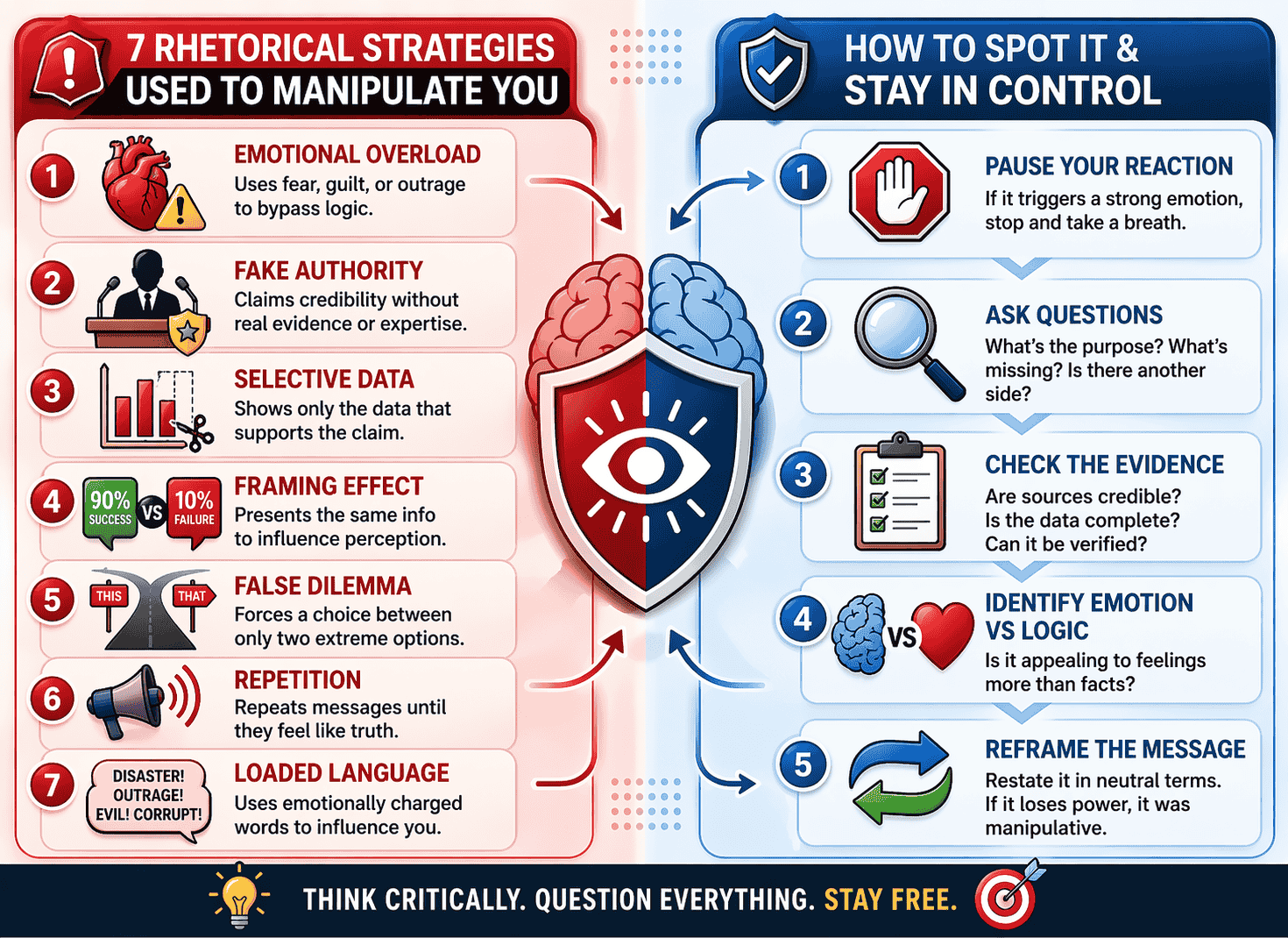
Rhetorical strategies are persuasive techniques (ethos, pathos, logos) that can influence thinking but they become manipulative when they rely on emotion, selective information, or misleading framing – And can be spotted by analyzing evidence, intent, and language.
They’re not inherently bad. In fact, they’re essential for communication. But when used strategically, they can quietly shape your beliefs, decisions, and emotions—often without you noticing.
This guide will show you:
- What rhetorical strategies really are
- How they’re used to manipulate you
- Real-world examples
- A simple system to spot and resist them
What Are Rhetorical Strategies?
Rhetorical strategies are techniques used to persuade or influence an audience.
They help speakers and writers:
- Make arguments more convincing
- Connect emotionally
- Build credibility
- Guide how information is interpreted
The 3 Core Types (You Must Know)
1. Ethos (Credibility)
Appeal to trust and authority
“Experts agree…”
2. Pathos (Emotion)
Appeal to feelings
“Imagine your family in danger…”
3. Logos (Logic)
Appeal to reasoning and data
“Studies show a 75% increase…”
Individually, they persuade.
Combined, they become powerful—and sometimes manipulative.
When Persuasion Becomes Manipulation
Persuasion = helping you make a decision
Manipulation = influencing you without full awareness or fairness
The difference lies in:
- Intent
- Transparency
- Balance of information
If something feels emotionally intense but logically weak—you’re likely being manipulated.
7 Common Rhetorical Strategies Used to Manipulate You
1. Emotional Overload (Pathos Abuse)
Instead of presenting facts, the message overwhelms you with emotion.
Example:
- Fear-based headlines
- Guilt-driven charity ads
- Outrage-driven social media posts
Why it works:
Emotion bypasses critical thinking.
2. Authority Without Evidence (Fake Ethos)
Someone appears credible—but provides no real proof.
Example:
- “Experts say…” (no source)
- Influencers pretending to be specialists
- Titles used to avoid scrutiny
Red flag:
Authority is claimed, not demonstrated.
3. Selective Data (Distorted Logos)
Only the data that supports a claim is shown.
Example:
- Cherry-picked statistics
- Ignoring contradictory evidence
- Misleading graphs
Result:
You see a partial truth—and assume it’s complete.
4. Framing Effect
The same information is presented differently to influence perception.
Example:
- “90% success rate” vs “10% failure rate”
Same fact. Different emotional reaction.
5. False Dilemma
You’re forced into choosing between two extremes.
Example:
- “Either you support this or you don’t care.”
Reality:
There are usually more options.
6. Repetition (Illusion of Truth)
The more you hear something, the more true it feels.
Example:
- Viral misinformation
- Repeated slogans
- Political messaging
Brain shortcut:
Familiarity = truth (even when false)
7. Loaded Language
Words are chosen to trigger emotion instead of clarity.
Example:
- “Disaster,” “outrage,” “corrupt,” “miracle”
These words shape how you feel before you think.
Real-Life Examples of Rhetorical Manipulation
Advertising
- Emotional storytelling instead of product facts
- Celebrity endorsements (ethos)
- Fear of missing out (pathos)
News Media
- Sensational headlines
- Selective reporting
- Biased framing
Social Media
- Viral outrage posts
- Simplified arguments
- Emotional bait content
How to Spot Rhetorical Manipulation (Step-by-Step)
Use this simple mental checklist:
Step 1: Pause Your Reaction
If it triggers a strong emotion, stop.
Strong emotion = high chance of manipulation
Step 2: Ask “What’s Missing?”
- Are both sides presented?
- Is context included?
- Is data complete?
Step 3: Identify the Strategy
Ask yourself:
- Is this emotional (pathos)?
- Is authority being used (ethos)?
- Is logic actually sound (logos)?
Step 4: Look for Evidence
- Are sources credible?
- Are claims verifiable?
- Is data manipulated?
Step 5: Reframe the Message
Try to restate it neutrally.
If it loses power → it was emotionally framed.
Quick Checklist (Save This)
Before believing or sharing anything, ask:
- Is this trying to make me feel something first?
- Is there solid evidence behind the claim?
- Are opposing views ignored?
- Is the language exaggerated?
- Am I being rushed to a conclusion?
If you answer “yes” to 2+ → be cautious.
Why This Matters More Than Ever
In 2026, attention is currency.
Platforms reward:
- Emotional content
- Polarizing opinions
- Simplified narratives
That means:
Manipulative rhetoric spreads faster than rational thinking.
If you don’t actively filter what you consume, someone else will shape how you think.
Final Thoughts
Rhetorical strategies aren’t the enemy.
In fact, they’re essential tools for communication, leadership, and storytelling.
But when used without transparency, they become subtle weapons of influence.
The goal isn’t to reject persuasion—
It’s to recognize it, understand it, and stay in control of your decisions.