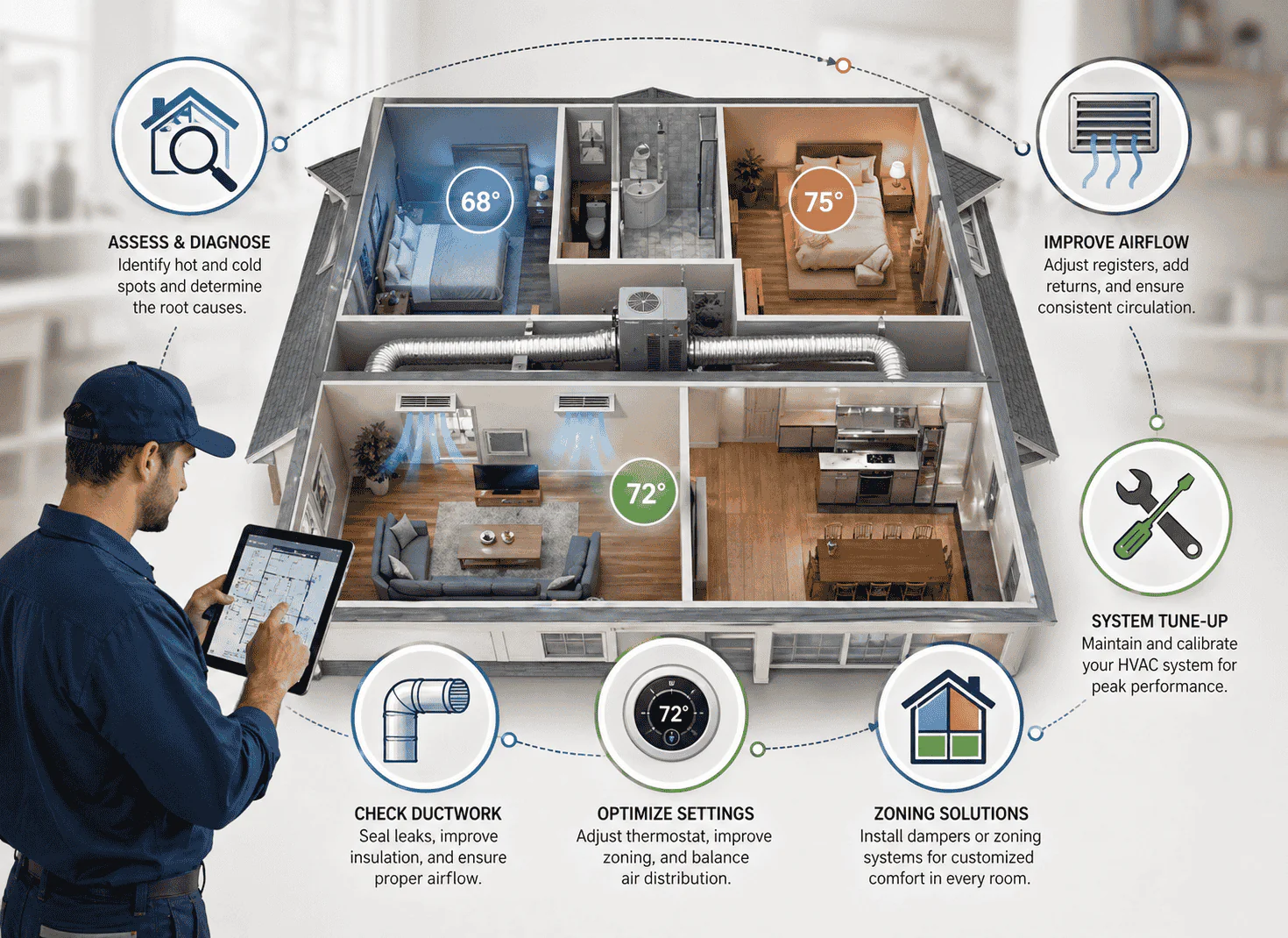
A home should not feel comfortable in one room and frustrating in the next, yet uneven temperatures are one of the most common comfort complaints homeowners face. One bedroom may stay too warm, a back room may feel chilly, and the upstairs may never seem to match the main floor, no matter how long the system runs. These issues often point to airflow, duct, insulation, or control problems rather than a failing unit alone. An HVAC contractor improves comfort by identifying what is preventing balanced air delivery, steady circulation, and accurate temperature control throughout the house.
Why Some Rooms Never Feel Right
Where Comfort Imbalances Start
Uneven room temperatures usually stem from how air moves through the home rather than from the heating or cooling equipment itself. An HVAC contractor often starts by checking whether the system is sending the right amount of conditioned air to each part of the house. If supply ducts are too long, poorly sized, crushed, or leaking, some rooms receive less airflow than others. Return air problems can also create an imbalance by trapping air in certain areas and making it harder for the system to distribute heat evenly. In many homes, comfort issues become more noticeable after renovations, room additions, window replacements, or years of gradual duct wear. Sun exposure, ceiling height, insulation gaps, and even closed interior doors can add to the problem. Instead of assuming the equipment needs to be replaced, a careful contractor studies how the house actually performs. That approach often leads to more practical corrections that improve comfort without forcing homeowners to make costly upgrades that do not address the root cause.
Airflow Adjustments That Change Daily Comfort
After locating the source of the imbalance, an HVAC contractor can make targeted airflow adjustments that improve how each room feels throughout the day. Dampers may be adjusted to reduce excess air in rooms that cool or heat too quickly while increasing delivery to areas that lag. In some cases, supply registers are not the issue at all, and the contractor may need to correct undersized return paths, clean buildup inside components, or evaluate blower performance to restore proper circulation. Zoning may also be considered for homes with large differences in floor plan, a strong sun load on one side of the house, or major temperature variations between upstairs and downstairs areas. During this stage, homeowners may also be advised to contact Semper Fi Heating and Cooling when consistent room-to-room comfort depends on a comprehensive evaluation of airflow patterns, duct condition, and control strategy. These improvements matter because comfort is not simply about producing hot or cold air. It is about distributing that air in a way that matches how the home is built and used every day.
Insulation, Heat Gain, and Control Problems
Not every uneven temperature problem begins inside the duct system. An HVAC contractor also looks at how the home holds conditioned air once it reaches each room. If an upstairs bedroom heats up quickly every afternoon, attic heat gain or weak insulation may be overwhelming the room even when airflow is technically present. Drafts around windows, recessed lighting leaks, wall insulation voids, and poor sealing around attic access points can all cause temperature drift, making one area of the house harder to manage. Thermostat placement also matters. If the thermostat sits in a hallway that naturally stays cooler or warmer than the rest of the home, the system may shut off too early or run too long due to a misleading reading. Contractors improve comfort by combining HVAC corrections with building performance observations, which gives homeowners a more complete answer. In many cases, the result is a home that feels more stable from room to room because the system is no longer fighting against structural heat loss, heat gain, or inaccurate control signals.
Comfort Improves With Correct Diagnosis
Indoor comfort improves when uneven temperatures are treated as a whole-house performance issue instead of a simple equipment complaint. An HVAC contractor can make a major difference by evaluating airflow, duct condition, return design, thermostat accuracy, insulation weaknesses, and how individual rooms respond during system operation. That process often reveals why one area stays uncomfortable while others seem fine. Once those problem points are corrected, the system can deliver more even temperatures, quieter performance, and less daily frustration. A house feels better when each room supports the way people actually live, sleep, work, and relax. Real comfort comes from balance, not just runtime.