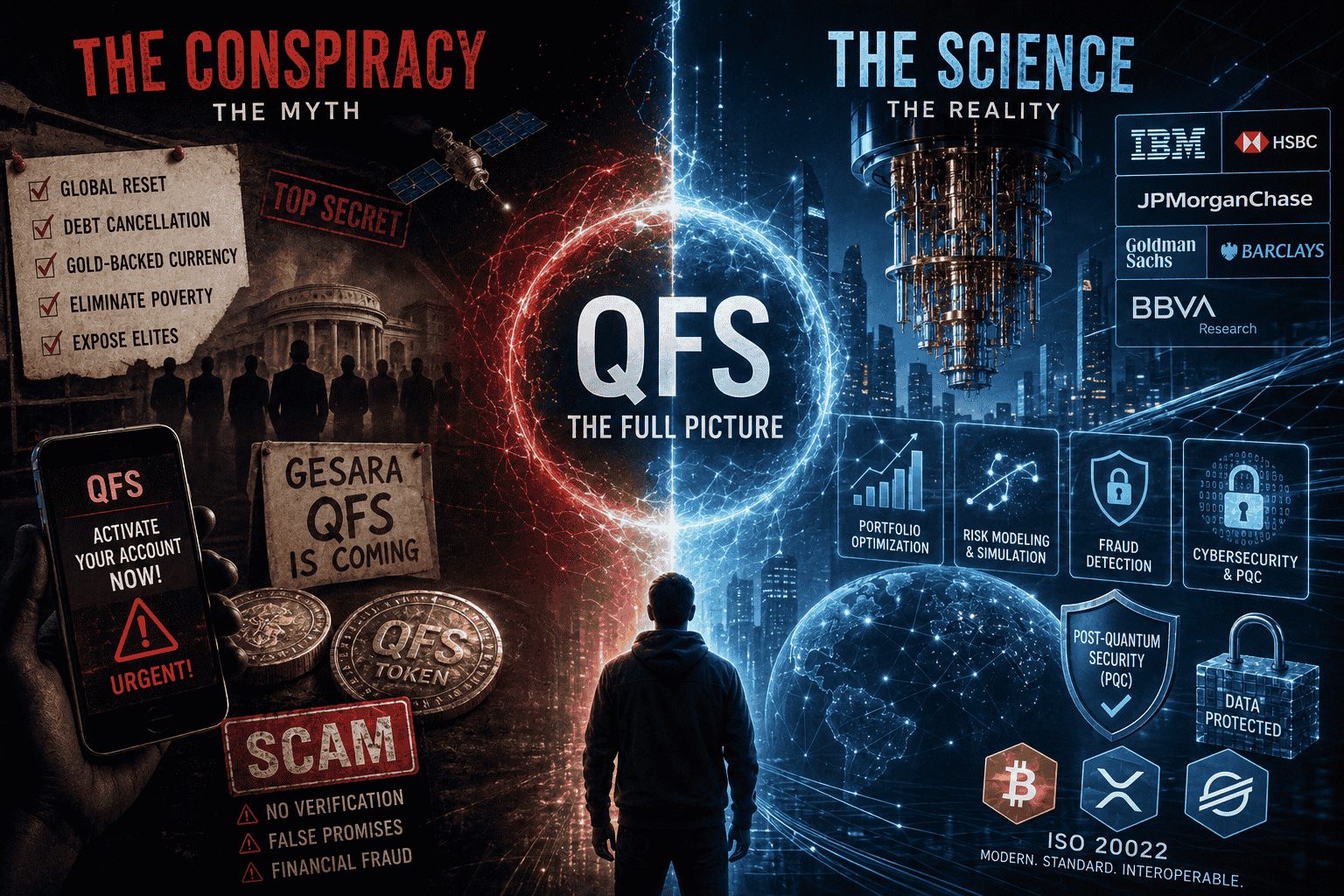
The Quantum Financial System (QFS) refers to two distinct things that are frequently confused. The first is a conspiracy theory — circulating since the early 2000s — claiming a secret, satellite-based quantum financial network will replace all existing banking systems, cancel global debt, and introduce a gold-backed currency. No government, central bank, or financial regulator has ever confirmed this system exists, and it has been linked to large-scale crypto investment scams. The second is a legitimate field of research: the real-world application of quantum computing technology to financial services, including portfolio optimization, fraud detection, Monte Carlo risk simulations, and quantum-resistant encryption.
As of 2026, no fully operational quantum financial system exists at scale — but quantum computing research in finance is active and growing, with firms including JPMorgan Chase, HSBC, Goldman Sachs, and Barclays running verified quantum computing pilots. The global quantum computing market in financial services was valued at approximately $3.52 billion in 2025 and is projected to reach $20.2 billion by 2030.
Either QFS is a secret global reset that will wipe away debt, restore gold-backed currency, and dismantle the central banking system — or it’s pure conspiracy theory spread by scammers targeting vulnerable people.
Both framings are partly right. And both leave out things you actually need to know.
This guide gives you the complete picture: where the QFS theory came from, why it’s wrong about the specifics, and what the real quantum revolution in finance actually looks like — because that part is very real, already happening, and directly affects your bank account, your crypto, and your savings.
First: What Is the Quantum Financial System?
The term “Quantum Financial System” (QFS) means two completely different things depending on where you encounter it.
In online communities, forums, and social media, QFS describes a secret, satellite-based financial network supposedly being built to replace the global banking system. According to its proponents, QFS will cancel all debt, introduce a gold-backed currency, eliminate poverty, and expose corrupt elites. No launch date has ever been confirmed. No government or central bank has acknowledged it exists.
In finance and technology research, a quantum financial system describes the practical application of quantum computing to banking, trading, risk management, and cybersecurity. This version is real, verifiable, and already generating measurable results at major financial institutions.
Understanding the difference between these two versions of QFS is not just academic. It’s the difference between falling for a scam and making an informed decision about one of the most significant technological shifts in modern finance.
The Conspiracy Theory: Where QFS Actually Came From
To understand why QFS beliefs spread so widely, you need to go back to the 1990s.
NESARA: The Legitimate Proposal That Got Hijacked
In the late 1990s, an engineer named Harvey Francis Barnard drafted a proposal called NESARA — the National Economic Security and Reformation Act. It was a genuine, if unconventional, tax reform proposal advocating for the elimination of income tax and the return to a precious metals-backed currency. The proposal was circulated among politicians but was never introduced in Congress, let alone signed into law.
That should have been the end of it.
Instead, starting around 2000, a woman known online as “Dove of Oneness” — real name Shaini Goodwin — began claiming that NESARA had been secretly signed into law by President Clinton, under duress, immediately before the September 11 attacks were staged to prevent its announcement. The story escalated: NESARA would forgive all debt, abolish the IRS, restore common law, and trigger a global currency reset.
The story was completely fabricated. But it spread anyway.
NESARA Became GESARA, and GESARA Became QFS
Over the following two decades, the NESARA narrative evolved into GESARA — the Global Economic Security and Reformation Act — because the original American framing felt too geographically limited for a growing international audience of believers.
Then, as quantum computing began appearing in mainstream news in the 2010s, the narrative absorbed the new terminology. The “quantum” language gave the theory a scientific-sounding foundation it never actually had. By the mid-2010s, “Quantum Financial System” was circulating in the same communities as a next-generation upgrade to the NESARA/GESARA story: the financial reset would be powered by quantum computers, secured by quantum cryptography, and operated through a satellite network orbiting Earth.
None of this is based on real technology or verified plans. It is, as researchers have documented, a mythology that borrows legitimate terminology to make itself harder to dismiss.
Why the QFS Narrative Is So Sticky
Conspiracy theories survive because they contain enough truth to make the fiction feel plausible. And in QFS’s case, the real problems it points to are genuine:
- Cross-border payments in 2024 took an average of three to five business days and cost 6.4% of the transaction value in fees.
- Financial fraud costs the global economy over $5 trillion annually.
- A significant portion of the world’s population remains unbanked or underbanked.
- Traditional encryption standards are mathematically vulnerable to sufficiently powerful quantum computers.
These are real failures of the existing financial system. QFS proponents take real problems, attach real-sounding technological language, and claim a hidden solution already exists. That combination is what makes it persuasive — and what makes it dangerous.
The QFS Scam Problem: What You Need to Know
This section matters more than any other in this article, so read it carefully.
The QFS narrative has been systematically weaponized to steal money from real people.
A New Lines Magazine investigation published in July 2025 documented how QFS-based investment schemes operate: promoters promise that certain cryptocurrencies — often XRP, XLM, or newly issued tokens — are “QFS-compliant” and will surge in value when the quantum financial reset triggers. Victims are told to buy and hold, sometimes urged to liquidate retirement savings or take out loans. When prices are artificially pumped and then crash, promoters disappear with the proceeds.
The victims are disproportionately elderly people and communities with limited financial literacy. Some U.S. lawmakers have been drawn into promoting related content without realizing its connection to organized financial fraud.
Five Warning Signs of a QFS Scam
1. The claim that a specific date has been set. QFS promoters frequently announce imminent launch dates — January 2025, March 2025, Q4 2025. None have materialized. Any fixed launch date for QFS is fabricated.
2. A specific cryptocurrency described as “QFS-compliant” or “QFS-ready.” No cryptocurrency is officially designated for use in any quantum financial system because no such system exists. ISO 20022 compliance — frequently cited in this context — is a modern financial messaging standard unrelated to quantum computing.
3. A claim that QFS accounts already exist and can be activated. There are no QFS accounts. Any platform offering to open one is fraudulent.
4. Pressure to act before a deadline. Urgency is the mechanism that bypasses critical thinking. Legitimate financial innovations do not require you to move in the next 48 hours.
5. Information sourced exclusively from anonymous forums, Telegram channels, or YouTube videos. Real quantum computing research is published by IBM, NIST, major universities, and peer-reviewed journals. It is findable, verifiable, and attached to named researchers. If every source promoting a QFS claim is anonymous, that is not an accident.
If you have encountered content matching these patterns, you can report it to the FTC at ReportFraud.ftc.gov or to your country’s equivalent financial regulator.
The Real Technology: Quantum Computing in Finance
Now that you understand what QFS is not, here is what quantum finance actually is — and why it genuinely matters.
What Quantum Computing Does That Classical Computers Cannot
A classical computer processes information as binary bits — each one is either a 0 or a 1. Every calculation happens in sequence, one step at a time.
A quantum computer uses quantum bits, or qubits. Because of a property called superposition, a qubit can exist in multiple states simultaneously — it is, in a meaningful sense, both 0 and 1 at the same time until measured. A second property, called entanglement, means that qubits can be correlated with one another across any distance, allowing the state of one qubit to instantaneously reflect the state of another.
The practical result: quantum computers can evaluate enormous numbers of possible solutions to a problem at the same time, rather than testing them one by one. For problems involving massive datasets, complex optimization, or exhaustive search — all of which are central to modern finance — this represents a genuinely revolutionary capability.
What Banks Are Actually Doing With Quantum Computing Right Now
Here is the verified landscape of real quantum finance activity as of 2026. These are confirmed outcomes from named institutions — not theories.
HSBC and IBM — high-frequency trading. In a verified pilot, HSBC and IBM combined classical and quantum computing to predict the likelihood of a trade filling at a quoted price — a fundamental problem in high-frequency trading. HSBC reported a forecast accuracy improvement of up to 34%. This is real, peer-verified, and published.
JPMorgan Chase — portfolio optimization and derivatives pricing. JPMorgan has committed up to $10 billion to quantum technology research. Its quantum computing team has published research on applying quantum algorithms to option pricing and portfolio optimization, demonstrating measurable speed improvements over classical models in controlled trials.
Barclays — clearing algorithms. Barclays launched quantum computing research in 2017 and has published breakthrough research on quantum clearing algorithms — the process by which completed trades are formally settled between counterparties.
BBVA — distributed quantum algorithm pilots. BBVA completed a successful pilot of distributed quantum algorithm execution across multiple cloud servers using the AWS cloud, and is a founding member of the Quantum Safe Financial Forum.
Goldman Sachs — Monte Carlo simulations. Goldman has published research demonstrating that quantum algorithms can accelerate Monte Carlo simulations — used for pricing derivatives and stress-testing portfolios — significantly beyond classical computing benchmarks.
The global quantum computing market in financial services was valued at approximately $3.52 billion in 2025. It is projected to reach $20.2 billion by 2030, growing at a compound annual rate of 41.8%.
The Four Real Applications of Quantum Finance
Portfolio optimization. Selecting the optimal mix of assets from thousands of global securities is a combinatorially explosive problem. Classical computing simplifies it with approximations. Quantum algorithms can evaluate the full solution space more completely, producing better-optimized portfolios adjusted for specific risk parameters.
Risk modeling and Monte Carlo simulation. Monte Carlo methods are central to pricing derivatives, stress-testing portfolios, and regulatory compliance. Classical supercomputers can take hours or days to run complex simulations. Quantum algorithms can run these simulations significantly faster — and, in controlled trials, with greater accuracy.
Fraud detection. Banks process billions of transactions daily. Quantum machine learning algorithms can identify fraudulent patterns and behavioral anomalies in real time, at a scale and speed that classical systems cannot match. This has direct implications for the $5 trillion in annual fraud losses that the current system fails to prevent.
Cybersecurity and cryptographic protection. This is arguably the most urgent real-world application — and the one that affects every person with a bank account, not just finance professionals. More on this below.
The Threat Nobody Is Talking About: “Harvest Now, Decrypt Later”
Here is the most important thing you will read in this article.
Nation-state actors — primarily China, Russia, and North Korea based on intelligence community assessments — are currently intercepting and storing encrypted financial communications, diplomatic cables, and sensitive data transmissions.
They cannot decrypt this data today. Classical encryption, particularly the RSA and ECC standards used by virtually every bank and payment system in the world, is computationally infeasible to break with current technology.
But “today” is the operative word.
A sufficiently powerful quantum computer — one with enough stable, error-corrected qubits — could break RSA encryption using an algorithm called Shor’s algorithm. Current estimates from NIST and the intelligence community put this capability at somewhere between eight and twenty years away, depending on how quickly the technical challenges in quantum hardware are solved.
The strategy is straightforward: collect the encrypted data now, and decrypt it later when the hardware exists. This is known as “harvest now, decrypt later,” and it is not a hypothetical threat. It is an active, ongoing intelligence operation.
The implications for financial data are significant. Bank transaction records, wire transfer communications, and financial messages that are intercepted and stored today could be exposed within your financial lifetime.
What the Industry Is Doing About It
In August 2024, the National Institute of Standards and Technology (NIST) finalized the first set of post-quantum cryptographic (PQC) standards — a landmark moment in cybersecurity. These are mathematical encryption methods designed to be secure against both classical and quantum computers.
Major banks are already running multi-year PQC migration programs. The transition from RSA and ECC to NIST-standardized PQC algorithms is underway across the financial sector. BBVA’s Quantum Safe Financial Forum was established specifically to coordinate this transition.
What this means for your bank account: major financial institutions are actively preparing. The risk is real, but it is being addressed. The timeline matters — both because institutions need to complete the transition before quantum computers become powerful enough to pose a threat, and because data being collected today may be at risk even if the institutions successfully migrate.
What this means for your crypto: Bitcoin’s elliptic curve digital signature algorithm (ECDSA) is vulnerable to Shor’s algorithm at the same theoretical threshold that threatens RSA encryption. Estimates suggest a quantum computer capable of breaking Bitcoin’s cryptography would require approximately four million physical qubits in error-corrected operation — far beyond the capabilities of any current system. Development teams across multiple blockchain projects are already researching quantum-resistant signature schemes. The timeline is measured in years to decades, not months.
The NISQ Era: Why We’re Not There Yet
Every claim that a quantum financial system is imminent — whether from QFS believers or overly optimistic tech writers — runs into the same technical reality: we are currently in the NISQ era.
NISQ stands for Noisy Intermediate-Scale Quantum. It describes the current state of quantum hardware: systems with enough qubits to demonstrate genuine quantum advantage on narrow, specific problems, but not yet capable of the large-scale, error-corrected computation needed for production financial systems.
The core challenge is decoherence. Qubits are extraordinarily fragile — they lose their quantum state in microseconds when disturbed by heat, vibration, or electromagnetic interference. Maintaining the coherence needed for complex calculations requires extreme isolation and cryogenic cooling to temperatures colder than outer space. Current quantum computers make too many errors to be trusted for live financial transactions.
The roadmap to fault-tolerant quantum computing — the kind that could run production financial systems — involves solving the error correction problem at scale. Leading estimates from IBM, Google, and academic institutions suggest fault-tolerant systems capable of financial-scale applications are approximately ten to twenty years away, depending on the rate of hardware progress.
This is why the HSBC and JPMorgan pilots are significant: they demonstrate quantum advantage on narrow, well-defined problems using current NISQ hardware. They are proof-of-concept work, not production deployment.
Anyone promising that a global quantum financial system will launch next quarter is either misinformed or lying.
The ISO 20022 and XRP Connection: Separating Fact From Fiction
If you follow the XRP or Stellar (XLM) communities, you have likely encountered claims that ISO 20022 compliance makes these cryptocurrencies “QFS-ready.”
Here is what is true and what is not.
What ISO 20022 actually is: A modern, standardized messaging format for financial data — essentially a shared language that allows different financial institutions to exchange transaction information in a structured, interoperable way. Major payment networks are transitioning to ISO 20022 because it carries more detailed data than older formats and enables faster, more accurate cross-border payments.
What ISO 20022 has to do with quantum computing: Nothing. ISO 20022 is a data formatting standard. Quantum computing is a hardware and algorithm development effort. They are unrelated technologies operating in entirely different domains.
What XRP’s ISO 20022 compliance actually means: Ripple, the company behind XRP, has built messaging layers that conform to the ISO 20022 standard. This makes XRP’s transaction data compatible with modern banking infrastructure. It does not make XRP part of any quantum financial system, and Ripple itself has never made that claim.
The conflation of ISO 20022 compliance with QFS readiness is a specific piece of QFS community lore — not a statement from Ripple, NIST, or any financial authority.
How to Actually Invest in Quantum Finance
If you want real exposure to the quantum computing revolution in finance, here is the legitimate landscape.
Publicly traded companies with real quantum programs:
IBM (NYSE: IBM) — operates the most commercially accessible quantum computing network in the world through IBM Quantum, with over 100 quantum systems available to research and commercial partners. IBM’s financial services clients include HSBC, Goldman Sachs, and Wells Fargo.
IonQ (NYSE: IONQ) — a pure-play quantum computing company building trapped-ion quantum systems. Has published peer-reviewed research on financial applications.
Quantinuum — a private company (joint venture between Honeywell and Cambridge Quantum) with one of the highest-performing quantum systems by qubit fidelity. Partners with financial institutions including JPMorgan.
Alphabet/Google (NASDAQ: GOOGL) — published the landmark “quantum supremacy” paper in 2019. Has active financial services quantum research programs.
D-Wave (NYSE: QBTS) — focuses on quantum annealing, a specific type of quantum computation particularly suited to optimization problems common in finance.
ETF exposure:
Defiance Quantum ETF (QTUM) — tracks an index of companies developing quantum computing, quantum security, and enabling technologies. Provides diversified exposure without single-company risk.
Investing in actual QFS: There is no legitimate investment in the Quantum Financial System as described by QFS proponents. Any platform claiming to offer QFS accounts, QFS tokens, or QFS-linked investments is a scam. The only investable exposure to quantum finance is through the companies and ETFs above — all publicly traded, SEC-regulated, and independently verifiable.
Frequently Asked Questions
Is the Quantum Financial System real?
It depends on what you mean. As a conspiracy theory describing a secret global financial reset — no. There is no verifiable evidence this exists. As a description of quantum computing’s role in finance — yes, and it’s growing rapidly. The confusion between these two meanings is the source of most QFS misinformation.
When will the quantum financial system launch?
No official quantum financial system is scheduled to launch. Real quantum computing applications are being deployed incrementally by individual institutions — not as a single global event. Fault-tolerant quantum computers capable of running full financial system operations are estimated to be ten to twenty years away.
Is XRP or XLM part of the QFS?
No. Neither Ripple nor Stellar has been officially designated as part of any quantum financial system. ISO 20022 compliance — often cited as evidence — is a messaging standard unrelated to quantum computing.
Will quantum computers break Bitcoin?
Eventually, if fault-tolerant quantum computers are developed at sufficient scale, yes — Bitcoin’s current ECDSA signatures would be vulnerable to Shor’s algorithm. The timeline is measured in decades, not years. Bitcoin developers are actively researching quantum-resistant alternatives. The threat is real but not imminent.
Is my bank account safe from quantum attacks?
In the short term — yes. In the medium term, the answer depends on how quickly the financial sector completes the transition to post-quantum cryptographic standards, which is currently underway. The “harvest now, decrypt later” threat is real, but it affects long-lived secrets more than everyday transactions.
How do I report a QFS scam?
In the United States: ReportFraud.ftc.gov or file a complaint with the SEC at investor.gov. In the UK: actionfraud.police.uk. in Australia: scamwatch.gov.au. In all cases, preserving screenshots and transaction records before reporting strengthens the case.
Can I invest in QFS?
Not legitimately. Real quantum finance exposure comes through publicly traded companies (IBM, IonQ, D-Wave, Alphabet) and diversified ETFs (Defiance QTUM). Any platform claiming to sell QFS investments or open QFS accounts is engaging in fraud.
A Timeline: The Realistic Road Ahead
Now — 2028: NISQ-era hardware continues improving. Narrow quantum advantage on specific financial problems (pricing, optimization, fraud detection) demonstrated in controlled pilots. Post-quantum cryptography standards adopted across major financial institutions. Quantum-resistant blockchain development accelerates.
2028 — 2033: Early fault-tolerant quantum processors emerge. Quantum algorithms deployed in production for Monte Carlo simulations and portfolio optimization at select institutions. Post-quantum cryptography becomes standard practice across the global banking system.
2033 — 2040: Fault-tolerant quantum computing matures. Quantum advantage demonstrated across a broader range of financial applications. Legacy encryption systems that have not been updated become genuinely vulnerable.
Beyond 2040: If hardware progress continues at current rates, quantum computers may become capable of large-scale financial system operations. This will happen through incremental deployment at individual institutions — not a single global launch event.
At no point in this timeline does a secret satellite-based global financial reset occur.
Final Word
The Quantum Financial System is not coming to save you.
There is no hidden system being activated, no debt jubilee, no gold-backed currency waiting in reserve. The conspiracy is real — but it is a conspiracy of scammers exploiting the legitimate anxiety people feel about a financial system that fails them, dressed in the language of real science.
The real quantum revolution in finance, however, is coming — and on a longer, less dramatic timeline than anyone on either side of the QFS debate tends to acknowledge.
It is already producing measurable results at the world’s largest banks. It will reshape how risk is calculated, how fraud is detected, and how financial data is secured. The transition to post-quantum cryptography is not optional and is already underway.
The most useful thing you can do with this information is not to invest in QFS tokens or wait for a reset. It is to understand that the technology is real, the timeline is long, the threats are genuine, and the scams are sophisticated.
Stay curious. Stay skeptical. And the moment anyone tells you a specific date, a specific cryptocurrency, or a specific account type will unlock your share of the quantum financial future — walk away.