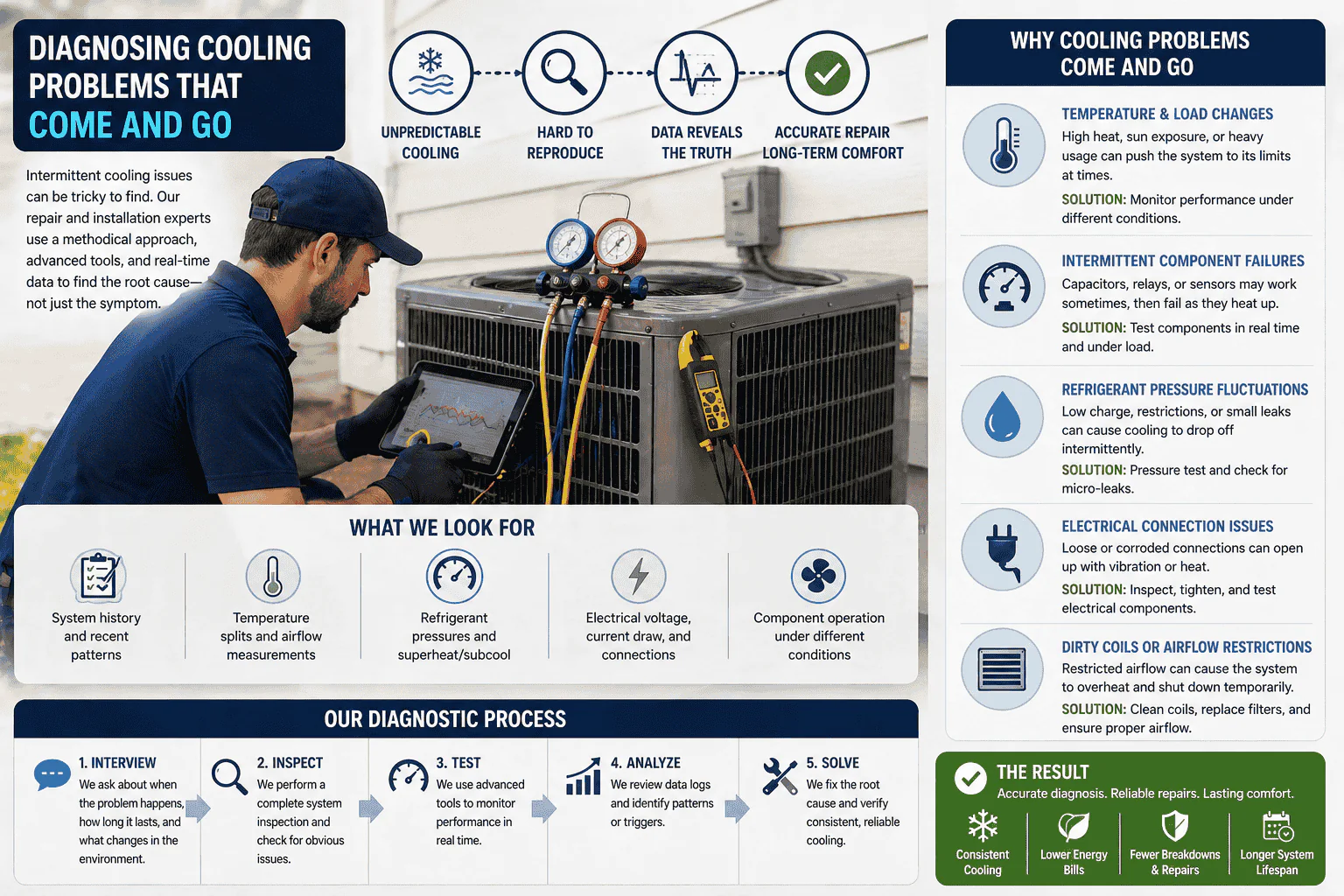
Intermittent cooling problems are some of the most frustrating issues a property can have. The system works long enough to create doubt, then fails just long enough to disrupt comfort, tenant confidence, or daily operations. That inconsistency often leads owners to delay service, assuming the problem has corrected itself when it has only gone temporarily quiet.
For property managers, facility managers, and building owners, cooling problems that come and go are rarely minor. They point to a system that is reacting to changing demand, temperature, airflow, or control conditions in ways that should be understood before the issue leads to a complete loss of cooling. Air conditioning repair and installation services diagnose these problems by tracking patterns, testing performance under real operating conditions, and identifying which part of the system is losing consistency.
Where The Cooling Loss Begins
1. Inconsistent Cooling Still Leaves Clues
An air conditioner does not need to fail continuously to reveal what is wrong. Intermittent cooling issues usually show patterns in timing, weather, occupancy, or runtime. The system may cool normally in the morning but struggle in the afternoon. It may fail only during peak outdoor heat, only after extended operation, or only in certain zones of the building. Those patterns matter because they often point to causes that would be missed during a quick inspection.
A capable technician starts by asking when the cooling issue appears, how long it lasts, and what changes at the same time. 1. Does the fan keep running while the air stops feeling cold? 2. Does the thermostat call for cooling, but the outdoor unit fails to respond? 3. Does the system recover after being shut off for a while? These details create the roadmap for diagnosis and help narrow the source before unnecessary parts are replaced.
2. Looking Beyond The Obvious Complaint
The visible complaint is usually simple: the property gets warm even though the air conditioner is on. The real diagnostic task is determining whether the system is losing cooling on the thermostat, controls, airflow, refrigeration, or electrical side. A strong service company does not treat every intermittent cooling issue like a low refrigerant call or a thermostat issue by default. It tests the full chain of operation.
That is why companies associated with Barrie Air Conditioning Repair and Installation Services often focus first on operating conditions rather than rushing to a quick assumption. A system that cools some of the time properly is still performing part of its job, which means the failure is often conditional rather than total. Identifying those conditions is what separates accurate diagnosis from repeated service calls that never fully solve the problem.
3. Thermostat And Control Problems Matter
One of the first places technicians look is the control side of the system. Cooling that comes and goes may be tied to thermostat miscommunication, faulty wiring, sensor drift, programming errors, or control boards that respond inconsistently under certain conditions. A thermostat may appear to be working while sending unstable calls for cooling, or it may lose accuracy when the space temperature changes too quickly.
This matters because the system can seem mechanical when the real problem is electronic or control-related. If the cooling cycle is not being started, maintained, or ended properly, the equipment may look unreliable when it is actually responding to poor instructions. Technicians often verify thermostat operation, check low-voltage circuits, and observe how the control sequence behaves across multiple cycles before deciding the issue lies deeper in the equipment.
4. Airflow Problems Can Mimic Cooling Loss
Not every intermittent cooling complaint begins with refrigerant or compressor trouble. Airflow issues can make a system appear to lose cooling even when the refrigeration cycle is technically active. A dirty filter, a clogged evaporator coil, a restricted return path, a weak blower motor, a slipping fan component, or a high static pressure condition can all reduce the amount of conditioned air that reaches occupied spaces. Under lighter demand, the system may appear acceptable. Under higher heat load, the weakness becomes obvious.
This is especially common in buildings where some rooms stay comfortable while others drift warm. Technicians evaluate blower performance, temperature drop, duct conditions, and system pressure to determine whether the issue is actual cooling loss or poor air delivery. Without this step, an intermittent airflow problem can easily be mistaken for an intermittent refrigeration problem, leading to the wrong repair path.
Accurate Diagnosis Prevents Repeat Disruption
Cooling problems that come and go are easy to underestimate because the system keeps giving the impression that it still works. In reality, intermittent performance often means the system is already unstable in one critical area. Air conditioning repair and installation services diagnose these issues by looking at timing, controls, airflow, refrigerant behavior, electrical load, and installation conditions as one connected system rather than a list of unrelated symptoms.
For property managers and building owners, that approach matters because temporary recovery is not the same as dependable performance. A system that fails only under certain conditions is still on the path toward bigger disruption. When the diagnosis is based on actual operating patterns rather than quick assumptions, repairs become more precise, tenant complaints are easier to resolve, and the property avoids the costly cycle of recurring cooling issues that never seem fully explained.