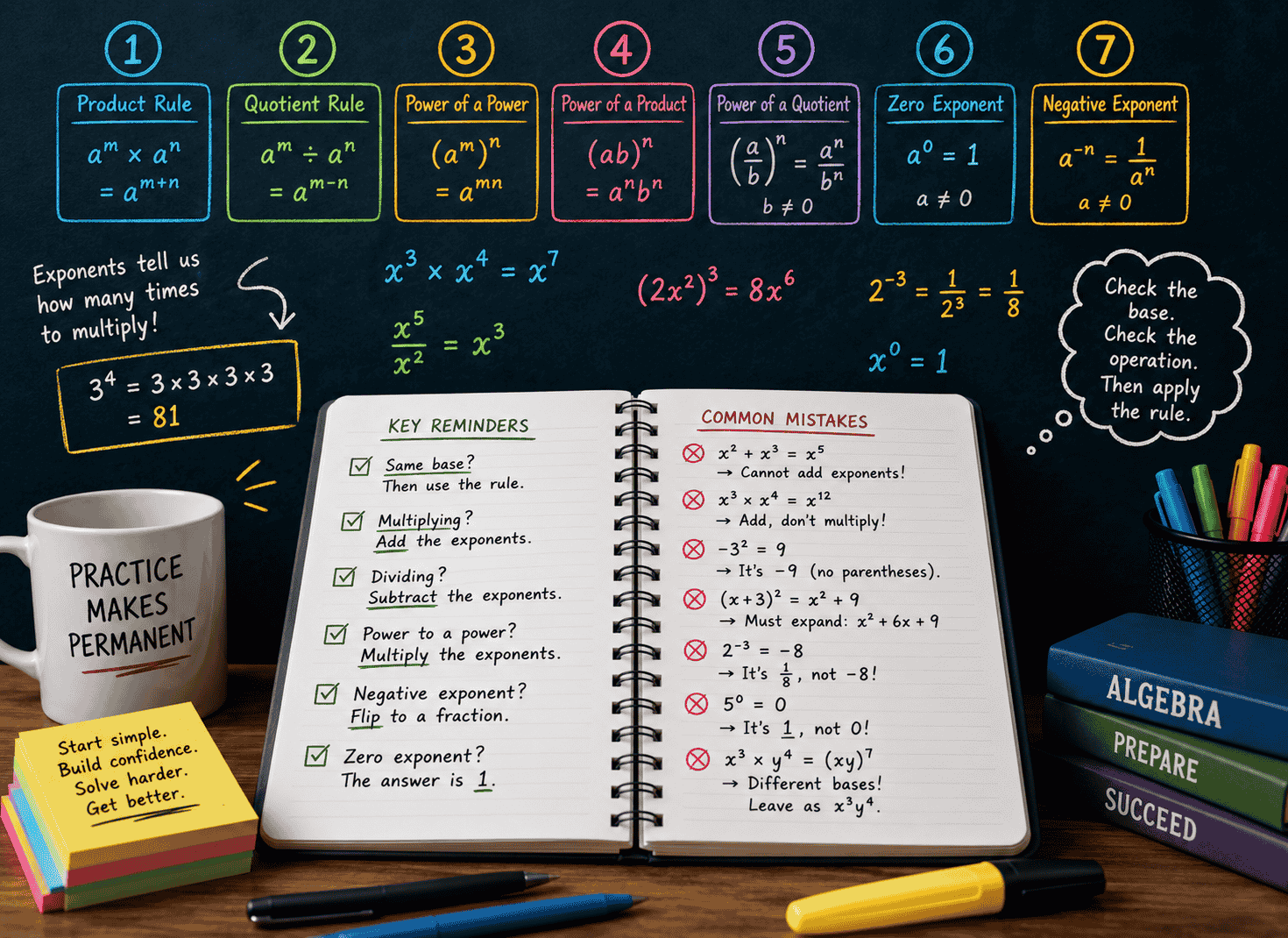
Exponent rules (also called laws of exponents or properties of exponents) are the 7 mathematical laws used to simplify expressions that contain powers. The seven rules are: the product rule (add exponents when multiplying same-base terms), the quotient rule (subtract exponents when dividing), the power of a power rule (multiply exponents), the power of a product rule (distribute the exponent to each factor), the power of a quotient rule (distribute to numerator and denominator), the zero exponent rule (any non-zero base to the power of zero equals 1), and the negative exponent rule (a negative exponent means take the reciprocal). These rules apply to all real numbers, variables, and algebraic expressions — and they form the foundation of algebra, scientific notation, and exponential functions.
Exponent mistakes are among the most common algebra errors at every level, from Grade 8 through university. The frustrating part? Most of them come from tiny misunderstandings that no one ever pointed out clearly.
This guide fixes that. You’ll get all 7 exponent rules explained in plain language, and the exact mistakes that cost students marks — with a clear fix for every single one.
Let’s get into it.
What Is an Exponent (Quick Refresher)
Before diving into the rules, make sure you’re clear on the basics.
An exponent tells you how many times to multiply a number by itself.
In the expression 3⁴, the number 3 is the base and 4 is the exponent (also called the power or index).
So 3⁴ means: 3 × 3 × 3 × 3 = 81
That’s it. Everything else — all 7 laws — flows naturally from this definition. Keep that in mind, and the rules stop feeling like random facts to memorize.
The 7 Exponent Rules (Laws of Exponents)
Law 1 — The Product Rule
When you multiply two powers with the same base, add the exponents.
aᵐ × aⁿ = aᵐ⁺ⁿ
Why it works: You’re just counting how many times the base gets multiplied in total.
x³ × x⁴ = (x · x · x) × (x · x · x · x) = x⁷ ✓
Example:
- 2³ × 2⁵ = 2³⁺⁵ = 2⁸
- y² × y⁶ = y⁸
⚠️ Key condition: The bases must be identical. You cannot add exponents if the bases are different.
Law 2 — The Quotient Rule
When you divide two powers with the same base, subtract the exponents.
aᵐ ÷ aⁿ = aᵐ⁻ⁿ
Why it works: Division cancels matching factors from the top and bottom.
x⁵ ÷ x² = (x · x · x · x · x) ÷ (x · x) = x³ ✓
Example:
- 5⁷ ÷ 5³ = 5⁷⁻³ = 5⁴
- m⁹ ÷ m⁴ = m⁵
⚠️ Key condition: The base cannot equal zero (you can’t divide by zero).
Law 3 — The Power of a Power Rule
When a power is raised to another power, multiply the exponents.
(aᵐ)ⁿ = aᵐⁿ
Why it works: The outer exponent just says how many times to apply the inner one.
(x²)³ = x² × x² × x² = x⁶ ✓
Example:
- (3²)⁴ = 3²×⁴ = 3⁸
- (y³)⁵ = y¹⁵
Law 4 — The Power of a Product Rule
When a product inside brackets is raised to a power, distribute the exponent to every factor.
(ab)ⁿ = aⁿbⁿ
Example:
- (2x)³ = 2³ · x³ = 8x³
- (3y²)² = 3² · (y²)² = 9y⁴
⚠️ Critical warning: This rule works for multiplication only. It does NOT work for addition. More on this below.
Law 5 — The Power of a Quotient Rule
When a fraction inside brackets is raised to a power, apply the exponent to both the numerator and denominator.
(a/b)ⁿ = aⁿ/bⁿ (where b ≠ 0)
Example:
- (x/3)² = x²/9
- (2a/b)³ = 8a³/b³
Law 6 — The Zero Exponent Rule
Any non-zero number raised to the power of zero equals 1.
a⁰ = 1 (where a ≠ 0)
Why it works: Use the quotient rule on identical terms.
x³ ÷ x³ = x³⁻³ = x⁰ — and obviously x³ ÷ x³ = 1, so x⁰ = 1 ✓
Example:
- 7⁰ = 1
- (3x²y)⁰ = 1 (as long as x and y aren’t zero)
⚠️ The exception: 0⁰ is undefined. It’s an indeterminate form — not 1.
Law 7 — The Negative Exponent Rule
A negative exponent means take the reciprocal — it does NOT make the answer negative.
a⁻ⁿ = 1/aⁿ
Why it works: Follow the pattern from the quotient rule.
x² ÷ x⁵ = x²⁻⁵ = x⁻³ — and written out, that’s (x·x)/(x·x·x·x·x) = 1/x³ ✓
Example:
- 2⁻³ = 1/2³ = 1/8
- x⁻⁴ = 1/x⁴
- 1/y⁻² = y² (negative exponent in the denominator moves up)
⚠️ Key reminder: x⁻² does not equal −x². Negative exponent ≠ negative number.
Bonus: Fractional (Rational) Exponents
Once you’re comfortable with the 7 laws, fractional exponents complete the picture.
aᵐ/ⁿ = ⁿ√(aᵐ) = (ⁿ√a)ᵐ
The denominator is the root. The numerator is the power. Either order works.
Example:
- 8^(1/3) = ³√8 = 2
- 27^(2/3) = (³√27)² = 3² = 9
- 16^(3/4) = (⁴√16)³ = 2³ = 8
This connects exponents directly to radicals — they’re just two ways of writing the same thing.
The Mistakes That Actually Cost You Marks (And How to Fix Them)
Here’s the section most articles never include. These are the exact errors that show up on exams — and the precise fix for each one.
Mistake 1 — Adding Exponents When You’re Adding, Not Multiplying
Wrong: x² + x³ = x⁵ ✗
Right: x² + x³ stays as x² + x³ ✓
The product rule (adding exponents) only applies when you’re multiplying powers with the same base. Addition is completely different — there’s no exponent rule for it, and you cannot simplify x² + x³ further.
The fix: Before applying any rule, ask yourself: “Am I multiplying or dividing these terms?” If the answer is no, the exponent laws don’t apply.
Mistake 2 — Multiplying Exponents When You Should Add Them
Wrong: x³ × x⁴ = x¹² ✗ (multiplied the exponents)
Right: x³ × x⁴ = x⁷ ✓ (add the exponents when multiplying)
Students often confuse the product rule with the power rule. The power rule (multiply exponents) only applies when a power is raised to another power — like (x³)⁴.
The fix: Two separate terms being multiplied → add the exponents. A power inside brackets raised to a power → multiply the exponents.
| Situation | Rule | Operation |
|---|---|---|
| x³ × x⁴ (multiplying two powers) | Product rule | Add: x⁷ |
| (x³)⁴ (power of a power) | Power rule | Multiply: x¹² |
Mistake 3 — The Negative Base Trap
This is one of the most heavily tested — and most commonly missed — distinctions in all of algebra.
Wrong: −3² = 9 ✗
Right: −3² = −9 ✓
Here’s why: without parentheses, the exponent applies only to the base (3), not the negative sign. The expression −3² means −(3²) = −9.
But with parentheses:
(−3)² = (−3) × (−3) = +9 ✓
The parentheses tell you the entire negative number is the base.
The fix: Always check for parentheses around a negative base. No parentheses = the negative sign is applied after the exponent.
| Expression | Meaning | Answer |
|---|---|---|
| −3² | −(3²) | −9 |
| (−3)² | (−3) × (−3) | +9 |
| −3³ | −(3³) | −27 |
| (−3)³ | (−3) × (−3) × (−3) | −27 |
Mistake 4 — Distributing an Exponent Over Addition
Wrong: (x + 3)² = x² + 9 ✗
Right: (x + 3)² = (x + 3)(x + 3) = x² + 6x + 9 ✓
The power of a product rule distributes an exponent over multiplication — not addition. When you have a sum inside the brackets, you must expand it by multiplying brackets, not by squaring each term separately.
The fix: Is there a + or − inside the brackets? Then you cannot distribute the exponent. Expand using FOIL or the distributive property instead.
Mistake 5 — Treating a Negative Exponent as a Negative Number
Wrong: 2⁻³ = −8 ✗
Right: 2⁻³ = 1/2³ = 1/8 ✓
A negative exponent creates a reciprocal — it has nothing to do with making the result negative. The answer is always positive (assuming a positive base).
The fix: See a negative exponent? Immediately rewrite it as a fraction: a⁻ⁿ = 1/aⁿ. This one rewrite prevents nearly all errors.
Mistake 6 — Forgetting x⁰ = 1 and Claiming It’s 0
Wrong: 5⁰ = 0 ✗
Right: 5⁰ = 1 ✓
This mistake happens because “zero” feels like it should produce zero. But as shown earlier, the zero exponent rule comes directly from the quotient rule — anything divided by itself is 1, so x⁰ = 1.
The fix: Memorize this with a concrete example. 5³ ÷ 5³ = 5⁰ — and 125 ÷ 125 is obviously 1. So 5⁰ = 1, every time.
Mistake 7 — Applying Rules to Different Bases
Wrong: x³ × y⁴ = (xy)⁷ ✗
Right: x³ × y⁴ stays as x³y⁴ ✓
The product rule and quotient rule only work when the bases are identical. x and y are different bases, so there’s nothing to combine.
The fix: Check the bases before applying any rule. If they don’t match, either leave the expression as-is or try to rewrite one base in terms of the other.
Example where rewriting helps: 8³ × 4² = (2³)³ × (2²)² = 2⁹ × 2⁴ = 2¹³
Here, both 8 and 4 are powers of 2 — so you can combine them after rewriting.
Which Rule Do I Use? A Quick Decision Guide
When you’re staring at a complex expression, work through this order:
- Are you multiplying same-base terms? → Product rule → add exponents
- Are you dividing same-base terms? → Quotient rule → subtract exponents
- Is a power raised to another power? → Power rule → multiply exponents
- Is a product or quotient inside brackets with an external exponent? → Distribute the exponent to each factor
- Is the exponent zero? → The result is 1 (base ≠ 0)
- Is the exponent negative? → Flip to reciprocal with positive exponent
- Is the exponent a fraction? → Rewrite as a root
Always work from the inside out when expressions are nested. Tackle brackets first, then apply the outer operation.
A Multi-Step Example (Putting It All Together)
Simplify: (2x²y⁻¹)³ ÷ (4x⁻¹y²)¹
Most articles only show single-rule problems. Real exam questions look like this. Let’s walk through it step by step.
1 — Apply the power of a product rule to the bracket: (2x²y⁻¹)³ = 2³ · (x²)³ · (y⁻¹)³ = 8x⁶y⁻³
2 — Rewrite the second term (no bracket to expand here): (4x⁻¹y²)¹ = 4x⁻¹y²
3 — Divide using the quotient rule: (8x⁶y⁻³) ÷ (4x⁻¹y²) = (8/4) · x⁶⁻⁽⁻¹⁾ · y⁻³⁻² = 2 · x⁷ · y⁻⁵
4 — Convert negative exponents to positive: = 2x⁷/y⁵
That’s your final answer. Notice how four different rules were used in sequence — product, power of a power, quotient, and negative exponent.
Exponent Rules Quick-Reference Cheat Sheet
| Rule | Formula | Memory cue |
|---|---|---|
| Product rule | aᵐ × aⁿ = aᵐ⁺ⁿ | Multiply → add |
| Quotient rule | aᵐ ÷ aⁿ = aᵐ⁻ⁿ | Divide → subtract |
| Power of a power | (aᵐ)ⁿ = aᵐⁿ | Power on power → multiply |
| Power of a product | (ab)ⁿ = aⁿbⁿ | Brackets × → distribute |
| Power of a quotient | (a/b)ⁿ = aⁿ/bⁿ | Brackets ÷ → distribute |
| Zero exponent | a⁰ = 1 | Anything to zero → one |
| Negative exponent | a⁻ⁿ = 1/aⁿ | Negative → flip |
| Fractional exponent | aᵐ/ⁿ = ⁿ√(aᵐ) | Denominator is the root |
Frequently Asked Questions
Can you add exponent rules when the bases are the same?
Only if you’re multiplying the terms (product rule). You cannot combine exponents when the terms are being added or subtracted. x² + x² = 2x², not x⁴.
What happens when a negative number is raised to an even power?
The result is always positive. (−4)² = +16, (−2)⁴ = +16. A negative base raised to an odd power stays negative: (−2)³ = −8.
What is 0⁰?
It’s undefined — an indeterminate form. The zero exponent rule (a⁰ = 1) only applies when the base is a non-zero number.
Why does a negative exponent give a fraction, not a negative number?
Because a⁻ⁿ is defined as 1/aⁿ — it represents a reciprocal, not a subtraction. It’s a shorthand for “flip the base and make the exponent positive.”
Do exponent rules work with variables?
Yes, exactly the same way they work with numbers. The rules apply to any non-zero real base.
What’s the difference between (−x)² and −x²?
(−x)² = x² (the exponent applies to −x as a whole). −x² = −(x²) (the exponent applies only to x). The parentheses make all the difference.
Final Word
The 7 exponent laws aren’t complicated — but they’re easy to misapply when you’re working under exam pressure. The good news is that every mistake on this list follows a predictable pattern.
Go through the mistakes section one more time and honestly ask yourself: have I been making any of these? If the answer is yes, that’s actually great news — because now you know exactly what to fix.
Work through a handful of multi-step problems using the decision guide above, and these rules will stop being something you have to remember and start being something you simply see.
Found this useful? Share it with someone who’s prepping for their algebra exam — these are the exact mistakes that separate a B from an A.