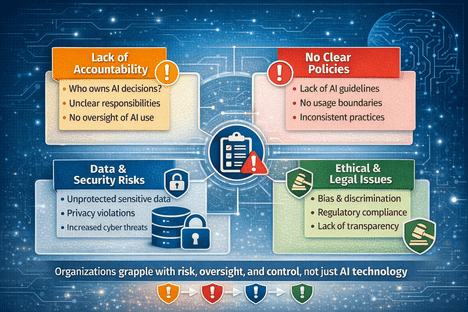
AI transformation is a problem of governance because organizations struggle more with managing accountability, risk, data, and decision-making than with the AI technology itself. Companies across industries are investing heavily in automation, machine learning, and generative systems. Yet despite this rapid adoption, many organizations are quietly struggling to turn AI into real business value.
The reason isn’t a lack of technology, It’s governance.
AI transformation is often framed as a technical challenge, but in reality, it’s a governance problem—one that involves leadership, accountability, risk management, and decision-making. If governance is weak, even the most advanced AI systems fail to deliver.
This guide explains what that means, why it matters, and how organizations can fix it.
What Is AI Transformation?
AI transformation goes beyond simply using AI tools. It refers to embedding AI into the core of business operations, strategy, and decision-making.
AI Adoption vs AI Transformation
Many companies confuse adoption with transformation.
- AI adoption: Using tools like chatbots, analytics, or automation in isolated areas
- AI transformation: Integrating AI across departments to drive long-term impact
Adoption is easy. Transformation is complex—and that’s where governance becomes critical.
Real-World Examples
- A healthcare provider using AI for diagnostics across multiple departments
- A financial firm automating risk assessment and fraud detection
- A marketing team using AI to personalize campaigns at scale
These examples require coordination, policies, and oversight—not just tools.
Why AI Transformation Is a Governance Problem
The core issue is simple: AI systems make decisions, and every decision needs accountability.
Without governance, organizations lose control over how AI is built, deployed, and used.
Lack of Clear Ownership
In many companies, no one truly “owns” AI.
- IT teams manage infrastructure
- Data teams handle models
- Business teams use the outputs
This creates confusion. When something goes wrong, responsibility is unclear.
Absence of Policies and Frameworks
AI often gets deployed faster than policies are created.
Without clear guidelines:
- Teams use inconsistent data
- Models behave unpredictably
- Ethical boundaries are ignored
Data Governance Challenges
AI depends on data—often sensitive, dynamic, and complex.
Poor data governance leads to:
- Inaccurate predictions
- Privacy violations
- Compliance risks
Ethical and Regulatory Risks
AI introduces serious ethical concerns:
- Bias in decision-making
- Lack of transparency
- Unfair outcomes
Regulations are evolving, and organizations must stay compliant or face legal consequences.
Scaling Without Control
AI works well in pilot projects. But when companies try to scale, problems emerge:
- Models drift over time
- Systems become harder to monitor
- Risks multiply
Without governance, scaling AI becomes chaotic.
Key Governance Challenges in AI Transformation
Understanding the challenges helps explain why so many AI initiatives fail.
Who Owns AI Decisions?
Ownership is one of the biggest gaps.
IT vs Business Conflict
IT teams focus on systems and security.
Business teams focus on outcomes and speed.
Without alignment, decisions become fragmented.
Leadership Gaps
Many executives support AI in theory but lack a clear governance strategy. This creates a disconnect between vision and execution.
Managing Risk and Bias
AI systems are not neutral. They reflect the data they’re trained on.
Algorithmic Bias
Bias can lead to unfair decisions in hiring, lending, or healthcare. This is not just a technical issue—it’s a governance failure.
Compliance Requirements
Laws around data protection and AI usage are increasing. Organizations must ensure their AI systems meet legal standards.
Data Privacy and Security
AI systems often process large volumes of personal data.
Without strong governance:
- Data leaks become more likely
- Unauthorized access increases
- Trust is damaged
Lack of Standardization
Many organizations build AI systems in silos.
This leads to:
- Inconsistent practices
- Duplicate efforts
- Difficult scaling
Governance provides the structure needed to standardize processes.
The Impact of Poor AI Governance
When governance is weak, the consequences are serious.
Failed AI Projects
Many AI initiatives never move beyond the pilot stage. Others fail to deliver ROI due to poor oversight.
Financial Losses
AI investments are expensive. Without governance, companies waste resources on ineffective systems.
Legal and Compliance Risks
Regulatory violations can result in fines and reputational damage.
Loss of Trust
Customers and stakeholders expect fairness and transparency. Poor governance erodes trust quickly.
What Is AI Governance?
AI governance refers to the framework of policies, processes, and controls that guide how AI is developed and used.
Core Components of AI Governance
Policies and Guidelines
Clear rules define:
- How AI can be used
- What data is allowed
- Ethical boundaries
Monitoring and Auditing
AI systems must be continuously monitored to ensure they behave as expected.
Risk Management
Organizations need systems to identify, assess, and mitigate risks related to AI.
How to Fix the Governance Problem in AI Transformation
Solving this problem requires a structured approach.
Define Clear Ownership
Assign responsibility for AI initiatives.
- Create dedicated AI leadership roles
- Ensure accountability across teams
Build a Governance Framework
Develop a formal structure that includes:
- Policies
- Standards
- Approval processes
This ensures consistency across the organization.
Implement Ethical Guidelines
Ethics should be built into every stage of AI development.
- Identify potential biases
- Ensure transparency
- Promote fairness
Strengthen Data Governance
High-quality data is essential.
- Standardize data collection
- Ensure accuracy and security
- Control access
Monitor and Improve Continuously
AI systems evolve over time.
- Track performance
- Audit outcomes
- Update models regularly
Governance is not a one-time effort—it’s ongoing.
Best Practices for AI Governance
Organizations that succeed with AI follow a few key principles:
Align AI With Business Goals
AI should support clear objectives, not exist as a standalone initiative.
Create Cross-Functional Teams
Bring together IT, data, legal, and business teams to ensure balanced decision-making.
Invest in Governance Tools
Use platforms that support monitoring, compliance, and risk management.
Stay Updated on Regulations
AI laws are evolving. Staying informed helps avoid legal issues.
Common Mistakes to Avoid
Many organizations repeat the same errors:
Focusing Only on Technology
AI tools are important, but governance determines success.
Ignoring Governance Early
Waiting too long to establish governance leads to bigger problems later.
Lack of Skilled Leadership
Without experienced leaders, AI initiatives lack direction.
Poor Data Management
Bad data leads to bad outcomes—no matter how advanced the AI is.
Conclusion: Governance Is the Foundation of AI Success
AI transformation is not just about innovation—it’s about control.
Organizations that treat AI as a purely technical challenge often fail. Those that prioritize governance build systems that are scalable, ethical, and reliable.
The takeaway is clear:
AI transformation succeeds when governance leads the way.
If companies want to unlock the full potential of AI, they must focus less on tools—and more on how those tools are managed.