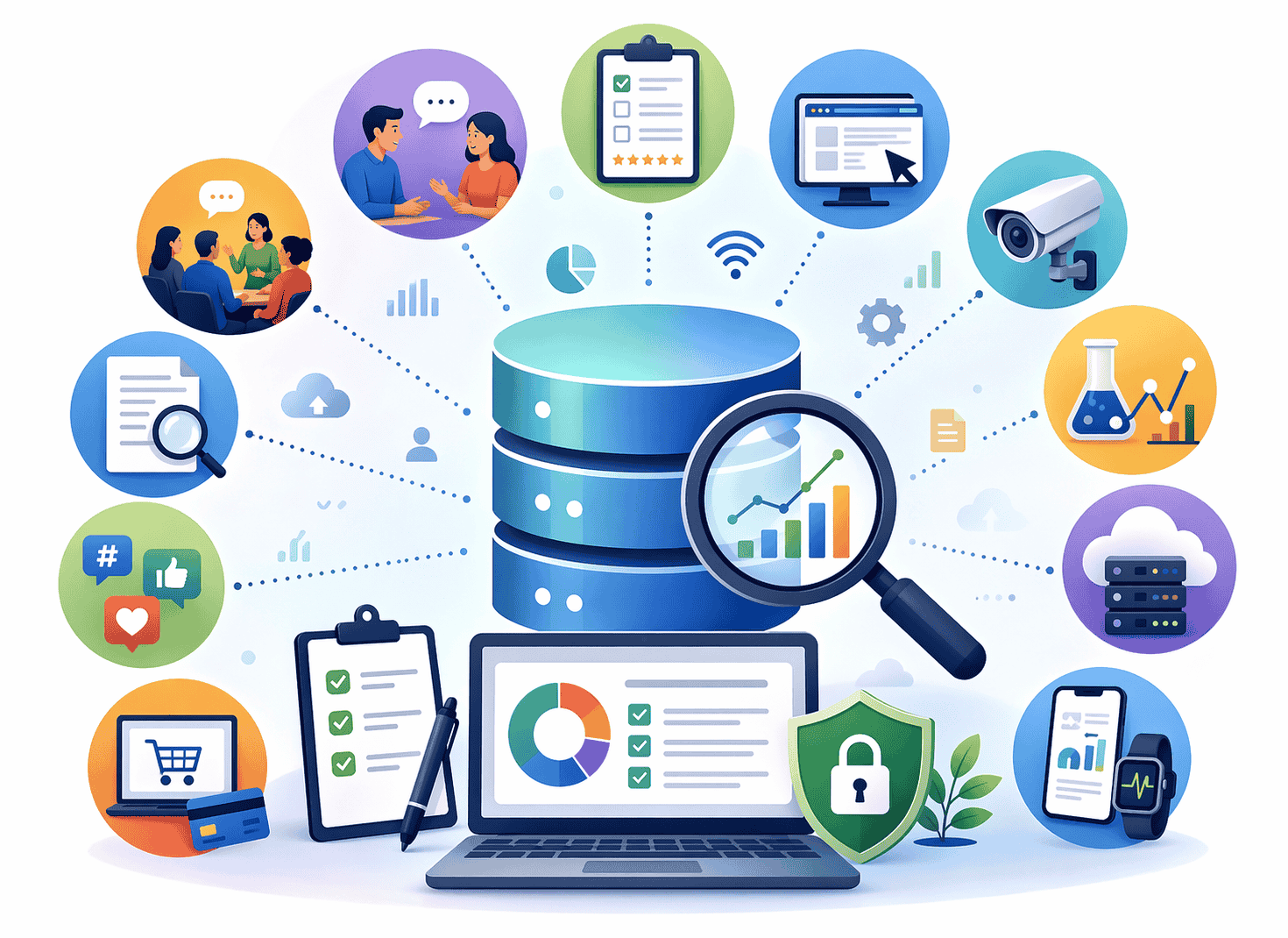
Data collection with accuracy is a smart strategy – but only if you collect it the right way. With so many methods available, choosing the wrong one wastes time, skews results, and in some cases, lands you in legal trouble.
This guide breaks down the top 15 data collection methods you need to know, explains when to use each, and gives you a clear framework to choose the right one for your project, business, or research.
What Is Data Collection — And Why Does It Matter?
Data collection is the process of gathering information – from one or more sources to answer a question, test a hypothesis, or inform a decision.
It sounds simple, But here’s the thing – the method you choose directly affects the quality, accuracy, and usability of the data you end up with. Poor collection methods produce misleading insights. The right method produces answers you can act on.
There are four broad categories every method falls under:
- Primary vs. Secondary — Did you collect it yourself, or did someone else?
- Quantitative vs. Qualitative — Is it numerical or descriptive?
Most projects use more than one method. That’s intentional — combining approaches (called triangulation) reduces the blind spots any single method creates.
The 15 Data Collection Methods
1. Surveys and Questionnaires
Surveys are one of the most widely used methods for a reason: they’re scalable, affordable, and fast.
You design a set of structured questions and distribute them to your target audience — via email, an app, or embedded on a website. Responses are collected and analyzed for patterns.
Best for: Customer satisfaction research, market sizing, employee feedback, academic studies.
Watch out for: Response bias. People tend to answer in ways they think are expected, not always how they actually feel. Keep surveys short, neutral, and anonymous where possible.
Real example: SaaS companies routinely send post-onboarding surveys to measure activation experience. A 5-question NPS survey can reveal churn risks before they become cancellations.
2. Interviews
Interviews go deeper than surveys. A researcher speaks directly with a participant — either in person, over video, or by phone — to explore their experiences, motivations, and opinions.
They can be structured (fixed questions), semi-structured (guided but flexible), or unstructured (open conversation).
Best for: User experience research, qualitative research studies, product discovery, journalism.
Watch out for: Interviewer bias. The way you phrase or react to answers can influence the respondent. Train interviewers carefully and record sessions when possible.
3. Focus Groups
Focus groups gather a small group — typically 6 to 12 people — to discuss a topic together. A moderator guides the conversation while observing group dynamics and shared opinions.
Best for: Brand perception research, concept testing, advertising feedback, social research.
Watch out for: Groupthink. Dominant voices can silence quieter participants. Use a skilled moderator and follow-up with individual interviews for sensitive topics.
4. Observation
In observational research, the researcher watches and records behavior as it naturally happens — without asking questions. This can be direct (in-person) or indirect (recorded footage, session replay tools).
Best for: Usability testing, behavioral studies, retail analytics, classroom research.
Watch out for: Observer effect. People sometimes change their behavior when they know they’re being watched. When possible, observe unobtrusively.
Real example: E-commerce brands use tools like Hotjar to record user sessions and observe where visitors drop off — without ever asking a single question.
5. Experiments and A/B Testing
Experiments test the effect of one variable by controlling all others. In digital settings, this usually means A/B testing — showing two versions of a webpage, email, or ad to different audience segments and measuring which performs better.
Best for: Conversion rate optimization, product feature testing, scientific research, clinical trials.
Watch out for: Running tests with too small a sample size. Statistically insignificant results lead to bad decisions.
6. Document and Records Analysis
This method involves analyzing existing documents — reports, meeting notes, financial records, legal filings, case files, or historical archives.
Best for: Historical research, compliance audits, policy analysis, competitive intelligence.
Watch out for: Documents may be incomplete, outdated, or reflect the bias of the person who created them. Always cross-reference sources.
7. Case Studies
A case study is an in-depth investigation of a single subject — a person, organization, event, or decision. It combines multiple data sources (interviews, documents, observations) into one rich narrative.
Best for: Business strategy analysis, academic research, marketing storytelling, policy evaluation.
Watch out for: Case studies aren’t generalizable. One company’s experience doesn’t guarantee the same result elsewhere.
8. Secondary Data Analysis
Instead of collecting new data, you analyze data someone else already collected. This includes government databases, academic datasets, industry reports, census data, and published research.
Best for: Trend analysis, background research, benchmarking, meta-analysis.
Watch out for: The data may not match your exact research question. Always verify the methodology used to collect the original dataset.
Real example: A healthcare startup studying diabetes rates doesn’t need to survey patients — it can pull from CDC datasets, cross-reference WHO reports, and build a picture without a single original data point.
9. Web Scraping
Web scraping uses automated tools to extract publicly available data from websites — product prices, job listings, social media posts, news headlines, and more.
Best for: Competitive pricing research, sentiment analysis, lead generation, market trend monitoring.
Watch out for: Legal and ethical grey zones. Scraping personal data without consent can violate GDPR and platform terms of service. Always check robots.txt and applicable laws before scraping.
10. Social Media Monitoring
Social listening tools track brand mentions, hashtags, keywords, and audience sentiment across platforms like X (Twitter), Reddit, Instagram, and LinkedIn.
Best for: Brand management, PR crisis detection, product feedback, trend identification.
Watch out for: Social media data skews toward vocal minorities. The people who post aren’t always representative of your full customer base.
11. Transactional Data Collection
Every time a customer makes a purchase, clicks a button, or completes a form, they generate transactional data. Collecting and analyzing this data reveals behavioral patterns at scale.
Best for: E-commerce analytics, financial services, SaaS product usage analysis, retail optimization.
Watch out for: Without proper tagging and data governance, transactional data becomes messy quickly. Invest in clean pipelines from the start.
12. IoT Sensors and Device Data
The Internet of Things (IoT) refers to physical devices — from smartwatches to industrial machines — that continuously collect and transmit data. This is passive, real-time, and highly granular.
Best for: Manufacturing (predictive maintenance), healthcare (patient monitoring), agriculture (soil and weather data), smart cities.
Watch out for: IoT generates enormous data volumes. Without the right infrastructure, storage and processing costs spiral fast.
Real example: Precision farming companies attach soil moisture sensors to fields across thousands of acres. The sensors feed data in real time, allowing farmers to irrigate only when and where needed — cutting water use by up to 30%.
13. API Data Collection
APIs (Application Programming Interfaces) allow systems to communicate and transfer structured data automatically. Developers use APIs to pull data from platforms like Google Analytics, Stripe, Salesforce, or social media networks directly into their own tools.
Best for: Business intelligence dashboards, ML training pipelines, real-time analytics, SaaS integrations.
Watch out for: Rate limits. APIs restrict how much data you can pull per hour or day. Plan your ingestion architecture accordingly, and always handle authentication securely.
14. Crowdsourcing
Crowdsourcing distributes data collection tasks to a large group of people — often through platforms like Amazon Mechanical Turk, Appen, or Scale AI. Participants label images, transcribe audio, verify facts, or complete micro-tasks.
Best for: Building AI training datasets, image labeling, content moderation, translation tasks.
Watch out for: Quality control is the main challenge. Use validation layers, redundant labeling (multiple contributors per task), and statistical agreement checks.
15. Federated Learning (Emerging)
Federated learning is a cutting-edge approach where data never leaves the device. Instead of sending raw data to a central server, the AI model trains locally on each device and only shares model updates — not the underlying data.
Best for: Healthcare AI (sensitive patient data), mobile apps, financial services where data privacy is non-negotiable.
Watch out for: This method requires significant technical infrastructure and expertise. It’s not a plug-and-play solution — but it represents the future of privacy-safe data collection at scale.
The Ethics and Legal Layer (Most Guides Skip This)
Choosing a method isn’t just a research decision. It’s a legal one.
As of 2025, data collection operates under a dense and growing web of regulations. The GDPR in Europe, the CCPA in California, and over 20 additional state-level US privacy laws all impose strict requirements on how you collect, store, and use data.
Here’s what you must consider regardless of which method you choose:
Consent. You must have a documented, lawful reason for collecting personal data — whether that’s explicit user consent, contractual necessity, or legitimate interest. Vague or buried consent language doesn’t cut it.
Transparency. Tell people what you’re collecting, why, and how long you’ll keep it. Hidden or deceptive data collection isn’t just unethical — it’s increasingly illegal.
Data minimization. Only collect what you actually need. Hoarding data “just in case” creates liability with no upside.
Security. Collected data must be protected. The global average cost of a data breach now exceeds $4 million, and regulators treat poor security as a compliance failure — not just a technical one.
The stakes are real. In 2025 alone, TikTok received a €530 million fine for failing to protect EU user data, and Clearview AI settled for $51.75 million over biometric data scraped without consent.
The bottom line: Whatever method you choose, build consent, transparency, and security in from the start — not as an afterthought.
How to Choose the Right Data Collection Method
With 15 options in front of you, decision paralysis is real. Use this framework step-by-step to narrow it down quickly.
1: Define your question clearly. What exactly are you trying to learn? Vague questions produce vague data. The more specific your question, the easier it becomes to identify the right method.
2: Identify the data type you need. Do you need numbers (quantitative) or stories and explanations (qualitative)? Some questions require both.
3: Consider your constraints.
- Budget: Surveys and secondary data are cheap. Experiments, IoT setups, and federated learning are expensive.
- Timeline: API collection and secondary data are fast. Interviews, case studies, and experiments take time.
- Scale: Need data from 10,000 people? Use surveys, transactional data, or web scraping. Need depth from 20 people? Use interviews or focus groups.
4: Match method to context.
| Goal | Best Method(s) |
|---|---|
| Understand customer opinions | Surveys, Interviews, Focus Groups |
| Track real-time behavior | Observation, Transactional Data, IoT |
| Build an AI training dataset | Crowdsourcing, Web Scraping, API |
| Analyze market trends | Secondary Data, Social Media Monitoring |
| Test a product feature | A/B Testing, Experiments |
| Sensitive personal data | Federated Learning, Anonymized Surveys |
5: Consider combining methods. Triangulation — using two or more methods together — produces stronger, more defensible insights. A survey tells you what customers think. An interview tells you why. Together, they tell the full story.
Common Mistakes to Avoid
Even experienced researchers make these errors:
- Biased sampling. Collecting data only from your most engaged users skews results toward the positive.
- Leading questions. Phrasing survey questions to suggest an expected answer poisons the data before you collect it.
- Ignoring non-response bias. People who don’t respond to your survey are often meaningfully different from those who do.
- Skipping validation. Collecting data without checking for duplicates, errors, or outliers leads to garbage-in, garbage-out analysis.
- Collecting without a plan. Data without a defined use case creates storage cost and compliance liability with no return.
Final Thoughts
Data collection isn’t a one-size-fits-all exercise. The method you choose shapes everything that follows — the quality of your insights, the validity of your conclusions, and your legal standing.
Start with a clear question. Match your method to your goals, budget, and timeline. Combine approaches where depth matters. And always, always build ethics and compliance into the process from day one.
The organizations that treat data collection as a strategic discipline — not just a technical task — are the ones that turn information into genuine competitive advantage.
Need help building a data collection strategy for your team or project? Start by defining the one question you most need answered — everything else follows from there.