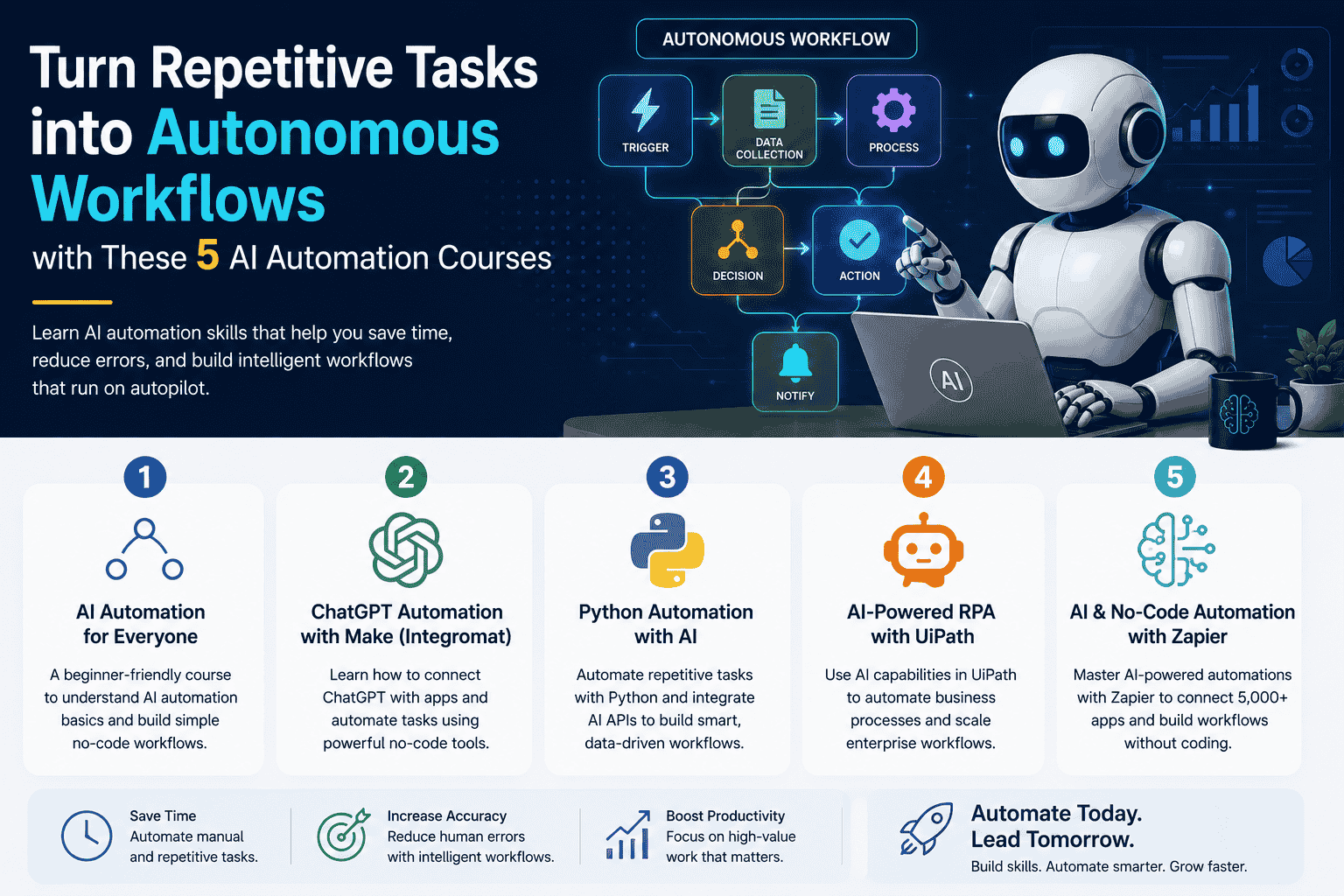
Repetitive work often hides inside ordinary business routines. Weekly reports require the same data collection; inbox messages need similar sorting; research follows a familiar sequence; and project updates are reformatted for different teams. Generative AI can make individual tasks faster, but larger productivity gains appear when those steps become a connected workflow.
AI agents take that idea further. Instead of waiting for a new prompt at every stage, a system can respond to a trigger, gather information, use tools, make decisions, and pass results to the next step. More advanced workflows can add RAG, memory, orchestration, human review, or multiple agents.
The five US-focused programs below approach automation at different levels, from no-code personal productivity systems to enterprise agent architecture and governance.
5 AI Automation Courses to Compare in 2026
| # | Program | Fees | Eligibility | Duration | Credentials |
| 1 | Postgraduate Program in AI Agents and Generative AI for Business Applications – The McCombs School of Business at The University of Texas at Austin | $3,450 | Professionals across industries; foundational pre-work included | 13 weeks | Certificate of Completion + CEUs |
| 2 | Certificate in Agentic AI Solutions for Managers – Georgetown University | $2,995 | Bachelor’s degree or equivalent | 6 weeks | Georgetown Certificate + 3.2 CEUs |
| 3 | AI-Native Professional: Workflows and Agents for Productivity – Great Learning | $600 | No coding or technical prerequisites | 6 weeks | Professional Certificate |
| 4 | Leading Enterprise Agentic AI Development – Carnegie Mellon University Heinz College | $4,250 | Senior leaders responsible for AI strategy or digital transformation | Five modules + applied lab across about 4 weeks | LEAAID Certificate |
| 5 | Strategic Leadership in the Age of Generative and Agentic AI – The University of Chicago | $15,000 | Mid-to-senior professionals; 5+ years of management experience | 7-8 months | Certificate of Completion + digital badge |
1. Post Graduate Program in AI Agents and Generative AI for Business Applications – The McCombs School of Business at The University of Texas at Austin
The program connects generative AI with practical automation rather than treating agents as a separate subject. Its ai agents business applications curriculum progresses through RAG, Agentic RAG, memory, reasoning, MCP, tools, and multi-agent systems. Learners can follow either a Python-based or no-code track.
Program Highlights: 3 hands-on projects, 15+ case studies, 15+ tools and techniques, n8n, LangChain, LangGraph, LangSmith, ChromaDB, MCP, human feedback, grounding, and agent security.
Duration: Online, 13 weeks, with recorded learning, live expert sessions, and monthly faculty-led sessions.
Outcomes: Learners build AI-powered systems for business automation, design single-agent and multi-agent workflows, and apply agents across customer support, finance, logistics, and operations.
Why to Choose this Course?
- It provides both code and no-code routes, allowing professionals with different technical backgrounds to work toward practical automation.
- The projects extend beyond simple task automation into retrieval, tool use, reasoning, and multi-agent workflows.
2. Certificate in Agentic AI Solutions for Managers – Georgetown University
Georgetown approaches autonomous AI from a management and solution-design perspective. Participants study how agents can optimize workflows, make decisions with limited oversight, and support business outcomes using vendor-independent design principles.
Program Highlights: LLMs, vector databases, autonomous agents, decision-making frameworks, workflow optimization, governance, ethical AI, vendor-independent solution blueprints, and 32 contact hours.
Duration: Online, 6 weeks, with weekly online sessions.
Outcomes: Participants learn to design and deploy agentic solutions, identify suitable business processes, improve decision velocity, and connect AI capabilities with responsible implementation.
Why to Choose this Course?
- The six-week structure offers a focused route into autonomous workflow design for managers, strategists, and innovation professionals.
- Its vendor-independent approach emphasizes reusable design principles rather than training learners on a single automation platform.
3. AI-Native Professional: Workflows and Agents for Productivity – Great Learning
This ai agent development course starts with the repetitive work professionals encounter every day. Learners begin with reusable prompting and document-based research, then connect tools into trigger-driven workflows before progressing to AI automation and agents.
Program Highlights: ChatGPT, Claude, Gemini, Perplexity, NotebookLM, Activepieces, Gmail, Google Sheets, tool chaining, trigger-based automation, weekly builds, and a multi-step capstone.
Duration: Live online, 6 weeks, with approximately 3 to 4 hours of study per week.
Outcomes: Learners create research systems, automated content workflows, an email triage assistant, a competitive intelligence agent, and a productivity system addressing a recurring workplace task.
Why to Choose this Course?
- It requires no coding background, making workflow automation accessible to professionals in marketing, HR, finance, operations, and other functions.
- Learners produce working systems throughout the program, rather than waiting until the final week to apply what they have learned.
4. Leading Enterprise Agentic AI Development – Carnegie Mellon University Heinz College
Carnegie Mellon addresses what happens when an agent prototype must operate within an enterprise. The program connects agent and multi-agent architecture with data foundations, APIs, security, governance, monitoring, orchestration, and value realization.
Program Highlights: Five virtual modules, multi-agent systems, vector databases, APIs, data pipelines, model validation, red teaming, secure deployment, governance, orchestration, and an applied Agentic AI Lab.
Duration: Fully virtual, with five modules and an applied lab delivered across approximately four weeks for the Fall 2026 cohort.
Outcomes: Participants evaluate enterprise use cases, design AI-enabled workflows, establish governance controls, and prototype an agent-based solution linked to a business problem.
Why to Choose this Course?
- It treats autonomous workflows as an enterprise system problem, covering architecture, risk, security, accountability, and scaling.
- The applied lab provides practical exposure to agent design, tool and data integration, orchestration, and output evaluation.
5. Strategic Leadership in the Age of Generative and Agentic AI – The University of Chicago
The University of Chicago offers a longer pathway for professionals responsible for broader AI transformation. Across five connected courses, participants examine AI strategy, Agentic AI, workflow customization, human-AI teams, governance, and responsible enterprise adoption.
Program Highlights: Agentic and generative AI, scalable workflows, LLM customization, RAG, hallucination reduction, governance controls, human-AI team design, five courses, and four AI Acceleration Projects.
Duration: Online with live interactive sessions, 7 to 8 months.
Outcomes: Participants learn to identify high-value AI initiatives, design scalable workflows and operating models, establish governance policies, and connect AI adoption with measurable business goals.
Why to Choose this Course?
- It connects automation with organizational change, including workforce planning, governance, operating models, and business value.
- Applied projects run across the program, allowing participants to test concepts against real business challenges rather than studying automation only in theory.
Conclusion
Turning repetitive tasks into autonomous workflows does not mean automating every process available. Work with predictable inputs, repeatable steps, accessible information, and clear human review points often provides a more practical starting place than high-risk activities that depend heavily on judgment.
When comparing agentic ai courses, consider how far you want automation to go. A no-code workflow may solve recurring personal or team tasks, while enterprise use cases can require data integration, agent architecture, security, monitoring, governance, and human oversight before greater autonomy becomes practical.